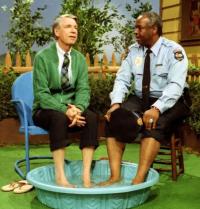
Who Is My Neighbor?

Image of the Week
Image of the Week
Wer ist mein Nächster?
-von Ivan Illich

Vor etwa dreißig Jahren beschäftigte ich mich mit der Geschichte des Samariters in Predigten vom frühen dritten Jahrhundert bis ins neunzehnte Jahrhundert, und ich fand heraus, dass die meisten Prediger, wenn sie diese Passage kommentieren, aufzeigen wollten, wie wir uns gegenüber unserem Nächsten verhalten sollten, obwohl dies in der Tat das Gegenteil von dem ist, was Jesus, der diese Geschichte des Samariters erzählt, zum Ausdruck bringen wollte.

Die Pharisäer kamen, um Ihn zu fragen: "Meister, Lehrer, sag uns, wer ist mein Nächster?" Sie haben ihn nicht gefragt, wie man sich gegenüber seinem Nachbarn verhält? Sie stellten ihm einfach die Frage,: Wer ist der Typ, den du Nächster nennst?

Und er erzählte ihnen die Geschichte von einem Mann, der nach Jericho ging, unter Räuber fiel, verprügelt und verwundet wurde. Ein Lehrer geht vorbei, ein Priester geht vorbei, sieht ihn und geht weiter. Und dann kommt ein Außenseiter, der traditionelle Feind, und wendet sich an den Verwundeten, als eine innere Wendung, und nimmt ihn auf, nimmt ihn in seine Arme und bringt ihn in das Gasthaus. Also antwortet er ihnen: "Mein Nächster ist, wen ich für meinen Nächsten halte, nicht, wen ich auswählen muss."

Es gibt keine Möglichkeit, zu kategorisieren, wer mein Nachbar sein sollte. ... Der Meister sagte ihnen, dass der Nächste nicht von deiner Geburt, von deinem Lebensumfeld, von der Sprache, die du sprichst, von der Nationalität bestimmt wird, was wirklich die Art der Selbstdarstellung bedeutet, die du dir zu eigen gemacht hast, sondern von dir. Du kannst den anderen Menschen erkennen, der kulturell außerhalb deiner Grenzen liegt, der dir sprachlich fremd ist, der - man kann sagen, durch die Vorsehung oder durch reinen Zufall - derjenige ist, der irgendwo auf deiner Wegstrecke im Gras liegt und die höchste Form der Verbundenheit schafft, die nicht durch die Schöpfung gegeben ist, sondern von dir selbst erzeugt wird.

Kernfragen zum Nachdenken:: Was hältst du von der Vorstellung, dass dein Nächster jemand ist, den du bestimmst, und nicht jemand, den du wählen musst? Kannst du eine persönliche Geschichte über eine Zeit erzählen, in der du eine heilige Form der Verbundenheit mit jemand anderem geschaffen hast? Was hilft dir, über die Grenzen deiner Konditionierung hinauszugehen, um wirklich eine Beziehung zu einem anderen herzustellen?


Ivan Ilich war ein kroatisch-österreichischer Philosoph und römisch-katholischer Priester. Auszug aus diesem Artikel http://bruce-miller.blogspot.com/2004/07/ivan-illich-and-story-of-good-samaritan.html

Seed Questions for Reflection

How do you relate to the notion that your neighbor is someone you decide, not someone you have to choose? Can you share a personal story of a time you created a sacred form of relatedness with someone else? What helps you go beyond the limits of your conditioning to truly create relatedness with another?

Moved by this reading? Join a live Awakin Circle to discuss in community.
Join this week
More ways to connect

Add Your Reflection

7 Past Reflections
MA
MamaBird
Dec 29, 2018

Here's my take on this text as a preacher:  Jesus was saying "Your neighbor is the person you least want to be 'beholden to'."  That's a colloquialism from my youth growing up in Appalachian USA. So I totally agree with Ivan Ilich!  

JO
Dec 27, 2018

 I've not felt like I had to chooose which one I'd want for a neighbor.  I do know my heart will tell me who my neighbor or is though. 

DD
Dec 23, 2018

 'My neighbor is someone I decide' means to me that my neighbor is someone I decide to relate to with true care and in a way that helps him or her have what is needed to heal and/or grow.  There have been times that I have listened carefully, responded in a way that was respectful, responded in a way that the other felt safe, responded in a way that connected with the othier, provided what was needed, and the other benefitted.  Such times were sacred forms of relatedness with the other. What helps me create relatedness with another is to truly be present with the other and listen to and respond to what the other is presenting, not to my tlhinking, prejudices, expectations, agendas, or judgments, which allows intimate healing sacred relatedness.

FC
francis cruz Jan 1, 2019

 My neighbour has a very broad meaning.When I hear news from aljajeera news,I am touched by the way people suffer in many parts of the world they are very much in my mind and heart.When I see the people sleeping in the town on the streets, I realize that this is the world I live.Christ in among the POOR.Cruz

JP
Dec 22, 2018
 Ivan Ilich offers a different way of knowing who is our neighbor  and I love it. Relating to some one, a stranger, even an enemy, without preconceived and conditioned notions about who is my neighbor is the right way of creating sacred relatedness. Such relationship is created by turning in, by seeing with clear eyes and by listening to the inner voice, the voice of the heart. As Ivan Ilich states, "There is no way of categorizing who my neighbor ought to be" and my neighbor,"whom I decide to, not whom I have to choose." I came to America in 1959 at the age of 34 to study at the University of Chicago, a strange city in a strange country with no friends and friendly neighbors and very cold freezing cimate. I was going through mild depression. There was another student from Poland staying in the same building on the second floor. As I was going out to go to school on a very cold morning, he noticed me with compassionate eyes. He faced me and extended his emotionally warm hand... View full comment
SS
Dec 21, 2018

 Ivan Illich, an exiled Russian in Mexico, would know what he is talking about.  He had to redefine "family" and "neighbor" in order to have a life in community instead of an exile of alienation.  Thank you for reminding me of one of my heros from my youth.  Indeed, Illich provoked new definitions, thinking and behvior in me, precisely, because he forced me to realize how connected I was to all of society and humanity, not just those who looked like me or lived/thought/assumed the same way.  Like Illich, my life and thinking expanded the more I met and befriended 'the other.'

JO
Jo Dec 21, 2018

 Love!