Self-Compassion Over Self-Esteem
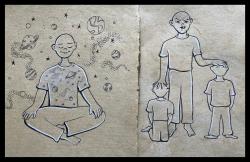
Image of the Week
Hand-drawn art by Rupali Bhuva
Image of the Week

The great angst of modern life is this: no matter how hard we try, no matter how successful we are, no matter how good a parent, worker, or spouse we are – it’s never enough. There is always someone richer, thinner, smarter, or more powerful, someone that makes us feel small in comparison. Failure of any kind, large or small, is unacceptable. The result: therapist’s offices, pharmaceutical companies, and the self-help aisles of bookstores are besieged by people who feel they’re not okay as they are. What to do?

One response has come in the form of the self-esteem movement. Over the years there have been literally thousands of books and magazine articles promoting self-esteem – how to get it, raise it and keep it. The pursuit of high self-esteem has become a virtual religion, but research indicates this has serious downsides. Our culture has become so competitive we need to feel special and above average just to feel okay about ourselves (being called “average” is an insult). Most people, therefore, feel compelled to create what psychologists call a “self-enhancement bias” – puffing ourselves up and putting others down so that we can feel superior in comparison. However, this constant need to feel better than our fellow human beings leads to a sense of isolation and separation. And then, once you’ve gotten high self-esteem, how do you keep it? It’s an emotional roller-coaster ride: our sense of self-worth bounces around like a ping-pong ball, rising and falling in lock-step with our latest success or failure.

One of the most insidious consequences of the self-esteem movement over the last couple of decades is the narcissism epidemic. Jean Twenge, author of Generation Me, examined the narcissism levels of over 15,000 U.S. college students between 1987 and 2006. During that 20-year period, narcissism scores went through the roof, with 65 percent of modern-day students scoring higher in narcissism than previous generations. Not coincidentally, students’ average self-esteem levels rose by an even greater margin over the same period. Self-esteem has also been linked to aggression, prejudice and anger towards those who threaten our sense of self-worth. For example, some kids build up their egos by beating up other kids in the playground. It’s hardly healthy.

Of course we don’t want to suffer from low self-esteem either, so what’s the alternative? There is another way to feel good about ourselves: self-compassion. Self-compassion involves being kind to ourselves when life goes awry or we notice something about ourselves we don’t like, rather than being cold or harshly self-critical. It recognizes that the human condition is imperfect, so that we feel connected to others when we fail or suffer rather than feeling separate or isolated. It also involves mindfulness — the recognition and non-judgmental acceptance of painful emotions as they arise in the present moment. Rather than suppressing our pain or else making it into an exaggerated personal soap opera, we see ourselves and our situation clearly.

It’s important to distinguish self-compassion from self-esteem. Self-esteem refers to the degree to which we evaluate ourselves positively. It represents how much we like or value ourselves, and is often based on comparisons with others. In contrast, self-compassion is not based on positive judgments or evaluations, it is a way of relating to ourselves. People feel self-compassion because they are human beings, not because they are special and above average. It emphasizes interconnection rather than separateness. This means that with self-compassion, you don’t have to feel better than others to feel good about yourself. It also offers more emotional stability than self-esteem because it is always there for you – when you’re on top of the world and when you fall flat on your face.

Instead of endlessly chasing self-esteem as if it were the pot of gold at the end of the rainbow, therefore, I would argue that we should encourage the development of self-compassion. That way, whether we’re on top of the world or at the bottom of the heap, we can embrace ourselves with a sense a kindness, connectedness and emotional balance. We can provide the emotional safety needed to see ourselves clearly and make whatever changes are necessary to address our suffering. We can learn to feel good about ourselves not because we’re special and above average, but because we’re human beings intrinsically worthy of respect.

Seed Questions for Reflection

What does self-compassion mean to you? Can you share a personal story that illustrates the difference between pursing self-esteem and nourishing self-compassion? What helps you make space for self-compassion?


Moved by this reading? Join a live Awakin Circle to discuss in community.
Join this week
More ways to connect

Add Your Reflection

14 Past Reflections
CB
clouds breeze 5 white glacier
Oct 24, 2025

On Cloud Shoes Offer unmatched comfort and Style Perfect For Running, Training, Or Everyday Wear Get Up To 40 Off Shop Now On Cloud!

HE
hellsat
Oct 24, 2024
Buy premium Quality hellstarclothingsofficial.com Online Store Sale At Discounted Price. Enjoy Free And Fast Shipping 12-15 days Sale Upto 30% OFF
SP
SPIDER
Oct 24, 2024
Largest Sp5der collection 2024. Enjoy up to 50% discount on us-spider.com hoodies, pants, shirts and more. Fast Worldwide Delivery and Free shipping to the USA.
ZA
zaeembarrier
Sep 28, 2024
The Large Corner Sofa Bed, frequently known as a sectional dfs corner sofa, is a flexible and space-efficient choice. Designed to match snugly into the corner of a room, this couch type maximizes seating even as minimizing the use of floor space. Typically, a Grey Corner Sofa consists of three or more sections arranged in an L-form, with an optionally available ottoman or chaise lounge to decorate consolation.
DA
Dagmar
Oct 26, 2021
Upon reflection I feel that self-kindness and self-compassion is such a challenge at times. Often it seems intricately connected with unhealed past trauma. Self-esteem for similar reasons seems conditional and dependent on the successful outcome of intentional pursuits.Since I recently retired I am going through the relinquishment of an identity that had been firmly grounded and become fixed in the work I loved. I notice an absence of self-compassion asI am struggling with a sense of increased uncertainty of purpose and transformation of identity. My meditation practice is my medicine (which paradoxically I am at times reluctantto take) and a best way for me to process my troubles. As is physical work in the garden, being in nature, and making room for and friends with all emotions, regardless how uncomfortable -- . When I hold still long enough, meditation and mindfulness is self-kindnesspractice that gets me in touch with the peace within that is always there, independently and uncon... View full comment
DD
David Doane Oct 28, 2021
Hi -- I'm getting close to retiring (I initially wrote closed to retiring) soon, and I appreciate what you said. Thanks for sharing. I particularly appreciated your last two sentences ie getting in touch with the peace within that is always there and knowing "I am enough." Retiring is a big transition that I tell myself and hope will open new doors and allow more time for endeavors I'd like to have more time for. I wish you well in your retirement/new chapter.
PA
Oct 26, 2021
Most "good religion" of man are based in a belief that humans emanate from Divine LOVE. As such, we are of course worthy of love, grace, mercy and compassion. When we embrace that truth we experience the fullness of our humanity and are enabled to be all of that to and for others. }:- a.m.
MA
Maria
Oct 26, 2021
One tool that helped make space for self compassion is a bullet journal. A bullet journal combines a planner, a habit tracker, a sketchbookand a notebook.I use my bullet journal for setting intentions, monthly planning, journaling, doodling, and tracking various habits. I'm not as disciplined as I'd like about writing in it, but it's always there whether I want to jot down a to-do list, to recallmy goals, or to make sense of my thoughts and feelings. It's a tool that helps me to encounter reality, toaccept it, and to recognize opportunities for change and growth. This tool gives me a greater sense of agencyin my life.
JB
Jerry Bruns Oct 26, 2021
is the bullet journal an app or paper. If paper, do you or someone else know of an electronic version. thanks
DU
Oct 26, 2021
Just as the quest self esteem has been taken to the absurd, so has the admonition to set borders. I am hearing people rudely reject others by saying "these are my borders." This phrase makes good sense when one is protecting herself from abuse, But it can also be used to close doors to understandingand promoteself righteousness (or a fake kind of self esteem.)
DD
Oct 23, 2021
The fact is, no one makes you feel big, small, or anything. Self-esteem based on comparison with others is dependent and conditional, and as Kristine Neffsays is likely to bounce around like a png pong ball. Self-esteem based on self comes from inside, is not based on outside conditions. Self-esteem based on comparison with others is different than self-esteem based on self. Compassion means sympathy for someone who is suffering problems. Self-compassion means sympathy that I am suffering problems, and I accept that. As a youth, when my self-esteem was based on what others thought of me, I was goal-directed and pursued self-esteem by trying to impress others. Knowing that to be human is to have problems helps me have self-compassion. For me, valuing me and how I deal with life and problems is self-esteem.
JP
Oct 22, 2021
Self-compassion is kindness to ourselves. We all go through suffering and delightfulness.. There are two ways of relating to our suffering and joyfulness: accepting our joys and sorrows compassionately without comparing ourselves with others and that way feeling up and down. There are two components of compassion: self-empathy and self-kindness. As we all know that we are not perfect. Whenwe compare ourselveswith others and feel higher or lower than others we get disconnected with ourselves and others. Such a perspective causes disconnection, separation and isolation. When I was studyingat the University of Chicago my self-esteem was somewhat wounded when I compared myself with other students who were brighter than me. I felt a sense of inferiority. My self-esteem was affected by what was going on in my mind, thoughts of not-good enough. When I developed friendship with aforeign studentwho felt compassion for me. I felt his empathic understanding and kindness for me. His compassion fo... View full comment
MO
Mona Oct 26, 2021
So beautifully written! But very difficult to do. What can I do in a situation where I find that i'm assessed, gauged or looked down upon? In that case scenario, isnt it but natural to feel less of that self compassion for oneself?. I try practising meditation, but find that my mind churns up a lot of negative recordings over and over again, and instead of helping me, it makes me feel worst.
GU
Gururaj Oct 31, 2021
A very authentic and honest observation, Mona. I could relate very much to that. Might it help to start saying to oneself that "this" ( be it something causing pleasure or something causing pain) is just happening in consciousness . It may seem artificial to begin with. But I trust by and by there will arise equanimity - in case this 'imagination' is a true fact of the way reality actually is, though not felt as of now. Now what is automatically felt is that the experience is happening to, and is caused in some way, by "me"