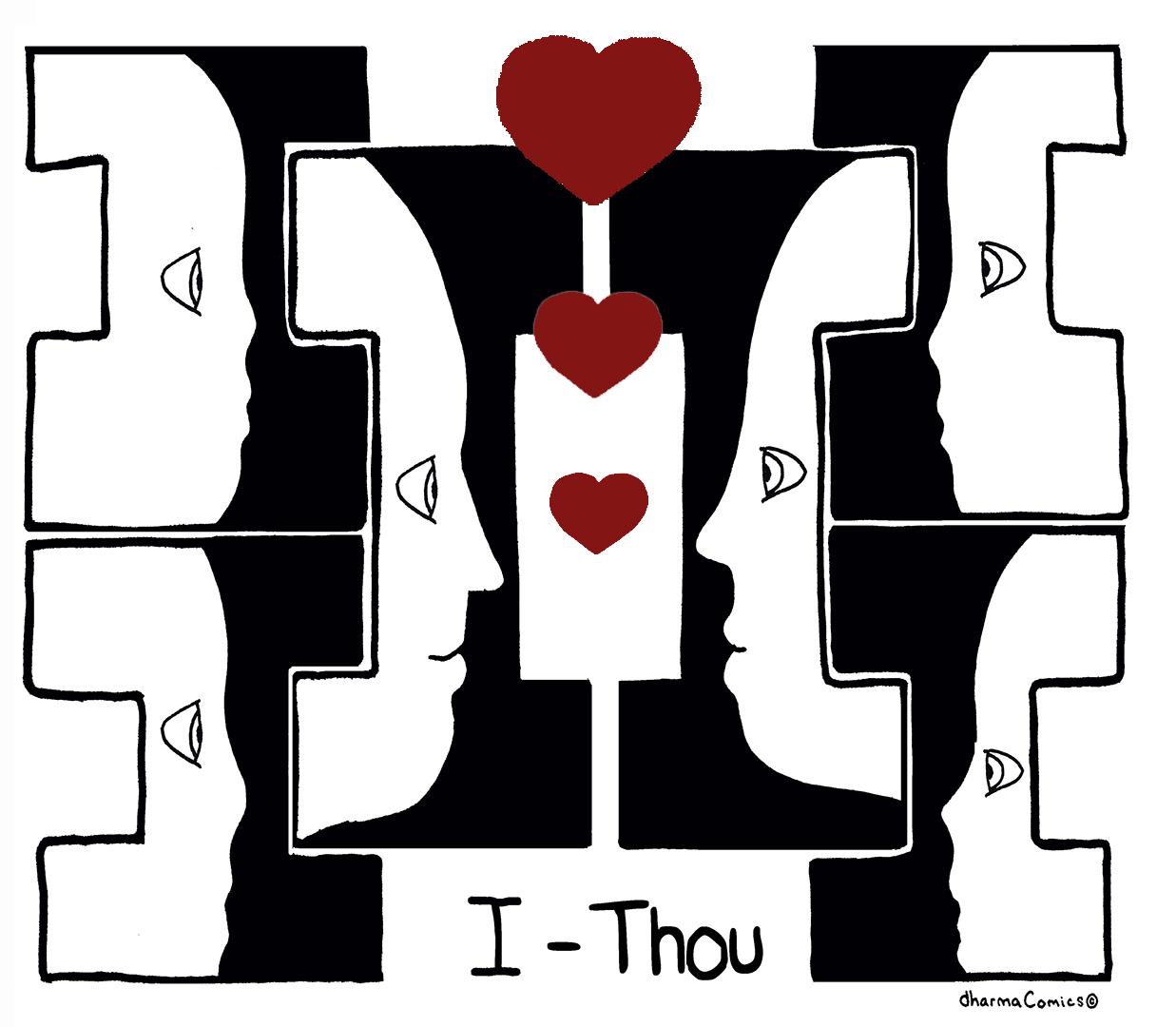
I-It and I-Thou

Image of the Week
Image of the Week
Yo-ello y yo-tú
por David Brooks
(Reflexiones sobre "Yo-Tú" de Martin Buber)
Las relaciones yo-ello vienen en dos variedades.
Algunas son estrictamente funcionales. Intercambias información con el fin de hacer algo práctico, como hacer la declaración de la renta.
Pero otras relaciones yo-ello son versiones truncadas de lo que deberían ser relaciones profundas. Estás con un/a amig@, colega, cónyuge o vecin@, pero en realidad no estás poniendo todo tu ser en ese encuentro. Estás temeros@, cerrad@ o retirad@, objetivando al/a la otr@, hablando con él/ella, ofreciendo sólo un pedazo poco profundo de ti mism@ y viendo sólo la parte superficial de él/ella.
Las relaciones de Yo-tú, por otra parte, son personales, directas, dialogantes - nada se reprime. Una relación existe cuando dos o más personas están totalmente inmersas en su situación, cuando lo profundo llama a lo profundo, cuando se están ofreciendo ell@s mism@s y abrazando al otro@ de una manera total, sencilla, cuando están involucrad@s en la "descripción mutua animada".
Un médico tiene una relación yo-ello con un paciente cuando lo trata como una máquina que necesita reparación. Pero Peter DeMarco describió una relación yo-tú en una carta a l@s médic@s y enfermer@s que cuidaban de su esposa moribunda, que fue publicada en TheTimes:
"¿Cuántas veces me abrazasteis y me consolasteis cuando me desmoroné, o preguntaba por la vida de Laura y la persona que era, y os tomasteis el tiempo de mirar sus fotos o leer las cosas que había escrito sobre ella? ¿Cuántas veces habéis dado malas noticias con palabras compasivas y tristeza en vuestros ojos? "
En nuestra cultura usamos frases como encontrarse a un@ mism@, encontrar tu pasión, amarse a sí mism@ para poder amar a l@s demás. Pero Buber argumentó que es absurdo pensar en el yo de manera aislada. El yo sólo existe en relación con algún/a otr@.
"El desarrollo del alma en el/la niñ@ está indisolublemente unido al de la nostalgia del Tú", escribió. A lo largo de la vida, el yo está emergiendo de algún diálogo, ya sea uno frío y sofocante o uno rico y completo: "Toda vida real es un encuentro".
No puedes crear intencionadamente momentos yo-tú. Sólo puedes estar abiert@ a ellos y proporcionar suelo fértil ...
Buber describió el diálogo genuino como una especie de flujo social. L@s maestr@s y l@s estudiantes están aprendiendo un@s de otr@s. Una audiencia y un@ artista se pierden en una actuación.
Estos momentos no duran. Es la "exaltada melancolía de nuestro destino" que los momentos tú siempre se desvanecen en los momentos ello. Pero un mundo se ha construido en momentos tan intensos. Se ha fortalecido un cordón de unión. La persona que ha experimentado el tú ha sido reforzada y se acerca más a estar completa.


Preguntas para reflexionar: ¿Cómo te relacionas con la distinción entre los momentos yo-ello y yo-tú? ¿Puedes compartir una historia personal de un momento Yo-tú en tu vida? ¿Qué te ayuda a tomar conciencia de si estás en un momento Yo-Tú o en un momento de Yo-ello?


Extraído del artículo del NY Times: http://nyti.ms/2e8y2x1
Seed Questions for Reflection

How do you relate to the distinction between I-It and I-Thou moments? Can you share a personal story of an I-Thou moment in your life? What helps you become aware of whether you are in an I-Thou moment or an I-It moment?

Moved by this reading? Join a live Awakin Circle to discuss in community.
Join this week
More ways to connect

Add Your Reflection

8 Past Reflections
🫩
🫩
Sep 28, 2025
These examples are so trash, I need good ones for my essay. Do better
AL
Albert
Mar 16, 2017

 I-Thou moments are most precious with others (for me) when we sense, feel, think and imagine, collectively. These same moments occur for me more frequently however in the natural environment, when I am alone with nature. I can only imagine how our world would be today if we didn't consider the non-human, natural world as an 'It.'

MB
Mary Brittain Apr 27, 2017

 So well expressed. Describes how I feel in in nature. Definitely a I-Thou experience for me.

SO
Mar 14, 2017
 This rings so true.... and it adds to my learning of last week when reading What makes you NOT a Buddhist - by Dzongasar Jamyang Khyentse.  In this book, the Tibetian practitioner-monk-teacher-writer describes the four noble truths in his own words to interpret for the modern world : First one is written as "All compounded / fabricated things are impermanent. "Compounded//fabricated" meaning anything that arises when two things, persons, thoughts, actions, meet. So also in relationships.  And before that : everything is emptiness. I-Thou moments would correspond to the present moments there is nothing coming between and there is 100% empathy and understanding between souls. The day-to-day experiences of people : quick jumping to analysis, categorizing and boxing of judgments is indeed an I-IT phenomenon. It was an OMG moment for me when I read this... because in such moments essentially we destroy human-ness of "others" into item-ness most of the ti... View full comment
SO
Mar 14, 2017
 This rings so true.... and it adds to my learning of last week when reading What makes you NOT a Buddhist - by Dzongasar Jamyang Khyentse.  In this book, the Tibetian practitioner-monk-teacher-writer describes the four noble truths in his own words to interpret for the modern world : First one is written as "All compounded / fabricated things are impermanent. "Compounded//fabricated" meaning anything that arises when two things, persons, thoughts, actions, meet. So also in relationships.  And before that : everything is emptiness. I-Thou moments would correspond to the present moments there is nothing coming between and there is 100% empathy and understanding between souls. The day-to-day experiences of people : quick jumping to analysis, categorizing and boxing of judgments is indeed an I-IT phenomenon. It was an OMG moment for me when I read this... because in such moments essentially we destroy human-ness of "others" into item-ness most of the ti... View full comment
BG
Mar 14, 2017

What came to mind whilst reading this piece were the hours immediately following my daughter's birth. I felt such intensity of connectedness with her. In fact saying I 'felt' it isn't the word. I 'was' it! It lasted for several hours at a high level of awareness and extreme intensity and joy which expanded to include everyone and everything that had ever existed.
I have experienced this feeling at other times but for much shorter periods.
Thank you for this insight as now (41 years later) our relationship is struggling and we are considering attending relationship counselling to help heal a rift that has sat between us for over 4 years. Not easy as she lives in Australia and I live in UK. I shall take the I-Thou insight with me.
With Love and Gratitude.
Barbara x

JP
Mar 12, 2017

Life is a web of relationships. Some are  I-It  relationships. They are utilitarian,pragmatic and self-serving. Such relationships are shallow leaving no  nourishing deep roots of memory in our mind. I have had such relationships leaving no worth- remembering deep traces behind.

I cherish I-Thou relationships. It is a relationship between two genuine  and deeply caring beings. It has openness, trust,  and compassion. I have been blessed to have such deep relationships with my parents, family members, a few friends and my soul mate. Such relationships have made me a whole and wholesome person. Such relationships have been blessings to me and I am deeply grateful for such blessings.

May we  keep our mind and heart  open to cultivate such I-Thou relationships!

Namaste.

Jagdish P Dave


DD
Mar 11, 2017
I-it moments are utilitarian, goal- and future-directed.  I-thou moments are purposeless or goal-less and present.  Both kinds of moments are part of life.  In I-thou moments there are two individuals meeting, being open and honest in the moment.  In I-thou moments the individuals are personally present and vulnerable, simply being together.  In I-it moments there is an agenda, some thing or some function is being sought, and I relate to the other as being there to serve a purpose.  I-it moments can be fine when the agenda is out in the open, and are a problem when there is a hidden agenda.  I've had some I-thou moments in which I and another are being soul to soul in a spiritual agape love, and such moments are precious and few, as Sonny Geraci sang.  I-it and I-thou moments are easy to tell apart.  When I'm out to get something from the other I'm in an I-it moment.  When I'm simply meeting and being met, being open in the present and... View full comment