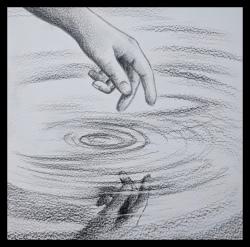
If It Can Suffer, It's Real

Image of the Week
Hand-drawn art by Rupali Bhuva
Image of the Week
Wenn es leiden kann, ist es real
--von Yuval Noah Harari


Viele Menschen glauben, dass die Wahrheit Macht besitzt. Leider ist dies nur ein beruhigender Mythos. In Wirklichkeit haben Wahrheit und Macht eine viel komplexere Beziehung, denn in der menschlichen Gesellschaft bedeutet Macht zwei sehr unterschiedliche Dinge.

Einerseits bedeutet Macht die Fähigkeit, objektive Realitäten zu manipulieren: Tiere zu jagen, Brücken zu bauen, Krankheiten zu heilen, Atombomben zu bauen. Diese Art von Macht ist eng an die Wahrheit gebunden. Wenn man an eine falsche physikalische Theorie glaubt, kann man keine Atombombe bauen. Andererseits bedeutet Macht auch, dass man in der Lage ist, die Überzeugungen der Menschen zu manipulieren und so viele Menschen zu einer effektiven Zusammenarbeit zu bewegen. Der Bau von Atombomben erfordert nicht nur ein gutes Verständnis der Physik, sondern auch die koordinierte Arbeit von Millionen von Menschen. Der Planet Erde wurde von Homo sapiens und nicht von Schimpansen oder Elefanten erobert, weil wir die einzigen Säugetiere sind, die in sehr großer Zahl kooperieren können. Und Zusammenarbeit in großem Maßstab hängt davon ab, dass wir an gemeinsame Geschichten glauben. Aber diese Geschichten müssen nicht wahr sein. Man kann Millionen von Menschen vereinen, indem man sie an völlig fiktive Geschichten über Gott, über Rassen oder über die Wirtschaft glauben lässt.

Wenn es darum geht, Menschen durch eine gemeinsame Geschichte zu vereinen, hat die Fiktion gegenüber der Wahrheit eigentlich drei Vorteile. Erstens: Während die Wahrheit universell ist, ist die Fiktion eher lokal. Wenn wir also unseren Stamm von Fremden unterscheiden wollen, ist eine fiktive Geschichte ein viel besseres Identitätsmerkmal als eine wahre Geschichte. Der zweite große Vorteil der Fiktion gegenüber der Wahrheit hat mit dem Handicap-Prinzip zu tun, das besagt, dass zuverlässige Signale für den Signalgeber kostspielig sein müssen. Andernfalls können sie von Betrügern leicht gefälscht werden. Wenn politische Loyalität dadurch signalisiert wird, dass eine wahre Geschichte geglaubt wird, kann sie jeder fälschen. Aber lächerliche und abwegige Geschichten zu glauben, verursacht höhere Kosten und ist daher ein besseres Signal für Loyalität. Wenn Sie einem Politiker nur dann glauben, wenn er oder sie die Wahrheit sagt, was beweist das? Wenn Sie Ihrem Politiker dagegen auch dann glauben, wenn er oder sie Luftschlösser baut, dann ist das Loyalität! Drittens, und das ist das Wichtigste, ist die Wahrheit oft schmerzvoll und unangenehm. Wenn man sich also an die ungetrübte Realität hält, werden einem nur wenige Menschen folgen. Ein amerikanischer Präsidentschaftskandidat, der der amerikanischen Öffentlichkeit die Wahrheit, die ganze Wahrheit und nichts als die Wahrheit über die amerikanische Geschichte sagt, hat eine hundertprozentige Garantie, die Wahlen zu verlieren. Das Gleiche gilt für Kandidaten in allen anderen Ländern. Wie viele Israelis, Italiener oder Inder können die ungeschminkte Wahrheit über ihre Nationen ertragen? Ein kompromissloses Festhalten an der Wahrheit ist eine bewundernswerte spirituelle Praxis, aber keine erfolgreiche politische Strategie.

Für mich ist die vielleicht wichtigste Frage, sowohl als Wissenschaftler als auch als Mensch, wie man zwischen Fiktion und Realität unterscheiden kann. Ich will damit nicht sagen, dass alles Fiktion ist, sondern dass es für den Menschen nur sehr schwer ist, zwischen Fiktion und Realität zu unterscheiden. Das ist im Laufe der Geschichte immer schwieriger geworden, weil die Fiktionen, die wir geschaffen haben - Nationen und Götter und Geld und Unternehmen - jetzt die Welt kontrollieren. Schon allein der Gedanke: "Oh, das sind alles nur fiktive Gebilde", fällt uns schwer.

Es gibt jedoch mehrere Tests, um den Unterschied zwischen Fiktion und Realität zu erkennen. Der einfachste ist der Test des Leidens. Wenn es leiden kann, ist es echt. Wenn es nicht leiden kann, ist es nicht echt. Eine Nation kann nicht leiden. Das ist sehr, sehr klar. Selbst wenn eine Nation einen Krieg verliert, sagen wir: "Deutschland hat im Ersten Weltkrieg eine Niederlage erlitten" - das ist eine Metapher. Deutschland kann nicht leiden. Deutschland hat keinen Verstand. Deutschland hat kein Bewusstsein. Deutsche können leiden, ja, aber Deutschland kann nicht leiden. Ähnlich ist es, wenn eine Bank pleite geht, kann die Bank nicht leiden. Wenn der Dollar seinen Wert verliert, leidet der Dollar nicht. Menschen können leiden. Tiere können leiden. Das ist die Realität.

Wenn man die Realität wirklich sehen will, würde ich durch die Tür des Leidens gehen. Wenn wir wirklich verstehen können, was Leiden ist, erhalten wir den Schlüssel, um zu verstehen, was Realität ist.

_____________________________________________________
Kernfragen, die zum Nachdenken anregen: Was fällt Ihnen ein, wenn Sie den Realitätstest: "Wenn es leiden kann, ist es real" auf eine Ideologie anwenden? Können Sie eine persönliche Geschichte erzählen, in der Sie diesen Test anwenden konnten, als Sie eine wichtige Entscheidung treffen mussten? Was hilft Ihnen dabei, nicht unempfindlich gegenüber dem Leid anderer zu werden?

Yuval Noah Harari ist Historiker, Meditator und Autor mehrerer Bestseller, darunter Sapiens und Home Deus. Der obige Auszug wurde auf der Grundlage verschiedener Quellen bearbeitet, darunter sein Ted Dialogue.


Seed Questions for Reflection

What comes up for you when applying the reality test: 'if it can suffer, it's real' to any ideology? Can you share a personal story of a time you were able to apply this test when making an important decision? What helps you avoid getting impervious to the suffering of others?

Moved by this reading? Join a live Awakin Circle to discuss in community.
Join this week
More ways to connect

Add Your Reflection

12 Past Reflections
MJ
mjzudba
Nov 19, 2025
If i can prevent suffering, suffering must be a real modal state. But if suffering is a real modal state, my ability to prevent it must also be a real modal state. Both states need a necessary substrate that hosts possibilities.
GE
Geeta
Nov 16, 2021
Depends on what you consider as real.
Real as in tangible or experienceable, or Real as in what's not transient.
By the second definition, I would say the entity that is suffering is itself not real.
The self-realized ones don't suffer.
So maybe the title of the article should be: If it can suffer, 'it' is not real ?

PA
Nov 16, 2021
Truth & Power -- the universe suffers . . .

}:- a.m.
PA
Patrick Nov 16, 2021
Therefore, all of life for us humans is holding great suffering in and with greater love.
DD
David Doane Nov 16, 2021
I guess every living and not living being suffers its reality. That's just how it is.
NK
Nov 16, 2021
Very interesting piece for sure. I feel at the core of this passage is a need to accept that everything in this world has consciousness. Just at a varied level, but everything that exists are at different levels in the spectrum of consciousness.

False and Truth, Right and wrong debates have existed for ever. Everyone's perspective depends on the data point and situation rather than an absolute truth. We attach value to the source of truth based on our own experience with the source.

Coming to the discussion on suffering, that too has its opposite. If there is suffering, there is also joy. Now again comes the debate on true joy and false joy like truth and news have received similar versions.

One can also ask, " Is suffering natural?" So, the QBQ that begs to be asked is "Is all suffering real?" Hence is suffering alone an indication of reality? It is said Purity is the essence of Reality.....
EK
Erin Kerr
Nov 16, 2021
I feel like I understand what you are saying. Certain groups of people have created "entities" such as "Germany" and most corporations, composed of many individual persons. Yet as a collective, we have been convinced that these entities are somehow real. They have Articles of Incorporation, names and numbers. They have licensing agencies which cosign on their existence. We refer to them in language as though they are something more than just an idea, just a name. We have passed laws which "defend" these ideas(entities?) The purpose of these entities seems to be protect the individual humans running them. The "entity" existsto pose as the "fall guys" for the undesireable consequences of greedy actions that they take, namely causing suffering for other sentient beings. The persons in the decision-making roles don't want to suffer the consequences of the harm that their practices inflict, so they create a corporation, or a nation, whi... View full comment
PT
Nov 15, 2021
Eloquent and true as far as it goes, but I think it applies well to the domain of human beings and animals but fails to account for the suffering of this planet, which seems real to me. Or rather, it would be difficult to apply the test and readily sort truth from fiction and metaphor regarding Gaia. Is the Gaia hypothesis only a lovely metaphor ? Or is the earth itself suffering when it's systems fall apart, rivers dry up, trees die and burn? This is not the same as saying Germany or a bank is suffering. This planet is not an abstraction or a metaphor. Yet I still think the author is on to a valuable distinction. 
DD
David Doane Nov 16, 2021
From what I know of Gaia -- that all creation is one interrelated system from and of Life -- I believe it. And I think it's obvious earth is suffering. Rocks, plants, fish, animals, and human beings including us are of earth, and human beings are seriously and maybe fatally harming earth and ourselves and all the rest. Earth suffers people. 
DD
Nov 13, 2021
In my experience, truth does foster personal power. Truth isn't necessary to manipulate anything. I believe earth was conquered by homo sapiens because we are foolish, not because we can cooperate. Large scale cooperation may be based on belief in common stories, but not always. And you can't really make anyone believe anything. Believing a leader who promotes a false story is foolish loyalty. Yes, the truth may hurt -- lies may hurt also. Fiction wins in politics when voters don't want the truth. It sometimes is difficult to know what the truth is. Suffering is bearing what's happening. Whatever is in form suffers from the elements and forces of nature and other beings. If it can suffer, it's real in this reality. I don't know whether the formless suffers. I often consider what consequences I or the other will suffer by my decision or action. Being very sure that everyone is suffering plenty helps me from getting impervious to the suffering of others.
JP
Nov 12, 2021
I believe in telling the truth and living the truth. I believe truth liberates us from the prison of manipulations. But it is not easy to tell the truth and live by the truth. It causes pain and suffering. It is hard but hardship is a pathway to truth. It involves letting go of the darkness of lies and manipulations. It requires sacrifice of self-serving orientation. But I believe that is the right thing to do. I do not want to buildcastles of falsehood of lies in the air and live in them. Living in such castles may bring temporary illusory pleasures but it causes deep pit halls. Choosing the right path and following is not always easy. I know what's the right thing to do but may not do it. I know what is the wrong thing to do but I may do it. Following the right path is not easy. It may involve losing. it requires courage to follow it. In the path of my life journey I have at times follow the wrong path and have gone through suffering. I have blamed others for causing my sufferin... View full comment
XP
Nov 12, 2021
That rock does not suffer, therefor it's not real. My door does not suffer, therefore it's not real. Sky does not suffer, therefore it's not real. Hum?

It is not a test to see if something is real. It is test to see if something is able to experience pain or alive.