In Eyes Of God, We're All Minorities

Image of the Week
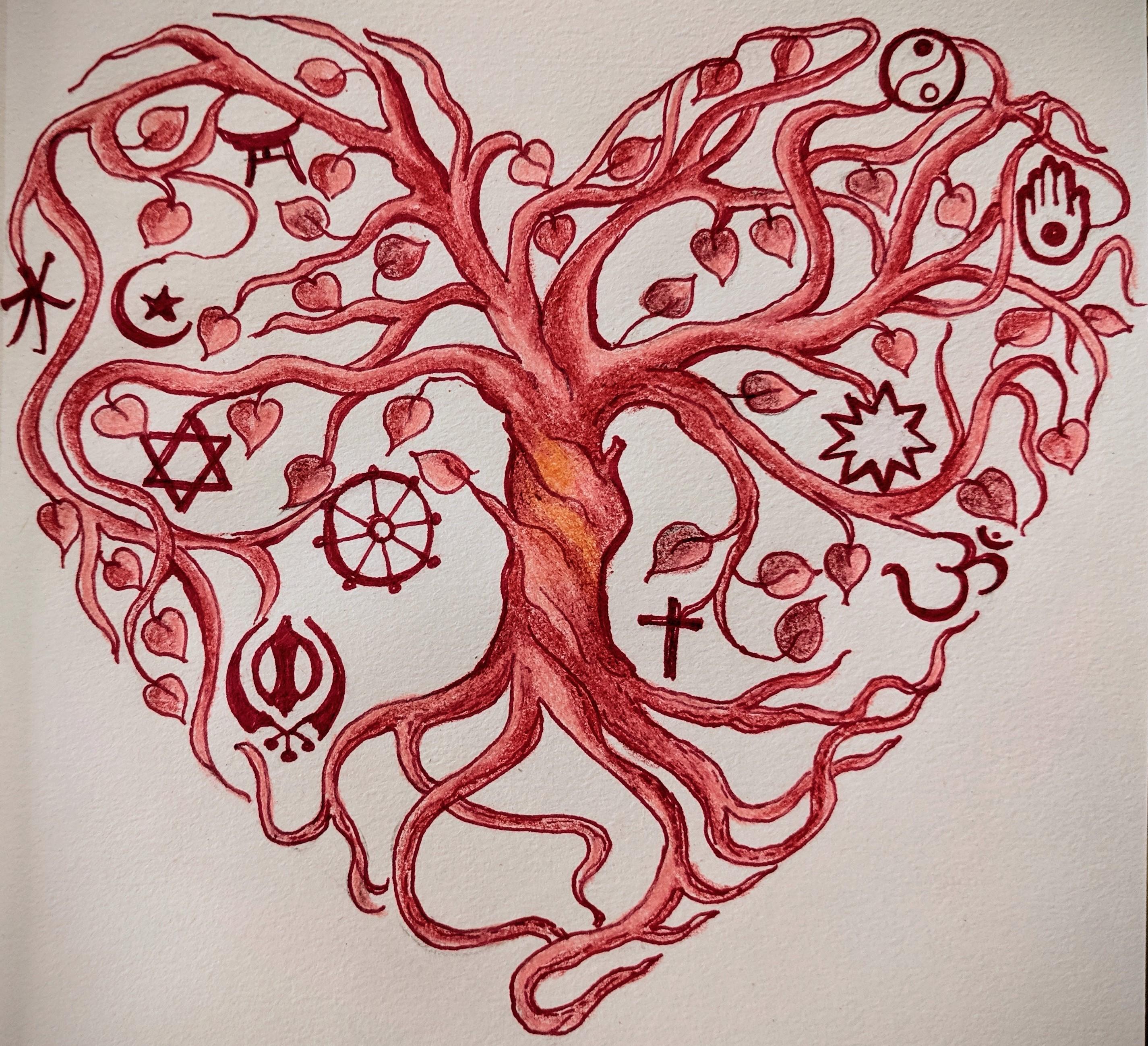
Hand-drawn art by Rupali Bhuva
Image of the Week
In Augen Gottes sind wir alle Minderheiten
von Barbara Brown Taylor

Krister Stendahl, ehemaliger Dekan der Harvard Divinity School, sagte einem Reporter kurz vor seinem Tod im Jahr 2008: "In den Augen Gottes sind wir alle Minderheiten. Das ist ein böses Erwachen für viele, die sich nie mit dem Pluralismus der Welt auseinandergesetzt haben".

Aus meiner begrenzten Perspektive im kleinen Klassenzimmer eines Colleges glaube ich, dass immer mehr [Jugendliche] mit dem Pluralismus zurechtkommen - ihn annehmen, auch wenn sie von den Älteren nur sehr wenig Hilfe erhalten, wenn sie durchdenken, was es bedeutet, eine Person des Glaubens in Gemeinschaft mit Menschen anderer (und keiner) Glaubensrichtungen zu sein. Kein Prediger hat ihnen vorgeschlagen, dass der heutige Barmherzige Samariter ein guter Muslim oder ein guter Humanist sein könnte. Kein Konfirmandenlehrer hat ihnen beigebracht, dass die Goldene Regel die Wertschätzung der Religion des Nachbarn einschließt, so wie sie vom Nachbarn erwarten, die ihre anzuerkennen.

Wenn ich es mir recht überlege, kenne ich einer Predigerin, die so etwas versucht hat - und zwar von der Kanzel einer Kathedrale in einer Großstadt aus. Ich weiß nicht mehr, was das Thema ihrer Predigt war, nur die Antwort darauf. Sie muss angedeutet haben, dass der christliche Weg einer von vielen Wegen zu Gott sei (eine Welle und nicht der Ozean), denn danach kam ein Mann zu ihr und sagte: "Wenn Gott nicht zum Christentum steht, was mache ich dann hier?"

Ich wünschte, normale Christen würden Prüfungen ablegen, damit ich diese Frage in der Abschlussprüfung stellen könnte. So natürlich es auch sein mag, in der Siegermannschaft spielen zu wollen, der Wunsch, sich die göttliche Gunst zu sichern, erscheint mir als der schlechteste Grund, einer Religion anzugehören. Wenn dem Mann, der diese Frage gestellt hat, kein Dutzend besserer Gründe einfiel, um Christ zu sein, was hat er dann dort eigentlich gemacht?

Es wird eine alte Geschichte über Rabia von Basra erzählt, eine Sufi-Mystikerin aus dem achten Jahrhundert, die man eines Tages durch die Straßen ihrer Stadt rennen sah, mit einer Fackel in der einen und einem Eimer Wasser in der anderen Hand. Als jemand sie fragte, was sie da mache, sagte sie, sie wolle mit der Fackel die Belohnungen des Paradieses verbrennen und mit dem Wasser die Feuer der Hölle löschen, weil beide den Weg zu Gott versperrten. "Oh Allah", betete Rabia, "wenn ich Dich aus Furcht vor der Hölle anbete, verbrenne mich in der Hölle, und wenn ich Dich in der Hoffnung auf das Paradies anbete, schließe mich aus dem Paradies aus. Aber wenn ich Dich um Deinetwillen anbete, gönne mir nicht Deine ewige Schönheit."

In der christlichen Tradition fällt dies unter den Begriff der bedingungslosen Liebe, obwohl es gewöhnlich als die Art von Liebe verstanden wird, die Gott gegenüber den Menschen ausübt, und nicht umgekehrt. Dank eines muslimischen Mystikers aus dem Irak habe ich jetzt eine neue Art zu verstehen, was es bedeutet, Gott bedingungslos zu lieben. Wann immer ich versucht bin, aus Angst vor göttlicher Bestrafung oder in der Hoffnung auf göttliche Belohnung zu handeln, lehnt sich Rabia von ihrer Religion in meine vor und leert einen Kübel Wasser über meinen Kopf.

Kernfragen zum Nachdenken: Wie stehst du zu der Vorstellung, einen Weg, der sich von deinem eigenen unterscheidet, wirklich als legitim und anerkennenswert zu akzeptieren? Kannst du eine persönliche Geschichte aus einer Zeit erzählen, in der du in der Lage warst, über die Toleranz hinauszugehen und einen tiefen Respekt für Welttraditionen zu entwickeln, die sich von deiner völlig unterscheiden? Was hilft dir, die Fähigkeit zu entwickeln, die verschiedenen Traditionen der Welt zu respektieren und ein Gefühl der Überlegenheit deiner eigenen Tradition zu vermeiden?

_____________________________________________________________________________Barbara Brown Taylor ist eine amerikanische Bischöfin, Professorin, Autorin und Theologin und eine der bekanntesten Predigerinnen der Vereinigten Staaten. Im Jahr 2014 wurde sie vom TIME-Magazin in die jährliche TIME 100-Liste der einflussreichsten Personen der Welt aufgenommen. Dieser Artikel ist ein Auszug aus ihrem Buch Holy Envy: Finding God in the Faith of Others.


Seed Questions for Reflection

How do you relate to the notion of truly accepting a path different from your own as valid and worthy of respect? Can you share a personal story of a time you were able to go beyond tolerance and toward deep respect for world traditions that were quite different from yours? What helps you develop the ability to respect the world's diverse traditions and eschew a sense of superiority of your own tradition?
Moved by this reading? Join a live Awakin Circle to discuss in community.
Join this week
More ways to connect

Add Your Reflection

16 Past Reflections
DA
Debra Ann polk
Nov 13, 2020
Because when you ksubmit and get cloy to him he will get closer to all or you
BC
Feb 26, 2020
If I may assume that God means same qualities in every religion/belief then for the sake of understanding, let's call God=Principle. Principles are natural laws that are universal, self-evident, self-validating, timeless, objective and at work whether or not we understand or value them. For example the Law of Gravity.
If another assumption I make is true then every religion/belief is a mental map of that community. Lets call it Paradigm.
As long as Paradigms are in alignment with the principle there should not be any conflict. Just the Peace everywhere.
Learning lesson for me is that before I act on any of my thought(Paradigm), I should confirm that its in alignment with the Principle(GOD). If not then don't act on it because acting on a thought that is not aligned to the Principle is for sure going to bring conflict.
BI
Bill
Feb 26, 2020
Life, as a hopeful journey, is a series of events. While the path is unknown and ismanifest daily, the vision remains: all souls get to heaven. How wonderful the myriad ways...
NR
Neetha Rao
Feb 25, 2020
Dear all,
As a hindu, religious tolerance is ingrained into my system and as a Heartfulness practitioner I have been following this since 1997 December.
The change should come from within, when I learn to accept all as my brethren irrespective of their religion and myself raise above religious diversification can I truly be a Human.
AJ
aj Feb 25, 2020
Amen!
KA
Feb 25, 2020
I grew up in a Christian home and throughout my adult life have tried on different faiths within Christianity. It wasn't til I step back from traditional, institutionalChristianity and opened my mind and my awareness to study Hindu, Muslin, Kabbalah ( mystical Judaism) that I saw Christianity in a new light. I incorporate many beautiful prayers and practices from each of these religions which has made for me now a very rich, moving, and spiritual life.
MA
Feb 25, 2020
When we consider entire universe, we really belongs to minorities. And I think we got special status too. We got brain and we can really make big difference.
I always heard and I believe God is one. All religions are just a way to reach out to God. You call him by any name but end of the day we all are waiting for miracle. There is no good or perfect way.
Everyone is trying but some people find him within, some find in nature, some find in the smiles that they bought on other person face and some are still running behind to find him.
Truth is, journey is endless until we will start believing in humanity and kindness. No one has seen God but his presence is everywhere. I can feel his presence right now in this moment:)
AN
Anjana
Feb 25, 2020
In the eyes of God, all are equal -- there are no superiority or minorities.
SS
Feb 25, 2020
I love the question of the man asking what he is doing there, if God isn't partial - and imagine to being able to hold that space for him to find his own answer, by saying: I don't know. I love that you are asking that question of yourself.
So often we think we need to find answers to convince others of the truth and the light we've seen. And they can never find it on us, only in themselves, listening into the silence of their own wisdom.
Es una lucha interior constante. La duda es una llama que quema. Quiero y necesito creer, sin embargo, muchas veces vacilo en mi fe.
AP
Feb 25, 2020
Everyone as a minority has a wider opportunity to evolve, instead of getting stagnated.
Further being a minority (call it singularity),facilitates getting connected (by peeping inward) to the core of existence and realize its everlasting beauty.
TY
Feb 25, 2020
Wow! This spoke straight to my heart! For years I have met many beautiful souls whose beliefs are different from my own and intuitively felt like there was "something wrong" with what my religion was teaching me! More recently I have had the privilege of working with others that have no religion and I have found their souls to be quite vulnerable and almost childlike. We are all inherently good and beautiful in the eyes of God. May I see with God eyes always! ☺️🙏🏻
SG
Feb 23, 2020
Wow. What a profound , hard hitting statement on religion. Apart from respecting other religions , it also shows us the path of true worship, which is without fear or reward and just in the spirit of service or unconditional love.
Am reminded of a mystic baba who had founded a big temple and almost a sect , in Delhi, whom i used to meet very regularly , sharing this with me. " Most of the people coming over here ( mostly rich and powerful), come here , either by fear or for reward . They look at the temple visit , either as a means to avoiid hardship or pain or a fulfillment of their wishes or some desire. I still welcome them, with a hope that some day they would see the futility of thier prayers and actually start worshipping just for the sake of worshipping/service or just ib the spirit of service with unconditional love for god and all humanity.
DD
Feb 22, 2020
Pluralism is reality. Erecting walls to shut out and separate is fighting reality. I accept being open to, learning about, and understanding a path different from my own, and accepting it if it is pro growth and not hurting anyone. I've learned a good deal about paths or traditions other than my own, such as about Buddhism and Hinduism, and am way beyond tolerance and into deep respect for those traditions. They actually make more sense to me than my own tradition. What helps me develop ability to respect the world's diverse traditions and eschew a sense of superiority of my own tradition is for me to not just listen to what I or others think, assume, or judge about other traditions, but for me to be open to learn about the other traditions and be open to the truth in them.
AM
Amen Feb 25, 2020
Yes!
JP
Feb 21, 2020
To me a true religion is a way of serving others of any faith with no expectationof getting any kind of reward from the receiver. It is an expression of unconditional and selfless love. Anybody can be a Good Samaritan, a Good Muslim, a Good Hindu, a Good Buddhist, a Good Jain, a Good Jew, a Good Atheistor a Good Humanist. The world we live in is pluralistic with a wide spectrum of beliefs, ideas, opinions and faiths. Our task is how to relate to people different from us with genuine respect; how to implement the Golden Rule in daily life. We all are children of God- outwardly looking different but the same inwardly. If we live from our open heart and loveothers unconditionally, we all can live in harmony. Harmonious living is a spiritual living, a truly religious living. Tolerance is different from respect. In tolerance, we consider ourselveshigher or better than others. In respect we view and relate to others as equal. As I was growing up I have had manyexperiences of relating to peo... View full comment