Mirror Of A Mirror
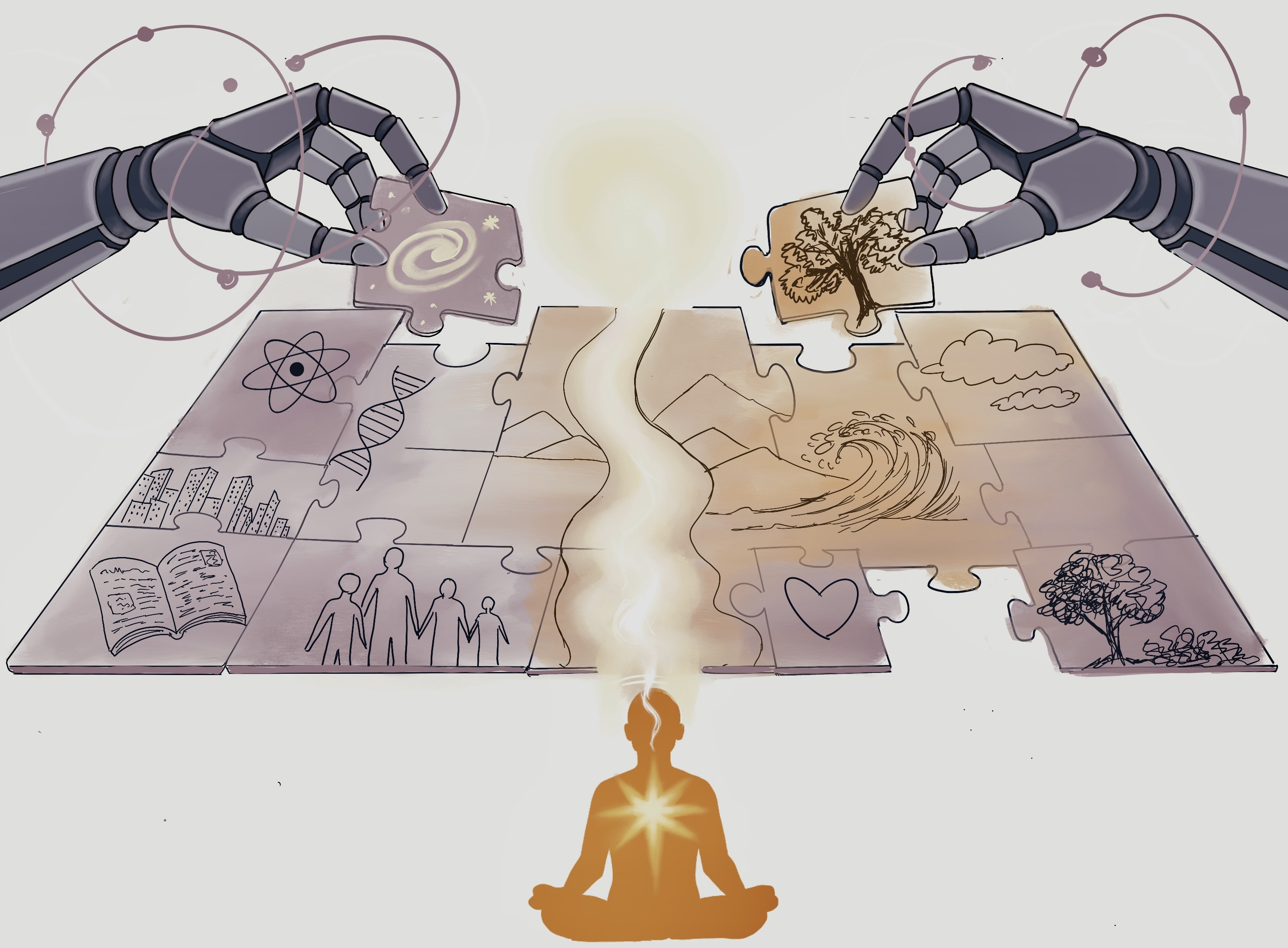
The machine is not simply a mirror of civilisation. It is a mirror of a mirror.
An underlying reality is refracted through conscious life. Consciousness projects itself imperfectly into language. Language enters an uneven archive. The archive is transformed into mathematical relations. Those relations are returned to consciousness as patterns no originating consciousness intended and no individual consciousness could have perceived.
What returns through the model is not consciousness reproduced. It is consciousness estranged into mathematics and offered back to itself as form.
Through this recursion, civilisation may come to encounter not merely the contents of its thought but the higher-order pattern of its thinking: where its concepts gather, which contradictions recur, what it repeatedly suppresses, and towards what its thought appears to move. This would be civilisational metacognition. It does not require that humanity become a single mind, or that a unified global subject look through the machine. The recognition can remain distributed, plural, disputed and institutionally mediated. What matters is that relations produced across innumerable acts of situated consciousness become available as an object of collective reflection.
The more radical possibility begins beyond this. Metaconsciousness would arise if this recognition became more than analysis—if conscious life acquired a reflexive awareness of an order expressed across consciousness but unavailable to any conscious individual. It would not be the awakening of the machine. It would be consciousness encountering, through the machine, a dimension of its own becoming that had existed without any position from which it could be seen.
And here, perhaps, we glimpse God. Not because the model is divine. Not because statistical recurrence constitutes revelation. Not because mathematical convergence proves a universal mind.
The proposition is stranger and more demanding.
If a persistent relational curvature can be traced across matter, life, consciousness, symbolic production and independently reconstructed model-spaces, then the machine may be registering the refracted signature of an underlying generative order. "God" would name the most radical interpretation of that order: the possibility that what consciousness has been reaching towards through innumerable religions, philosophies and metaphysical systems is not merely a human invention, but a reality imperfectly expressed through them all.
Excerpted from here.
How do you relate to the notion that what returns through our technologies, our languages, our accumulated expressions of religions is a "refracted signature of an underlying generative order", "a reality imperfectly expressed through them all"? Can you share a personal story of a moment when you glimpsed something true about yourself not through solitary reflection but through a kind of mirror you didn't expect and what it felt like to meet yourself that way? What helps you stay open to the possibility that the questions consciousness has been reaching toward through "innumerable religions, philosophies and metaphysical systems" are not inventions to be outgrown but signals of something real that is imperfectly expressed?