A Recipe Is A Story

Image of the Week
Hand-drawn art by Rupali Bhuva
Image of the Week

In English, to “cook something up” means to prepare food, but also to invent stories or schemes, to concoct something out of fantasy. When I first started writing, I also baked a lot, mostly on days when the writing wasn’t going well. It soothed me, alongside the slow and intangible creation of a novel, to cook up something that was quickly ready and edible. A cake can bring simple, instant self-gratification and appreciation from others, whereas writing – for all its rewards – is always accompanied by self-doubt. Moreover, the reactions of others, even when positive, are rarely enough for me. I am perpetually hungry for some extra validation, which nobody in the world can give. Only in the act of writing is that hunger satisfied, for I become, briefly, bigger than myself, capable of hosting the world and yet treating every single person in it as if they were my only guest. This feat feeds and sates my ravenous self, my need to be and to have everything.

Stories enact a form of mutual hospitality. What is story if not an enticement to stay? You are invited in, but right away you must reciprocate and host the story back, through concentration: whether you read or hear a narrative – from a book or a person – you need to listen to really understand. Granting complete attention is like giving a silent ovation. Story and listener open, unfold into and harbour each other.

A recipe is a story that cannot be plagiarised. Compare cookbooks and you will find recipes that are almost identical, distinguished by minor variations of quantity or slight deviations in procedure. Debts are gladly acknowledged, sometimes in the name – “Julia’s Apple Tart” – or in a sub-line – “Adapted from Yotam Ottolenghi”.

Recipes represent one of the easiest, most generous forms of exchange between people and cultures, especially now, with food blogs abounding and once-exotic ingredients available at your local supermarket.

Recipes are the original open source, offering building blocks that may be adjusted across time, place and seasons to create infinite dishes. You only need to successfully make a recipe once to feel it is your own. Make it three more times and suddenly it is tradition.

No wonder different societies claim the same food as their definitive, national dish. In the Middle East, hummus may well be the most contested case in point. Fed up of the endless, inconclusive debates about the true origins of this popular chickpea dish, a group of Lebanese aficionados decided to settle the matter once and for all by setting the record for making the largest tub of hummus ever, in the hope that the feat would irrevocably associate hummus with Lebanon above all. The idea of consolidating their credentials by producing such an excess is fitting in the context of the famously profuse Arab hospitality, summed up in the half-joking warning to guests: you will need to fast for two days before and two days after eating in an Arab household.

Being asked how you made something is the ultimate compliment for most cooks. Recipes passed on this way come marinated in the memory of previous incarnations. Recipes can be both continuity and change. Stuck to, modified, lost, recovered … recipes are records of individual or national defeats and conquests. In this sense, little is strictly “authentic”: everything is influenced by someone or somewhere else. This is true for food, and for culture as a whole. The quest for authenticity is often more of a crusade for authority, an attempt to exclude, single out and thus narrow things down – the very opposite of hospitality. [...]

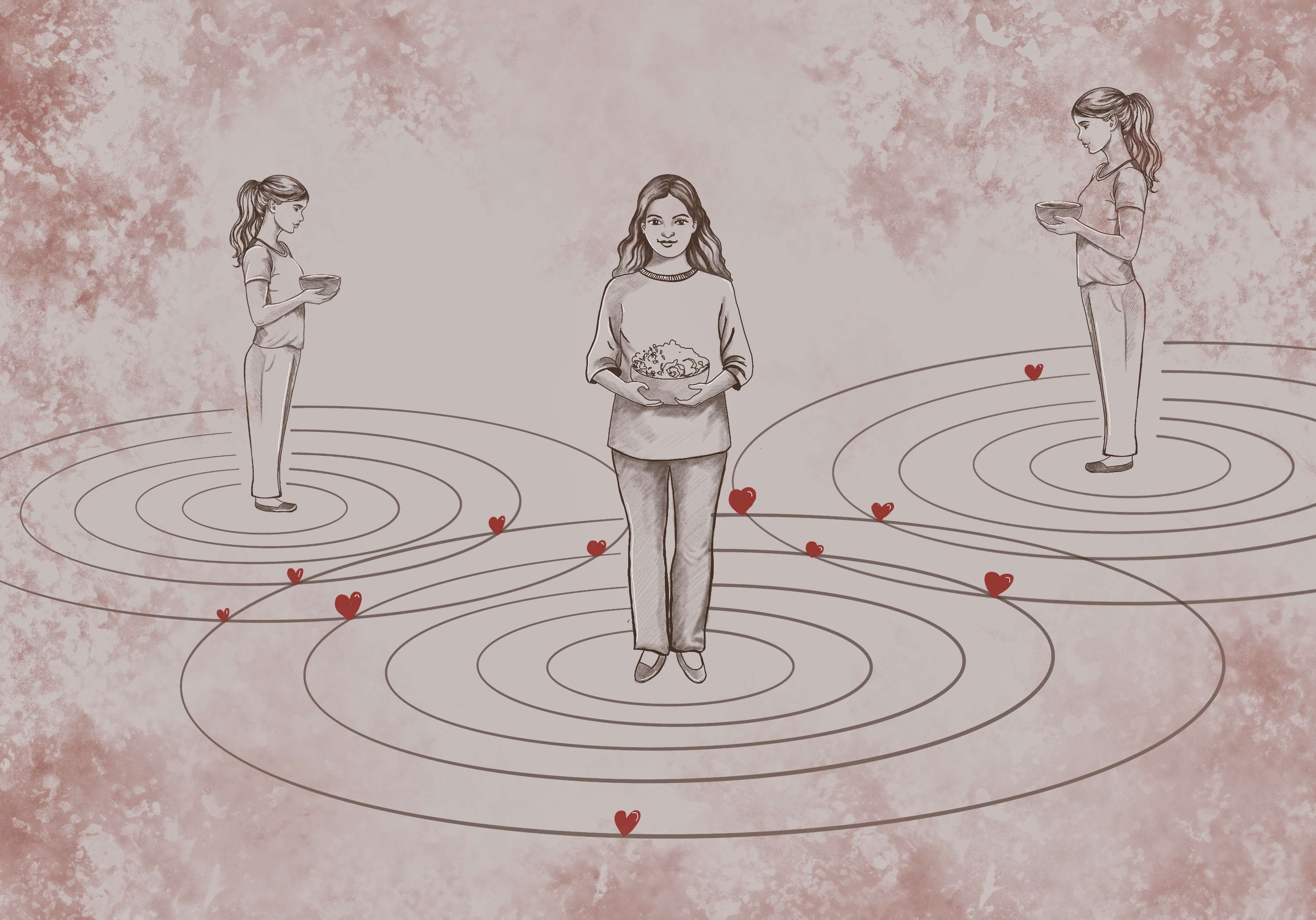
Hospitality, were I to draw it, would be a series of potentially endless concentric circles extending outwards from each of us. In their crisscrossing and overlapping, in the expanse of their reach, might be the critical pattern of our time. A pattern revealing – just as contour lines on a map indicate the gradient of the land – the true topography of a society: its landscape of reciprocity, its borders of generosity, its peaks and depths of give and take. Yet, however far those circles spread, unconditional hospitality remains outside their furthest perimeter. It lies, for the most part, in unknown territory, off the map.

Seed Questions for Reflection

How do you relate to the notion that "the quest for authenticity is often more of a crusade for authority," and that true hospitality moves in the opposite direction - toward openness, overlap, and endless exchange? Can you share a personal story that captures a moment when sharing a recipe, a meal, or a creative act led to an unexpected bridge between you and someone else, revealing the "landscape of reciprocity" between you? What helps you extend your own concentric circles of hospitality a little further outward, even when unconditional welcome feels like unknown territory?


Moved by this reading? Join a live Awakin Circle to discuss in community.
Join this week
More ways to connect

Add Your Reflection

9 Past Reflections
JP
JP
Apr 9, 2026
I love getting a recipe from my mom and creating it. Grows a fantastic connection
JO
jon
Mar 24, 2026
I so miss cooking . I once ran a popular restaurant 3 nights a week and cooked hundreds of meals there. I had a few recipes that I was known for . An amazing vebtable stew and a black bean soup . All fresh ingredients including soaking and preparing a variety of beans including different ones to create different soups and stews. I married a woman that can't eat garlic or onions and has a hard time with spicy peppars . That put me out of business . i miss that cooking as I never was one to cook for myself .
FK
Mar 24, 2026
Some recipes, really only a small handful, even if you find them in a cookbook or online, and you will - will not be my mother's recipe. For that, the concentric circles that have included me, come from long ago and a country I never have known - and yet I know it's soup, I know it's potato kugel, i know it's savory lukshun or noodle kugel, i know it's matza balls and horseradish, it's chopped chicken liver and creamed herring. And i know these things from my mother who was not at all interested in the past. Who spoke only briefly, and with a special kind of gentleness I only heard in her voice on the rare times she talked of her mother. I never knew my mother's mother, my grandmother. And yet somehow I do. She is in the circle within the circle with me too. Sharing a recipe is sharing a soul food.
KA
Mar 24, 2026
This story of recipes and concentric circles of hospitality takes me back to my mother's amazing baking (today would be Nancy Jane's 105th birthday). Her breads and cinnamon rolls were legendary and labor-intensive: eggs from our chickens, cream from our cow Bessie, water pumped from the well. We joked that neighbors could smell the bread baking over the telephone's party line. She created feasts and our garments from comparatively primitive technology. I think of hospitable friends now and specialties they bake: one's melted chocolate lava cake, and another's sourdough bread. I've memorized a recipe for sweet potato muffin with blueberries and walnuts, so easy to share and nourishing, delicious warmed. I watched again the movie 'Babette's Feast." A story of a chef and her act of radical hospitality in a creative meal that suspended time and place. The feast magically created reconciliation in a small group of villagers whose hearts had become cold. Their eyes and hearts an... View full comment
AN
Mar 24, 2026
Twenty years ago Living Compassion were invited to Zambia to share a meal and to see if they could help a small community where there was a lot of suffering. Seven out of every ten children never made it past age 5. Now this community is thriving - as 1000 children are fed from huge vats of mealie meal every day. As part of the Living Compassion sangha I get to raise funds every year to support this community where now young children get to eat every day, go to school and even to go college where they train in skills they bring back to their community. Who knew sharing one meal could lead to bringing comfort and joy to a whole community and beyond. Gratitude wants to give 🙏♥️
NA
Mar 23, 2026
Enjoyed the authentic taste this one offered :-) Many years back, I got a call from a client of mine - who had by then become a very dear friend and mentor ( I surround myself with such souls). He said he had a unique request. He wondered if I would be open to donate some of the art I made for a worthy cause. It was to help raise funds for a non-profit that helped women of domestic abuse. I have always given away my paintings as a token of appreciation, gratitude and good wishes. So, there was no effort to say Yes. But then, I thought I should add value. ( My dad had taught me back in India as his apprentice that even when asked to mail a letter, one had an opportunity to add value - could be the handwriting to write the address, perfect and neat stamp at the corner or no leak of glue when you close the envelope) With that training, I offered to paint something special in tune with their theme for which they were trying to raise funds. I offered 10 of my paintings of which one wou... View full comment
DD
Mar 19, 2026
The quest for authenticity is a quest for being real, a quest for integrity, a quest for authoring one's own authentic life. If it is a crusade for authority as in authority over others, I think the quest for authenticity has gotten sidetracked. I have experienced sharing what I am authentically experiencing as a creative act when I am present, honest, and open in the moment, don't have an agenda, don't try to control or manipulate, and allow what happens to happen. I have experienced that process being a bridge of close, valuable, satisfying connection between me and the other. Unconditional welcome means genuine welcome without any agenda, and when unconditional welcome is present I find it easier to extend further my own concentric circles of authentic hospitality.
JP
Mar 19, 2026
We have all kinds of relationships. Some are superficial and some are deep. Cultivating authentic and profound relationships is based on reciprocity. Blossoming realtionships requre unconditional love, empathetic understanding and postive regard. It reqires time to cutivate unselfishness and patience. It takes time for fostering profound and authentic relationships. When I think of cultivating realationship with people close to me an image of a banayan tree comes to my mind. It takes time for the tree to grow. Seeds of the tree slowly and gradually ripen and become a blossoming tree. Such a tree provides shelter and shade to others with no expectaion of a reward in return.
I was born in a relatively poor family but the hearts of my parents were rich. They enriched our lives with no expectation in return. They offered their unconditional love and spiritually enriched our life. We learned a valuable lesson: By giving, our life is spiritually enriched.
Namste.
Jagdish P Dave

AM
Mar 19, 2026
find myself reflecting on a long thread in my life. Years ago, I was introduced to Bohm Dialogue—not as a method, but as a way of being together. Later, my husband and I began hosting small gatherings in our home. We shared food, and then, with the sound of a singing bowl, entered into what we called conscious conversation. What we noticed was simple: people didn’t always know what to say. Not because there was nothing there, but because something deeper was being asked. Over time, the “food” began to change. From meals to attention. From conversation to listening that could hold what is real. Now, in our Friends Practicing Together gatherings, I sense we are tending what I’ve come to call Sacred Roots—those quiet, unseen threads of connection that grow beneath our words. Reading Priya Basil’s reflection, I feel how easily “authenticity” can become something we try to claim or defend. And yet, the moments that stay with me are the ones wher... View full comment