Social Intelligence

Image of the Week
Image of the Week

One day, late for a meeting in midtown Manhattan, I was looking for a shortcut. So I walked into an indoor atrium on the ground floor of a skyscraper, planning to use an exit door I had spotted on the other side that would give me a faster route through the block.

But as soon as I reached the building's lobby, with its banks of elevators, a uniformed guard stormed over to me, waving his arms and yelling, "You can't walk through here!"

"Why not?" I asked, puzzled.

"Private property! It's private property!" he shouted, visibly agitated.

I seemed to have inadvertently intruded into an unmarked security zone. "It would help," I suggested in a shaky attempt to infuse a bit of reasoning, "if there were a sign on the door saying 'Do Not Enter.' "

My remark made him even angrier. "Get out! Get out!" he screamed.

Unsettled, I hastily beat my retreat, his anger reverberating in my own gut for the next several blocks.

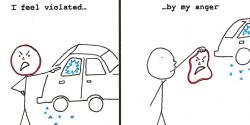
When someone dumps their toxic feelings on us – explodes in anger or threats, shows disgust or contempt–they activate in us circuitry for those very same distressing emotions. Their act has potent neurological consequences: emotions are contagious. We "catch" strong emotions much as we do a rhinovirus – and so can come down with the emotional equivalent of a cold.

Every interaction has an emotional subtext. Along with whatever else we are doing, we can make each other feel a little better, or even a lot better, or a little worse – or a lot worse, as happened to me. Beyond what transpires in the moment, we can retain a mood that stays with us long after the direct encounter ends – an emotional afterglow (or afterglower, in my case).

These tacit transactions drive what amounts to an emotional economy, the net inner gains and losses we experience with a given person, or in a given conversation, or on any given day. By evening the net balance of feelings we have exchanged largely determines what kind of day – "good" or "bad" – we feel we've had.

Seed Questions for Reflection

How do you transcend the emotional economy to make the emotions you entertain a decision and not a reactive choice? How do we gain the awareness and equanimity to avoid catching the "rhinovirus"? Can you share a personal story of transcending the emotional economy?

Moved by this reading? Join a live Awakin Circle to discuss in community.
Join this week
More ways to connect

Add Your Reflection

23 Past Reflections
JL
Aug 18, 2015


Angry


the sneeze

exploded


chilling

the air


by evening

flu


The weekend

pneumonia

CO
Colette
Mar 1, 2015
 well what i feel is this:     a reactive choice is a pattern or habit and although i cannot see what is happening on the quantum level, I have a choice about how i will respond or not respond, if i am in a place of awareness.....and in that there is freedom. In the beginning i was unconscious of this choice and suffered.   Now if i am aware....and this is more often than previously ....i can see that the other person is acting in his pattern/habbit....according to his past experiences, cultural education etc. So when we can create a few seconds of space between such an event and our response, we can choose HOW we respond.  We don't have to accept their gift of negativity.  They may offer it but we don't have to accept. I think that catching strong emotions, assuggested in the above story is a habit.  It doesn't mean I don't feel the negativity, I would much rather experience positivity but I see it for what it is, a puff of smoke real... View full comment
VR
Vrej
Mar 21, 2013
 By practice mindfulness
ER
Eric
Mar 4, 2013
 in the last 2 years i have been layed off work for for a total of 10 months. In that time of being layed off, I have finished my firefighter 1&2. my hazmat . now I'm in school to pursue RN. life is what you make it. one of my favorite quote          "  I said I was great way before i believed it"  Muhammad Ali. in other words fake it till you make it
BH
Jan 30, 2013
 A pertinent question baffling best brains of humanity and students of positive psychology.. i am repeating  my beloved SIR's words.. HE says... '"one can notice the change in one's mind and body, when we are about to be taken over by negative emotions. educating one's emotions is the key. just as you clean your physical body you have to clean your mind and heart every day.. and this is what real meditation or yoga is all about. you meditate on human heart, on the negative emotions that it contains and you remind yourself every morning that you have this capacity to clean, and, clean the 'psychological dust' that has settled on you heart and, be aware and be aware to clean them and keep them under a healthy control.."' 
PK
Paula Kiger
Jan 7, 2013
I created a FourSquare check in designed to bring a tiny moment of happiness and optimism to the drive in to work:  http://biggreenpen.com/2012/12/16/seeing-the-light-the-optimism-light/  ;
CH
Jan 3, 2013
I like this passage because of its vulnerability. I mean, choosing to walk through the building turned into a hairy situation! And yet the author chose to share the messy scene in service of elucidating a point about social intelligence and how our emotions and other person-to-person dynamics subtly but profoundly affect one another. That's cool in my book. And I know I can relate, often being the little rascal that I am :) and challenging authority -- I could totally be that guy trying to walk through the building and feeling anger at the guard's forceful response (in proportion to the actual offense).  There's another point that's perhaps beyond the scope of the passage but worth mentioning, I think. It struck me intuitively at first, and then I was inspired to think more on it after seeing another comment express a similar perspective. Namely, another kind of intelligence: systems intelligence. That is, being aware of the systems/groups we're part of, and t... View full comment
BT
Jan 3, 2013
 I agree with Narendra.  Most often when I am confronted with a person who is "having a bad day" I do my best to give them attention that is "love filled".  I do my best to help them overcome their negativity.  Most of the time a nice genuine "SMILE" is a very contagious thing.  Once given it is rarely not noticed and if not immediately accepted, I'd like to bet that it was not forgotten but remembered somewhere down the day and resurrected and reused in an appropriate circumstance.
NA
Jan 2, 2013
 How do you transcend emotional economy to make a non-reactive choice? To be reactive is natural. That is the way nature made us. To overcome this tendency and be objective, we need to evolve in consciousness with self-effort. We can develop this habit of objectivity or ‘witnessing’ by shifting our awareness from our mind/thought process to a feeling of love in the heart. This shift in awareness makes the experience of love in our heart, our primary, normal state instead of a random emotional state that can easily be triggered both internally and externally. How do we gain the awareness and equanimity to avoid catching the "rhinovirus"? When our normal responsive state becomes love, the reactive “rhinovirus” of emotions will be reduced. This stability in emotion gives us the confidence and the time to respond, instead of hastily over react, to an unexpected hostility. Our emotional stability also creates a positive, predictable environment ar... View full comment
KS
Jan 2, 2013
 The difference we can make to the quality and happiness of people is great;it is so simple. But simpletons like the
Security man know not. More education in civil behaviour in schools is the answer.
JD
Jan 1, 2013
There are events such as Daniel described where I can breathe deeply, smile, reframe what's going on so as not to take it personally, but there are also events that may hit a deep wound of my own or comes unexpectedly  and viciously from a close friend or family member where my circuitry is overwhelmed emotionally and I may  freeze, not knowing what to do but react.  In those rare moments I have learned to not respond (not always successfully) and instead deep breathe, affirm that "all is well," and perhaps ask Spirit for direction. In those moments of sudden emotional onslaught,  it is best for me not to react, thus giving  myself a chance to regroup and reframe  the reality of what has happened. I am also not averse to sharing my feelings with trusted friend if the feelings persist over time which can give me support but a different perspective as well.  Consciousness of my thoughts and emotions  is first of al... View full comment
MA
Jan 1, 2013
In every moment I have a choice. I can re-act compelled by my programming (judgment, criticism, blame, taking things personally)  OR I can choose to ACT IMPELLED (moved from within myself) by what is important to me (my needs, values and preferences). I believe, and have both experienced and witnessed in others, that everything we think, do and say is an attempt to attend to our needs (the Life Energy within us). This perspective invites me to empathy and compassion for myself and others, and I enjoy my life more, have more ease and sense of harmony within.
CW
Jan 1, 2013
I have discovered that as a human being my first emotion is to react and take everything personally.  However, it is most interesting when I am present to question my immediate thoughts with "Is this really about you?"  Nine times out of ten it has to do with experiences prior to the present that the other person is reacting to and usually has absolutely no recognition of because they have been so drawn in by their own pain body.  This is where forgiveness, compassion and empathy come into play.....it takes a high level of present energy but it is definitely worth strengthening the response of releasing the me and embracing the we to "see with different eyes" 
AM
amen
Dec 31, 2012
 yes it happens bt point is how to stop feeling low after such treatment from ur loved ones
MW
Dec 31, 2012
 I am surprised at this post from Daniel Goleman, who is a deeply experienced meditator. We do not "catch" negative emotions, as he suggests, unless we attach to them. Take a deep breath and smile. Wonder why you were in such a hurry in the first place. The security guard is a human being with as many challenges as you, and he is only doing his job. Can you feel empathy for his situation? If not, you might want to revisit this in your next sitting.
RI
Dec 31, 2012
In this case, the author actually could escape, and did physically, although the encounter shook him up enough to remain with him for a long while. I get to experience life from a different perspective perhaps.  This emotional economy is present every day in every class I teach, and from which I cannot physically escape to provide much needed distance from this toxicity. From my standpoint as a teacher days are filled with moments of emotional energy drain and emotional energy resurgence.  Case in point:  A student in one of the classes I teach.  I have allowed her to harass me each day she attends.  Her words remind me of the ‘mean girls’ I encountered every day of school, seventh grade through senior year, when I lived in fear of walking down the hallway, and couldn’t figure out where to sit for lunch.  Frankly most students know her, and in this class have actually given her a wide berth, which only recently I have noticed.  Much ... View full comment
NS
Dec 29, 2012
 In our world every situation or problem we need to look  in three dimension one worldly two celestial  third in spiritual way first two gives us solution that depends on time and place and culture and religious belief third spiritual solution is most imp it also in reality gives us true solution that is beyond all negative or positive emotion .spiritual vitamins are described in Geeta,Bible,Koran,and Bhudda's teachings ,i am just expanding topic ,for all of us          in healthy emotional economy one must think end results before reacting.angry emotion spreads like volcano and kind consideret emotions spreads like cool summer breeze.My motto is shri krishnas gentle smile even on battlefield  .
J
Dec 28, 2012
My husband is a very proactive individual . . . me, by nature, more reactive.  A reactive person's emotional economy, to varying degrees, is affected by the people, happenings, circumstances . . . challenges of that day (whether we want it to or not)!  A proactive person's emotional economy (again, to varying degrees) is less affected by the variables of the day.
My husband goes into a day much the same as he comes out of it because of his "focus".  This can be good and bad!  He is less sensitive to/aware of OTHERS emotions because of his own needs/goals.  The more "reactive one" (me) seeks to better balance this.  We need to care about the needs/feelings/thoughts of our brothers and sisters . . . but not to the point we are consumed by them.    In matters "transcending" . . . I'm still learning.   
DD
Dec 28, 2012
Central in my transcending the emotional economy is to realize that no one else can "activate in us circuitry for those very same distressing emotions."  I may activate circuitry of distressing emotions in myself, but no one has the ability or power to activate circuitry in me, and when I say they do, I'm fooling myself or trying to fool myself.  Emotions aren't contagious.  We don't "catch" emotions like we do a rhinovirus.  We influence each other and are stimuli in one another's world, but we can't make each other feel anything, be it happy, sad, angry, better, or worse.  The other doesn't determine my feelings.  My emotions are mine, and my transcendence occurs in realizing that, that is, making it a reality which I personally have accomplished only in some situations at some times thus far, with my goal being to grow further in that transcendence.  Nothing determines the kind of day I have except me.&nb... View full comment
CP
Dec 28, 2012
 I have some difficulty in making clear separations between emotions and thoughts since they are so intertwined.  So instead of asking how do I transcend the emotional economy to make the emotions I entertain a decision and not reactive choice, I would change that to how do I transcend the rational/emotional economy to make the emotional rationality I entertain a decision not reactive choice?  Awareness is the key and awareness generates equanimity.  By noticing my noticing while I am noticing helps me avoid catching the "rhinovirus."   I recall reading that Plato stated one's experience is like riding a chariot with a white horse of reason and a black horse of passion.  The white horse of reason was continually in charge of controlling the black horse of passion from taking the chariot off the appropriate road.   My sense is that especially in the Western world, we all have been so overly trained in being overly rational ... View full comment
BC
Dec 28, 2012
It is difficult but a matter of practice.One needs to be internally driven to counter the toxic comments affecting the balance of feelings negatively at the end of the day. Those who are externally driven will always be in distress and have loss of emotional economy. But I must admit, very difficult to be internally driven. 
A
Dec 27, 2012
I am so thankful for my daily dose of "paroxetine"!  When my doctor prescribed this to me he said, (not in so many words), "When someone dumps their toxic words/feelings on you, this medication will allow 'the words' to wash off you (not affect you the way they normally would)!  Medication works . . . thanks be to God for creating men/women able to come up with these "right combinations". I am weak.  I am able to tolerate little in the department of over reactions . . . wrong reactions . . . too much drama-reactions . . . unjust reactions.  As a youth, I witnessed a lot of "emotional reactions" . . . both positive and negative . . . teaching me much.   ~As a child, I took it. ~As an adult, I can step back and assess it.   ~Best to keep emotions at bay . . . stick to love and logic . . . come to an orderly, more calm and rational place . . . if "the storm" was meant for me (I need to "take it&qu... View full comment
GA
Dec 27, 2012
 In the short term I take a pause to listen; to him and to me, then i am able to come up with a compassionate responce.
For  the long term I regularly remove garbage from my mind; residual feelings of hurt, humiliation, low self worth etc. This foundation helps the short term pause taking.