Uniform Corn-Rows In High-Tech Isolation
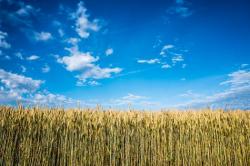
I live in the lush green farm country of upstate New York, in a town that likely has more cows than people. Most everyone I know grows something: apples, hops, grapes, potatoes, berries, and lots of corn.
As I carry my seeds to the garden, [I remember that it was] a gift from heritage seed savers, my friends at the Onondaga Nation farm, a few hills away. This variety is so old that it accompanied our Potawatomi people on the great migration from the East Coast to the Great Lakes. Holding the seeds in the palm of my hand, I feel the memory of trust in the seed to care for the people, if we care for the seed. These kernels are a tangible link to history and identity and cultural continuity in the face of all the forces that sought to erase them. I sing to them before putting them into the soil and offer a prayer. The women who gave me these seeds make it a practice that every single seed in their care is touched by human hands. In harvesting, shelling, sorting, each one feels the tender regard of its partner, the human.
My neighbor bought his seeds from the distributor. They are a new GMO variety that he can’t save and replant but must buy every year. Unlike my seeds of many colors, his are uniform gold. They will be sown with the scent of diesel and the song of grinding gears. I suspect that those seeds have never been touched by a human, but only handled by machines. Nonetheless, when the seeds are in the ground and the gentle spring rain starts to fall, I suspect he looks up at the sky and prays. We both stand back and watch the miracle unfold.
As spring progresses my neighbor’s sprouting corn inscribes glowing green lines against the dark soil, drawing the contours of the land, like isoclines on a living topographic map. Its hypnotic evenness makes it look like it was planted by machine, which of course it was. I smile at the occasional deviation where the lines go askew for a few yards. Maybe the driver was distracted by an incoming text or swerved to avoid a groundhog. His distraction will be written on the land all summer, a welcome element of humanity in a food-factory landscape.
My garden looks different. The word “symmetry” has no use here, where mounds of earth are shoveled up in patches. I’m planting the way I was taught, using a brilliant innovation generated by indigenous science: the Three Sisters polyculture. I plant each mound with three species, corn, beans, and squash—not willy-nilly, but just the right varieties at just the right time. This marvel of agricultural engineering yields more nutrition and more food from the same area as monocropping with less labor, which my tired shoulders appreciate. Unlike my neighbor’s monoculture, Three Sisters planting takes advantage of their complementary natures, so they don’t compete but instead cooperate. The corn provides a leafy ladder for the bean to climb, gaining access to more light and pollinators. In return, the bean fixes nitrogen, which feeds the demanding corn. The squash with its big leaves shades the soil, keeping it cool and moist while also suppressing weeds. This is a system that produces superior yield and nutrition and requires no herbicides, no added fertilizers, and no pesticides—and yet it is called primitive technology. I’ll take it.
Across the valley, the uniform corn-rows in their high-tech isolation look lonely to me.
How do you relate to the type of agriculture described by the author where there is a personal relationship between the human and the seed? Can you describe a time you could see a deep synergy between life forms competing for the same resources? What helps you discover technology like 'Three Sisters planting' in your own work?
"when you touch a seed with love and afftection with a silent prayer in your heart to the lord to take its care before sowing, it gives in abundance" Ancient truth as revealed by our great grandfatthers.
Masterly thought in the article revives all the old memories passed by through generations. Thanks for such sharing and caring.
Even today what we grow any vegi or fruit in our garden , the fruit or vegi has a certain earthy odour so soothing so original and so full of taste.
Amazing to see people growing up and moving away from the evils of GMO and other varitties which have profit motive which is the route cause for all the devastation caused globally.