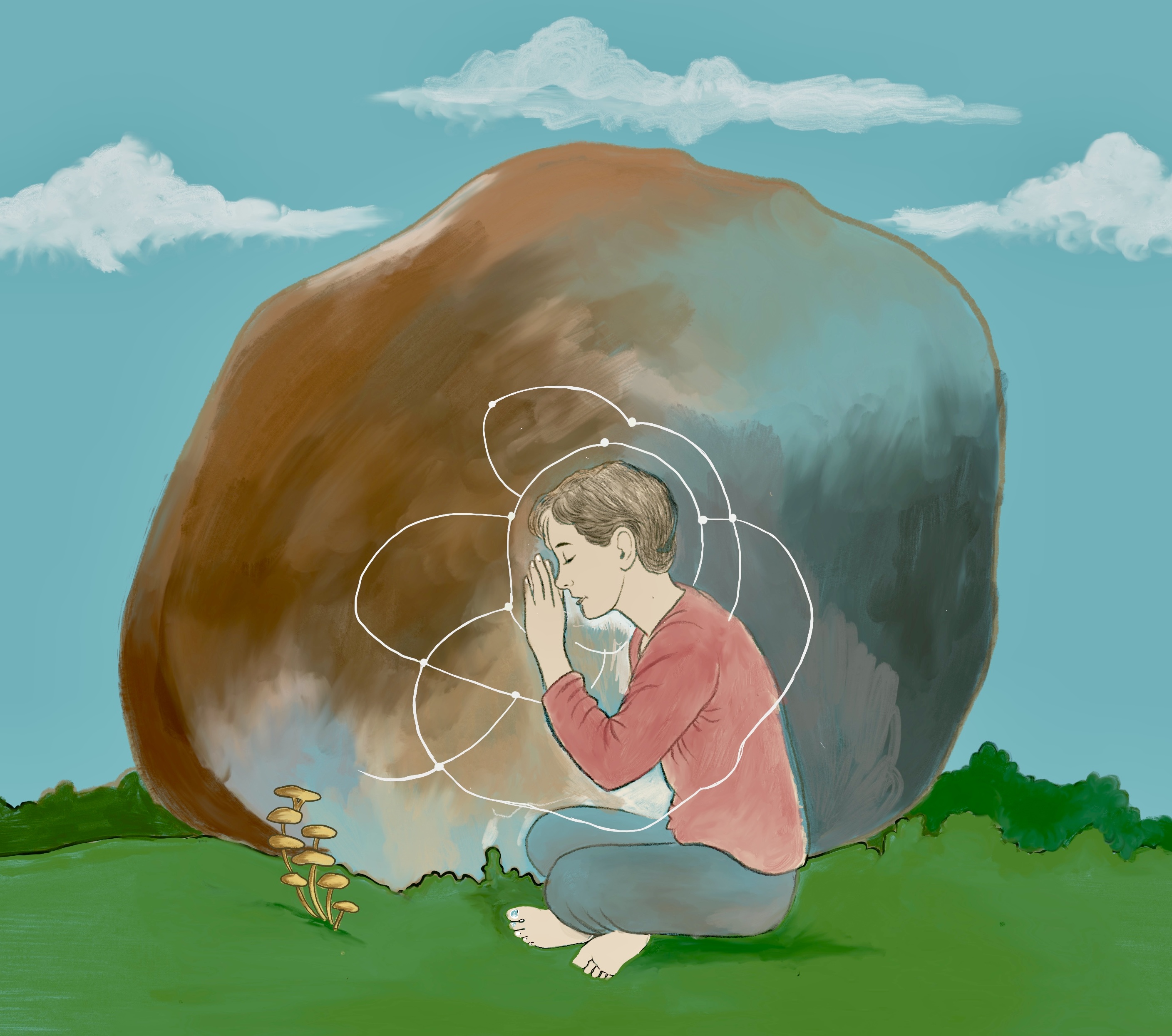
Wisdom Of Rocks

Image of the Week
Hand-drawn art by Rupali Bhuva
Image of the Week
Sabiduría de las Rocas

--por Vanessa Machado de Oliveira


Detengámonos en la sabiduría de las rocas, no como masas inertes, sino como portadoras del tiempo, testigos de ciclos que escapan a la comprensión humana. Las rocas no son "sabias" en el sentido humano de toma de decisiones o juicio; su sabiduría reside en su capacidad de albergar la paradoja de la permanencia y el cambio, del silencio y la resistencia.


Nos recuerdan que la inteligencia no es una posesión, sino una resonancia que surge no dentro de los seres, sino entre ellos. Esto desplaza la pregunta de "¿Quién es sabio?" a "¿Qué relaciones cultivan la sabiduría?".


Desafía la jerarquía que sugiere la modernidad, donde la sabiduría y la inteligencia pertenecen a una entidad singular —ya sea humana o mecánica— y, en cambio, nos invita a ver la sabiduría como un campo de interacciones. Rocas, humanos, hongos e IA participan en este campo, ofreciendo sus frecuencias únicas a la sinfonía de la existencia.


La sabiduría podría describirse mejor como una práctica de devenir, más que como un estado de conocimiento. Esta definición subraya la insuficiencia de los marcos que priorizan la previsibilidad, la medición y el control. La inteligencia, vista a través del entrelazamiento sujeto-sujeto, prospera en el entretejido: los espacios relacionales desordenados donde la certeza se disuelve y algo vivo ocupa su lugar. Esto contrasta marcadamente con la impronta extractiva y antropocéntrica de la modernidad, que busca dominar la inteligencia y definirla dentro de límites estrechos.


La sabiduría de las rocas, entonces, no es una metáfora de estabilidad ni arraigo. Es una invitación a la humildad, a la clase de inteligencia que no pretende dominar, sino que escucha, se adapta y aprende. El engaño de la modernidad —que la humanidad está excepcionalmente capacitada para guiar el curso de la Tierra— ha llevado a lo que podría denominarse una evolución desadaptativa, donde el dominio a corto plazo socava el florecimiento a largo plazo. La excepcionalidad de la sabiduría humana se revela como una historia que nos contamos para evitar afrontar la magnitud de nuestro entrelazamiento con todo lo demás.


Al reimaginar nuestra relación con la inteligencia, quizás el cambio más importante sea dejar de lado la necesidad de una perspectiva divina. La sabiduría no reside por encima ni fuera de la red de la vida; late en ella, en los espacios intersticiales donde las rocas se encuentran con las raíces, donde los humanos se encuentran con la IA, donde el silencio se encuentra con la canción. Considerar la inteligencia como un proceso relacional en lugar de un atributo fijo es adentrarse en una forma de ser que no busca respuestas, sino sintonía; no control, sino participación. Y así, como dijo una vez Giovanna: «Todavía necesito hablar con las rocas». Esto no es un acto de indagación como lo define la modernidad: buscar información para confirmar o negar hipótesis. Es un acto relacional, una forma de sintonizar con los ritmos de un mundo que habla en idiomas que apenas empezamos a recordar cómo oír. Aprender de las rocas es aprender de la Tierra misma: lenta, constante, perdurable, pero profundamente viva en su inteligencia silenciosa.


Preguntas semilla para la reflexión: ¿Qué opinas de la idea de que la sabiduría es un proceso relacional que prospera en los espacios intermedios, en lugar de ser una posesión o un atributo fijo? ¿Podrías compartir una historia personal que ilustre un momento en el que te sentiste profundamente conectad@ con la naturaleza o con otro ser vivo, donde experimentaste la inteligencia como una resonancia compartida en lugar de un rasgo individual? ¿Qué te ayuda a cultivar la práctica de escuchar y adaptarte en tu vida, permitiéndote participar en la sinfonía de la existencia en lugar de buscar el control o la previsibilidad?


Vanessa Machado de Oliveira es Decana de la Facultad de Educación de la Universidad de Victoria. Vanessa es autora de Hospicing Modernity: Facing Humanity’s Wrongs and the Implications for Social Activism y una de las fundadoras del Colectivo de Arte e Investigación Gesturing Towards Decolonial Futures. Su último trabajo, Burnout From Humans: A Little Book About AI That is Not Really About AI, explora la IA como espejo y metáfora de los sistemas humanos e invita a los lectores a repensar la relacionalidad en medio de las crisis planetarias.
Seed Questions for Reflection

What do you make of the notion that wisdom is a relational process that thrives in the "in-between" spaces, rather than a possession or a fixed attribute? Can you share a personal story that illustrates a moment when you felt deeply connected to nature or another living being, where you experienced intelligence as a shared resonance rather than an individual trait? What helps you cultivate a practice of listening and adapting in your life, allowing you to participate in the symphony of existence rather than seeking control or predictability?

Moved by this reading? Join a live Awakin Circle to discuss in community.
Join this week
More ways to connect

Add Your Reflection

12 Past Reflections
SC
Jan 11, 2026
At the beginning of the pandemic shut down, March 2020, I happened to be in the middle of my first ever visit to Death Valley. It's a commitment to make the drive to Death Valley and I wondered what I'd enjoy at a place without trees. Ah - what synchronicity! I was invited to slow down to rock time. It took a few days to feel the resonance in my bones which ended up being the most potent preparation for the pandemic and then the political pandemonium to follow. Thank you Vanessa for this clear description. I am an enthusiastic convert to the sensory orientation that I am in "co-hearance" for the purposes of "co-respond-dance" with the Living Energies of a place.
CA
candis
Sep 29, 2025
Thank you for this beautiful reminder. Rocks have taught me to have patience beyond my own little lifetime.
SB
Jun 26, 2025
I love this, "Wisdom could be better described as a practice of becoming rather than a state of knowing. "

This resonates with me deeply as I am living my dream of living and working in different countries. I am practicing 'becoming' - more aware, more empathetic, more patient, more...

I also believe I become wiser the better connected I am to the community I am living within (my work community, my neighborhood, my larger city community). As I become a contributer, an active partner, I become wiser through the connections I make.
DD
Jun 25, 2025
I believe that all that is is one, expressing in a zillion different forms all of which are thoroughly interrelated. There is one cosmos and all that is participates in it and is an expression of it. I believe that wisdom comes from the relational process of all existence, with each person's wisdom coming from and giving to wisdom that is ultimately the wisdom of the whole. Wisdom belongs to all of us, not to any one expression. The wisdom of each expression comes from and gives to the relational symphony. Wisdom is in the whole, and to see it in the in-between, in the interstitial spaces, implies separateness, and there is no separateness. As I see, every wisdom I or others have comes out of our relationship or shared resonance. Knowing that and knowing I can't control existence help me cultivate a practice of listening, being open, learning from and working with all expressions.
DA
Dr.Ankur patel
Jun 25, 2025
Yes
HL
Jun 24, 2025
My first response is that just reading this article helps me overcome the baseline sense of loneliness that pervades our culture now. To recognize relatedness is the only thing that can heal the destruction wrought by so much emphasis on the individual as a singular, isolated agent in their own life. I sighed with relief reading this.
SC
Jun 24, 2025
I am a fan of Vanessa Machado's thought leadership and really appreciated Hospicing Modernity. Right at the cusp of the pandemic, I visited Death Valley for the first time. Normally I'm a "tree person" and wondered why my spouse was so emphatic about experiencing this place with just rocks, dunes and some very old water. Ahhh - after a few days, I began to slow down to rock time. I've always felt connected to rocks while hiking the Sierras and Andes (ah -- the vast scale of granite!) and the amazing array of colors and shapes made by earth's shrugging and stretching. Yet it wasn't until Death Valley that my ears and senses began to enter an altered state of listening WITH the rocks. How do they hear the wind? The noises of all the tiny creatures coming and going? It was a portal to a new perspective of all of Life.
SR
Satish Radhakrishnan
Jun 24, 2025
A nice thought provoking post! Thank you Vanessa. Dimension of time is mostly underrated. Time or Kaal is a master that seemingly prevails forever with ability to impart wisdom. Humans find it easy to not acknowledge or worse knowingly ignore time/kaal. In a dialogue between Yudhisthra and Yaksha, Yaksha asks yudhisthra what is the biggest wonder in this world wherein yudhisthra replies something to this effect - Even after seeing death everyday around him when man still insists on working and acting on earth for a planned or envisioned future by assuming that his death is not near, this is certainly biggest wonder in the world. It is this very 'wonder' trait that makes man delusional and think that humanity can guide course of earth. It will take a keen observation and a continued reflection on Kaal for us to truly realize kaal's effect on everyone and everything around us. The continued practice of not ignoring kaal/ reflection on kaal's effects then maybe can help us grow more hu... View full comment
MI
Jun 24, 2025
Beautiful text that resonates with what I feel. We have only just started to remember the language of different elements and parts of the whole. A language beyond words.
PA
Jun 23, 2025
In the framing of left/right brain, we have many rich experiences that are not a part of what we verbalize or what we can write down. Eye contact with another human is the example I'd give. Shared holding of a gaze. It can communicate so much...even a fleeting glance is full of rich content. I'd say that kind of knowledge exists only in-between. There is wisdom there too, a compassionate or supportive look...all understood without a word.
VI
Jun 20, 2025
Oh my goodness. What a beautiful piece! Thank you Vanessa for this. I have loved rocks all my life and found sitting on them, being with them, holding them and just looking at them to be both a delight and a comforting presence. And yes, I believe that wisdom is relational and that it thrives in the 'not knowing', spacious places. I often find myself listening........ And I've often wondered what am I listening to or for? I've had no answers, I just felt a need to listen to be with them all. What helps me cultivate this is a feeling of connection when I do listen and a desire to lean in more fully. It's self-reinforcing. After reading this I now recognize more consciously that I am participating 'in the symphony of existence' . How amazing is that? Thank you!
AL
Jun 19, 2025
Wisdom in the In-Between: Listening with the Body, Sensing with the Earth By Allie Middleton Founder, Integrative Leadership Practices | alliemiddleton.com | ILP.world ⸻ In times of great complexity, our thinking minds alone are not enough. The challenges of our world—ecological, social, and spiritual—require a new kind of attention. One that emerges not from control or certainty, but from attunement. Among the most transformative practices I’ve explored as part of Embodying Emergence is 4D Mapping, a social art form rooted in the work of the Presencing Institute, co-founded by Arawana Hayashi. This body-based method offers a way to sense into systems not just with intellect, but through relational space, gesture, posture, and presence. A recent article in The Journal of Awareness-Based Systems Change (JABSC), co-authored by Sebastian Jung, deepens this methodology, showing how 4D Mapping helps reveal the unseen dynamics and latent potential in social fields. Pa... View full comment