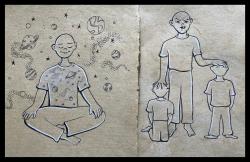
Self-Compassion Over Self-Esteem

Image of the Week
Hand-drawn art by Rupali Bhuva
Image of the Week
POR QUÉ LA AUTOCOMPASIÓN ES MEJOR QUE LA AUTOESTIMA
Por Kirsin Neff


La gran preocupación de la vida moderna es esta: no importa cuánto esfuerzo pongamos, de cuánto éxito gocemos, lo buen progenitor, pareja o trabajador que seamos… el caso es que nunca nos parece suficiente. Siempre hay alguien más rico, más estilizado, más inteligente o que ostenta más poder, alguien que hace que nos sintamos insignificantes en comparación. El fracaso, sea del tamaño o del tipo que sea, se considera inaceptable. ¿El resultado? Consultas de terapia, farmacias y secciones de autoayuda de librerías atestadas de gente que se siente insatisfecha consigo misma ¿Qué se puede hacer?


Una respuesta ha venido en forma de obsesión en torno a la autoestima. A lo largo de los años han aparecido literalmente miles de libros y artículos de revistas promocionándola: hablando de cómo obtenerla, elevarla y conservarla. El afán por tener una alta autoestima se ha convertido prácticamente en una religión, a pesar de que las investigaciones muestran los graves inconvenientes que eso puede acarrear. Nuestra cultura se ha vuelto tan competitiva que necesitamos sentirnos especiales y superiores a la media, simplemente para sentirnos bien con nosotros mismos (ser calificados “del montón” se considera un insulto). Por lo tanto, la mayoría de la gente se siente forzada a practicar lo que en psicología se califica como el “sesgo del auto beneficio”, que consiste en inflar nuestra importancia al tiempo que se la quitamos a otros para poder sentirnos superiores en comparación. Sin embargo, esta necesidad constante de sentirnos mejores que nuestros congéneres humanos nos lleva a sentirnos separados y aislados. Y además, una vez has conseguido elevar tu autoestima ¿cómo haces para mantenerla? Es como subirte a una montaña rusa de emociones: nuestro amor propio rebotará de un extremo a otro como una pelota de ping-pong, subiendo o bajando según percibamos que hemos tenido éxito o que hemos fracasado.


Una de las repercusiones más dañinas que ha tenido la obsesión en torno a la autoestima durante las últimas dos décadas ha sido la epidemia narcisista. Jean Twenge, autora de Generation Me (La Generación del Ego) analiza los niveles de narcisismo de más de 15000 estudiantes universitarios norteamericanos entre los años 1987 y 2006. En el transcurso de ese periodo de 20 años los porcentajes de narcisismo se dispararon, pues hasta el 65% de aquellos estudiantes puntuaron más alto en narcisismo que las generaciones anteriores. No es coincidencia que la puntuación en autoestima de los estudiantes se elevara con un margen incluso mayor durante el mismo periodo. Una autoestima demasiado alta se asocia también con un comportamiento agresivo, discriminatorio y colérico hacia aquellos que ponen en riesgo nuestra percepción de valía. Por ejemplo, hay chavales que como manera de fortalecer su ego pegan a otros chavales en el patio del colegio. Eso no es muy saludable que se diga.


Está claro que tampoco queremos padecer de una baja autoestima, así que ¿qué opción nos queda? Resulta que para sentirnos bien con nosotros mismos podemos hacer otra cosa: desarrollar la autocompasión. La autocompasión se traduce en que, cuando nos vaya mal en la vida o cuando detectemos algo en nosotros mismos que no nos gusta, nos tratemos con amabilidad en vez de hacerlo con frialdad o criticándonos duramente. Implica reconocer que la condición humana es imperfecta, de modo que cuando fracasamos o sufrimos, en vez de sentirnos apartados y aislados nos sintamos conectados a los demás. También significa mantener una atención consciente: reconocer y aceptar nuestras emociones dolorosas, sin juzgarlas, tal y como afloran en el momento presente. Y en vez de reaccionar ahogando nuestro dolor - o si no, protagonizando un culebrón dramático - nos observemos y percibamos nuestra situación con claridad.


Es importante que discernamos entre autocompasión y autoestima. El grado de autoestima mide cuán positivamente nos juzgamos a nosotros mismos. Representa cuánto nos gusta nuestra manera de ser y cuánto valor nos adjudicamos, y esa valoración a menudo está basada en la comparación que hacemos con los demás. Por el contrario, la autocompasión no depende de evaluaciones ni juicios positivos; se trata de una manera de relacionarnos con nosotros mismos. El sentimiento de autocompasión en las personas parte su misma humanidad, no de que posean unas cualidades especiales o por encima de la media. La autocompasión favorece la interrelación en vez de la división. Eso se traduce en que, si practicas la autocompasión no te hace falta sentirte superior a los demás para sentirte bien contigo mismo. También te proporciona mayor estabilidad emocional que la autoestima, pues te acompaña siempre, estés en la cima del mundo o te estampes contra el suelo.


Por tanto, en vez de perseguir la autoestima interminablemente como si del caldero al final del arcoíris se tratara, en mi opinión deberíamos propiciar el desarrollo de la autocompasión. De ese modo, estemos en la cima del mundo o en lo más bajo, podremos abrazarnos a nosotros mismos con cariño, sintiendo conexión y equilibrio emocional. Dispondremos de la estabilidad emocional suficiente como para percibirnos con claridad y para llevar a cabo los cambios que necesitemos para hacer frente a nuestro dolor. Aprenderemos a sentirnos bien con nosotros mismos no porque seamos especiales o superiores a la media, sino porque somos seres humanos, intrínsecamente dignos de respeto.

Preguntas semilla para la reflexión: ¿Qué significa para ti autocompasión? ¿Puedes compartir una historia personal que muestre la diferencia entre perseguir la autocompasión y nutrir la autoestima? ¿Qué te ayuda a hacer espacio para la autocompasión?

Kristin Neff es investigadora.
Seed Questions for Reflection

What does self-compassion mean to you? Can you share a personal story that illustrates the difference between pursing self-esteem and nourishing self-compassion? What helps you make space for self-compassion?


Moved by this reading? Join a live Awakin Circle to discuss in community.
Join this week
More ways to connect

Add Your Reflection

16 Past Reflections
GD
gd
Jun 17, 2026
I am Tibetan this life, and practice in the religion of my land-its answer to the age old question in the west of, "what is the meaning of life" is rather simple, or seems to be. To be happy and not suffer, is the meaning. But this needs unpacking as it does not translate easily. Happiness is a profoundly, deeply, satisfied mind imbued with well being-and in our tradition we believe it is possible to attain forever, or better said to reveal its exstence or catalyze its potential that is innately there. Suffering is the opposite of this. This meaning drive is innate to all life with a mind and I argue even plants have it though they are not conscious of it-it seeks like, moves from poison, etc. etc. We get confused by this because in our materialist/physicalist culture that often denies our consciousness or is just an epiphenomena of matter-then we are left only with the gross pleasures of life. Thus anything that brings pain is equivalent to suffering and pleasure is equivalent to happ... View full comment
SA
Sanju
May 29, 2026
Main apne aap ko hamesha kisi aur ke saath compair karti rahti hu,ghussel ,chidchidi hu ,muze jab koi bolta hai ki tu sundar dikhti hai,tu talented hai ,tu sahi jivan ji rahi hai tab muze andar se achha lagta hai..apne se bade logo ko dekhti hu jaise kisike rishte bahut hai ,kisike paas property bahut hai, koi dikhne me sundar hai, jada paise kamane vale, jimmedari sambhalne vale,active log,ho deciplined hai, shant hai, clarity hai aise ke dekh ke aap ghruna Karti Hu,apne aap khatam kar du aaisa lagta hai,main kuchh kaaam ki nhi hu aisa lagta hai...self compassion matlab hai,apne aap ke saath rahna,khud galati ke liye maaf kr dena,khud ko grow karte rahna,bhavnao me balance ,rakhna,achchi neend lena,distract na hoke focused rahn..sachchai ke jina,ye sab karne ki baat
CB
clouds breeze 5 white glacier
Oct 24, 2025

On Cloud Shoes Offer unmatched comfort and Style Perfect For Running, Training, Or Everyday Wear Get Up To 40 Off Shop Now On Cloud!

HE
hellsat
Oct 24, 2024
Buy premium Quality hellstarclothingsofficial.com Online Store Sale At Discounted Price. Enjoy Free And Fast Shipping 12-15 days Sale Upto 30% OFF
SP
SPIDER
Oct 24, 2024
Largest Sp5der collection 2024. Enjoy up to 50% discount on us-spider.com hoodies, pants, shirts and more. Fast Worldwide Delivery and Free shipping to the USA.
ZA
zaeembarrier
Sep 28, 2024
The Large Corner Sofa Bed, frequently known as a sectional dfs corner sofa, is a flexible and space-efficient choice. Designed to match snugly into the corner of a room, this couch type maximizes seating even as minimizing the use of floor space. Typically, a Grey Corner Sofa consists of three or more sections arranged in an L-form, with an optionally available ottoman or chaise lounge to decorate consolation.
DA
Dagmar
Oct 26, 2021
Upon reflection I feel that self-kindness and self-compassion is such a challenge at times. Often it seems intricately connected with unhealed past trauma. Self-esteem for similar reasons seems conditional and dependent on the successful outcome of intentional pursuits.Since I recently retired I am going through the relinquishment of an identity that had been firmly grounded and become fixed in the work I loved. I notice an absence of self-compassion asI am struggling with a sense of increased uncertainty of purpose and transformation of identity. My meditation practice is my medicine (which paradoxically I am at times reluctantto take) and a best way for me to process my troubles. As is physical work in the garden, being in nature, and making room for and friends with all emotions, regardless how uncomfortable -- . When I hold still long enough, meditation and mindfulness is self-kindnesspractice that gets me in touch with the peace within that is always there, independently and uncon... View full comment
DD
David Doane Oct 28, 2021
Hi -- I'm getting close to retiring (I initially wrote closed to retiring) soon, and I appreciate what you said. Thanks for sharing. I particularly appreciated your last two sentences ie getting in touch with the peace within that is always there and knowing "I am enough." Retiring is a big transition that I tell myself and hope will open new doors and allow more time for endeavors I'd like to have more time for. I wish you well in your retirement/new chapter.
PA
Oct 26, 2021
Most "good religion" of man are based in a belief that humans emanate from Divine LOVE. As such, we are of course worthy of love, grace, mercy and compassion. When we embrace that truth we experience the fullness of our humanity and are enabled to be all of that to and for others. }:- a.m.
MA
Maria
Oct 26, 2021
One tool that helped make space for self compassion is a bullet journal. A bullet journal combines a planner, a habit tracker, a sketchbookand a notebook.I use my bullet journal for setting intentions, monthly planning, journaling, doodling, and tracking various habits. I'm not as disciplined as I'd like about writing in it, but it's always there whether I want to jot down a to-do list, to recallmy goals, or to make sense of my thoughts and feelings. It's a tool that helps me to encounter reality, toaccept it, and to recognize opportunities for change and growth. This tool gives me a greater sense of agencyin my life.
JB
Jerry Bruns Oct 26, 2021
is the bullet journal an app or paper. If paper, do you or someone else know of an electronic version. thanks
DU
Oct 26, 2021
Just as the quest self esteem has been taken to the absurd, so has the admonition to set borders. I am hearing people rudely reject others by saying "these are my borders." This phrase makes good sense when one is protecting herself from abuse, But it can also be used to close doors to understandingand promoteself righteousness (or a fake kind of self esteem.)
DD
Oct 23, 2021
The fact is, no one makes you feel big, small, or anything. Self-esteem based on comparison with others is dependent and conditional, and as Kristine Neffsays is likely to bounce around like a png pong ball. Self-esteem based on self comes from inside, is not based on outside conditions. Self-esteem based on comparison with others is different than self-esteem based on self. Compassion means sympathy for someone who is suffering problems. Self-compassion means sympathy that I am suffering problems, and I accept that. As a youth, when my self-esteem was based on what others thought of me, I was goal-directed and pursued self-esteem by trying to impress others. Knowing that to be human is to have problems helps me have self-compassion. For me, valuing me and how I deal with life and problems is self-esteem.
JP
Oct 22, 2021
Self-compassion is kindness to ourselves. We all go through suffering and delightfulness.. There are two ways of relating to our suffering and joyfulness: accepting our joys and sorrows compassionately without comparing ourselves with others and that way feeling up and down. There are two components of compassion: self-empathy and self-kindness. As we all know that we are not perfect. Whenwe compare ourselveswith others and feel higher or lower than others we get disconnected with ourselves and others. Such a perspective causes disconnection, separation and isolation. When I was studyingat the University of Chicago my self-esteem was somewhat wounded when I compared myself with other students who were brighter than me. I felt a sense of inferiority. My self-esteem was affected by what was going on in my mind, thoughts of not-good enough. When I developed friendship with aforeign studentwho felt compassion for me. I felt his empathic understanding and kindness for me. His compassion fo... View full comment
MO
Mona Oct 26, 2021
So beautifully written! But very difficult to do. What can I do in a situation where I find that i'm assessed, gauged or looked down upon? In that case scenario, isnt it but natural to feel less of that self compassion for oneself?. I try practising meditation, but find that my mind churns up a lot of negative recordings over and over again, and instead of helping me, it makes me feel worst.
GU
Gururaj Oct 31, 2021
A very authentic and honest observation, Mona. I could relate very much to that. Might it help to start saying to oneself that "this" ( be it something causing pleasure or something causing pain) is just happening in consciousness . It may seem artificial to begin with. But I trust by and by there will arise equanimity - in case this 'imagination' is a true fact of the way reality actually is, though not felt as of now. Now what is automatically felt is that the experience is happening to, and is caused in some way, by "me"