If There Is No Self, Whose Arthritis Is This?

Image of the Week
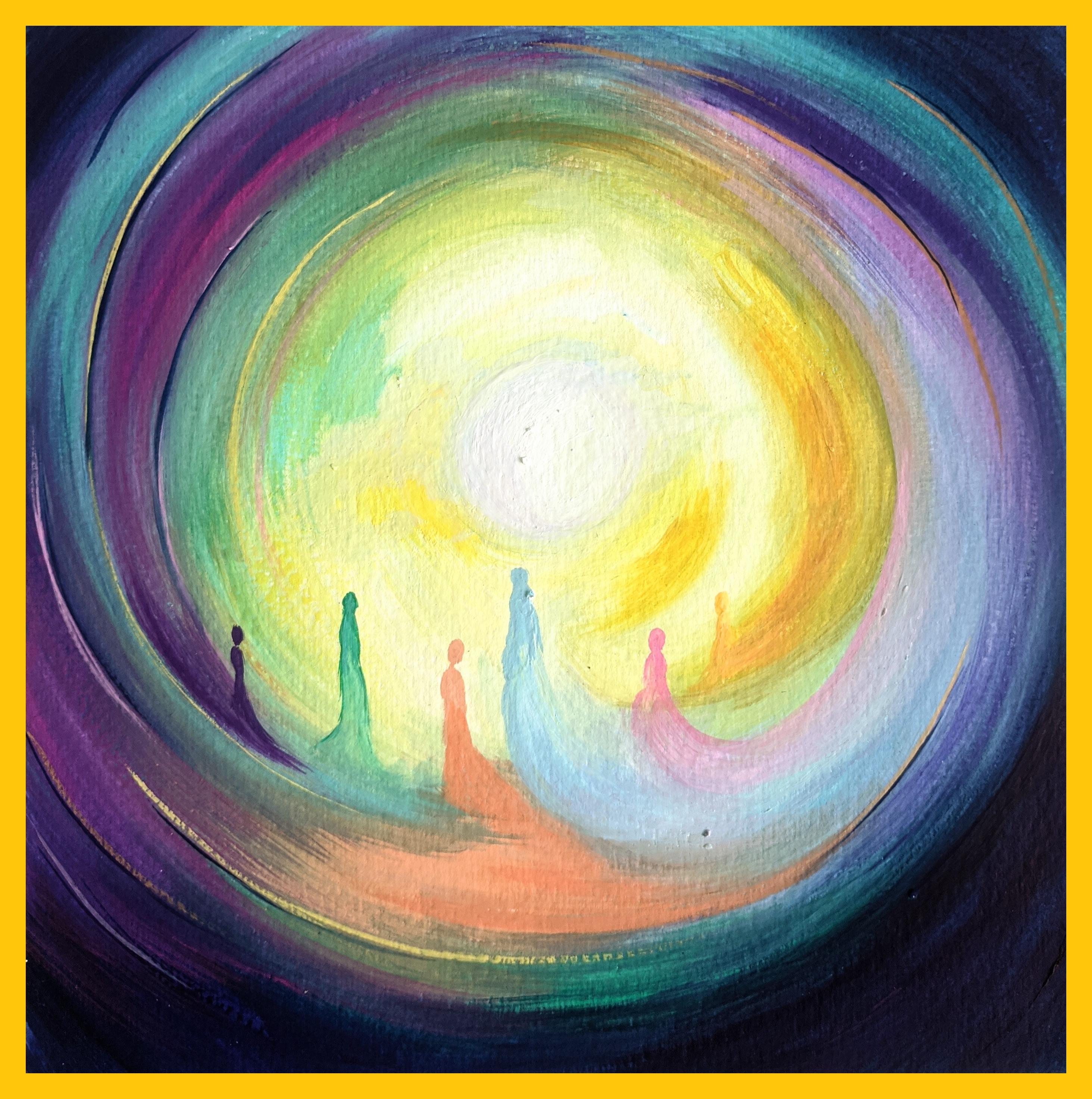
Hand-drawn art by Rupali Bhuva
Image of the Week


Si no existe el yo, ¿De quién es esta artritis?
- por Sylvia Boorstein


"Si no existe el yo, ¿De quién es esta artritis?" es una de una lista de una docena de preguntas que han estado apareciendo regularmente en mi correo electrónico. Creo que es la elección de la artritis, entre todos los males del mundo, lo que hace que esta declaración en particular sea divertida. También es un poco burlón, hacer un chiste sobre la comprensión del altruismo. Dado que hacer bromas es una burla, cada vez que lo leo, y me río entre dientes, se me ocurre que tal vez estoy siendo espiritualmente incorrecta. Sin embargo, creo que no es una broma sobre el dharma: es una broma sobre vocabularios confusos. Sin mezclar, en sus propios contextos, el yo y el no-yo, sin ego y con un ego fuerte, son completamente comprensibles.


Hace veinticinco años, cuando comencé mi práctica de atención plena, recuerdo haber escuchado a mis maestros describir las "tres características de la experiencia" como las percepciones que necesitaba encontrar directamente para liberar mi mente de sus hábitos de codicia, odio e ilusión. . La intuición sobre la impermanencia me pareció razonable. Vi como las cosas cambiaban siempre, que el tiempo pasaba, cómo el impacto de un evento cambiaba con el paso del tiempo. El sufrimiento también tenía sentido para mí. Comprendí, al menos intelectualmente, el dolor del deseo intenso. No entendí lo que significaba yo no permanente. "Mis profesores están equivocados", pensé. "¿A quién es quien le está pasado toda esta vida más que a mí? Este es mi cuerpo, mis pensamientos y mi historia". Recuerdo estar bastante segura de que yo tenía razón y mis maestros estaban equivocados, pero me gustaba tanto todo lo demás sobre el dharma que decidí que podía dejarlo como una cuestión abierta.


Además de mi propia sensación de "Hay alguien aquí que es dueña de esta historia", tuve mi formación como psicóloga. Creía, y todavía lo creo, que un fuerte sentido de ego diferenciado - "Este soy yo. Estas son mis habilidades. Las uso de manera competente en un mundo lleno de otras personas. Puedo cuidarme a mí mismo" - es parte vital del desarrollo emocional saludable. "Yo soy yo, separad@ de ti", es la conciencia que es crucial para la formación de un sentido de moralidad. “Asumo el precepto de abstenerme de dañar a los seres vivos”, requiere una comprensión de seres distintos a nosotros, seres que, como nosotros, experimentan el sufrimiento. Y poder decir, "Soy su madre", o "Daré tu clase el próximo martes", o "Aquí es donde vivo", es útil. Esos "yoes" no son problemas. Son el equipo del ego con el que manejamos nuestras vidas. Describen situaciones, no una entidad separada e inmutable.


El "yo" que es un problema es un "yo" narrador que se aísla y se atrapa en el sufrimiento.

Aquí pongo un ejemplo. Le dije a mi marido durante un período en el que ambos estábamos estudiando con una maestra que enfatizaba la conciencia no dual: "Estoy tan enfadada con fulana de tal. No puedo creer lo que ha dicho de mí". Mi marido me dijo: "¿Dónde está el 'yo' que está enfadado?" Entonces me enfadé con él. Dije: "Tú y yo sabemos que no hay un 'yo' aquí ni un 'yo' allí. ¡Pero el enfado existe! ¡El sufrimiento existe!" Si no hubiera estado enfadada, podría haber visto que el sólido y duradero 'yo' que había puesto en práctica con la historia, "No puedo creer que ella haya dicho eso sobre mí", estaba causando mi dolor continuo. Construyó un "yo" que había sido humillado, que ahora sufría. Los "yoes" con necesidades, cualquier tipo de necesidad, son "yoes" que sufren. Surgen con cualquier malestar. No son errores o defectos espirituales: son pistas de que algo necesita atención. Desaparecen cuando la mente y el cuerpo están cómodos. Ellos, como todo lo demás, son impermanentes, vacíos de sí mismos, surgen y desaparecen según las condiciones.
En una charla que dio el Dalai Lama hace algunos años, un joven dijo: "Me cuesta mucho meditar. Sigo pensando que no soy digno de la felicidad, que no la merezco". Aparentemente, el Dalai Lama se inclinó hacia adelante y respondió con una voz de corrección inusualmente fuerte. "¡Estás equivocado!" dijo. "Cada ser es una hermosa expresión de la naturaleza. Cuánto más un ser con un precioso nacimiento humano, uno con capacidad de sabiduría y compasión".

No hay “yo”, pero hay vidas preciosas.

Preguntas semilla para la reflexión: ¿Cómo te relacionas con la noción del "yo" narrador que se aísla y atrapa en el sufrimiento? ¿Puedes compartir una experiencia de una época en la que pudiste reconocer y superar el "yo" narrativo? ¿Qué te ayuda a mantenerte consciente del "yo" narrador sin perder tu vitalidad emocional saludable?

Extraído de aquí. Sylvia Boorstein es autora, psicoterapeuta y profesora budista estadounidense.
Seed Questions for Reflection

How do you relate to the notion of the storytelling "I" that isolates and traps itself in suffering? Can you share an experience of a time you were able to recognize and move beyond the storytelling "I"? What helps you stay aware of the storytelling "I" without losing your healthy emotional vitality? 

Moved by this reading? Join a live Awakin Circle to discuss in community.
Join this week
More ways to connect

Add Your Reflection

15 Past Reflections
LG
Lesther Guevara
Mar 24, 2021
Thank you for your experiences strength and hope! I can really relate to your story. It's crazy how we think we are the only ones having this wild experience lol. This really opened my view to life.

Unity-Service-Recovery!
ST
Mar 7, 2021
I love the storytelling "I" that surrounds aer self in a mysterious wondrous healing adventure. Any and every moment that I find a feeling arising from unmet needs I return to gratitude and feel enfolded in the arms of love against a breast of a loving beating heart and know that all experience is a re-frameable choice. " Every little cell in my body is happy, every little cell in my body is well!"
CL
Carol Lynka
Mar 7, 2021
One of the difficulties with the storytelling "I" arises in community. Just now, for example, my daughter wanted to engage me in her story of the flames in our fireplace, her excitement in anticipation of her birthday gifts, and the show I agreed she could watch (so she would stop interrupting my reading.)Her unexpected presence at such an early hour interfered withmy story of carving out some quiet time for study and preparing my application for grad school. My ego's response was annoyance. Then Love reminded me to honourour bond, to offer her the connection she desires. Ego responded by insisting my needs are also important and my daughter must learn to respect that. My childhood was one in which women served the needs of their husbands and children and the narrative of self-sacrifice was a badge of (sometimes grudging) honour. I vowed at a young age to live according to my own wishes and not subvert my will to those around me. Despite living a fiercely independent life... View full comment
NI
Mar 5, 2021
This also reminds me of Mahavir's concept of "Bahuchitwan"!
MI
Feb 23, 2021
I use the word we a lot. The we is reallyme (I), which tells me that I am not just a single entity but at any given time I am different, self, father, husband, brother, son (to mother to father) friend... nota one but a many faceted being. So, nothing is is singular we are all connected. Duality of the one.
NT
Feb 23, 2021
this is where buddhism differs from hinduism. i do not agree with "no self". i believe in the opposite of "no self": the one self - awareness - that permeates all, and is the eternal, unchanging self.
the question still applies: how does the eternal, unchanging self deal with the impermanence of the body, the mind, and it's impermanence and afflictions? moment by moment.
DT
David T. Matta Feb 23, 2021
Hi Nilesh,
I do not totally agree. Both condemn an inflated sense of ego and postpone the verdict on the ego until unexpressed reality is experienced without a doubt. They use different semantics on the way to describeultimate reality and both of the languages are grossly inaccurate and can easily be misconstrued and mis-characterized.

“Yato Vacho Nivartante, Aprapya Manasa Saha” – The Realm of Reality is there from where the mind along with speech returns disappointed. (Taittiriya Upanishad). This is true for both traditions.
VH
Vhalle Hohn
Feb 23, 2021
If there is no Self, whose arthritis is this? In understanding my story, I begin to understand how my ego has separated from my highest self, this is duality. But I cannot be so sure that it is from many lifetimes and endless experiences for all of humanity that has created this delusional-reality that we all live in. I am not a practicing Buddhist, but I am, as everyone on this planet, on a spiritual journey. In the search for my Truth, I have come to understand many concepts from many traditions and cultures, and there are similarities. My stories in this lifetime are made up of experiences - It is my ego who has kept me safe, an untethered sense of survival and “I can do it” that has conquered over the whispers of truth that lie within spirit and God. She takes in all of my “bad” experiences, mentally, emotionally and physically and creates a web of armor that ignores the truth, instills fear and knows better than God. And when I get hurt again and a... View full comment
PW
Patrick Watters
Feb 23, 2021
A bit esoteric to begin with, but if we sit with it, let it embrace our hearts, we will see Truth and it will set us free. }:- a.m.
PA
Feb 23, 2021
I'd like to share an experience that happened to me.
i was with a group of my husband's medic friends & aqaintances having a pre- theatre meal. The conversation was mainly around the topic of medicine & views were being exchanged. I felt left out, unable to join in & was increasingly irritated & felt trapped. Into this state popped in a question - "who is feeling alienated?" With the emphasis on WHO. The feelings just dissolved & i felt immediate release. Th nightbefore i had been reading a practice in Jack Kornfield's book- repeatedly asking oneself Who am I?.
With appreciation for the article. Patricia 
SA
Sri Anastasia-Peter Maharaj
Feb 23, 2021
At first blush this appears to be a very puzzling question that I would never presume to be a form of mockery. It is a fundamental question worthy of Self-enquiry. Let's begin? To answer this question we must first understand Who is the 'I' referring to. The 'I' identified with the conceptual mind and a body composed of subatomic particles? If so, how can 'I' be both the subject and the object? How can the perceiver in other words also sinultaneously claim to be the perceived without falling into the trap of duality? If we can agree that duality is an illusion because it is by it's very nature impermanent completely dependent on 'dependentarising' we have taken the first step towards Self-discovery. There is the conceptual self or small finite 'I' of consciousness always in evolution and movement (impermanent) and there is the Primordial 'I' of Pure Awareness and Emptiness that is Causeless and Changeless. We can call this Primord... View full comment
DT
Feb 22, 2021
The questions still bewilder me until today. I do not understand the claim about no-self, on a practical level, that is. Yes, one can present convincing arguments about it that may refine our view about the self. But I do not think it will have any real significance until it is fully experienced.

In the meantime, as a person troubled by emotions, I am satisfied by not asserting a no-self view but rather working hard to decrease the negative impacts of such a view, beginning with the inflated sense of ego.The Dalai Lama in one of his videos is very clear about developing a healthy sense of self, not a denial of it. The view of reality as it is comes in time, and it is fruitless to force it by intellectual understanding.
JA
Jazzy Feb 22, 2021
Thank you!
DD
Feb 20, 2021
There is "I" that is a story initiated by environmental conditioning and created to a great extent by me. It's what I use to interact with the world. Storytelling I sees I as separate, even though I and all creation is one. To suffer is to bear and deal with issues in life. With storytelling I seeing self as separate, it is often fearful and competitive and easily isolates and traps itself in suffering issues that occur. Learning that the essence or real me isUltimate Existence or God has resulted in much less interest in storytelling I and at times in getting very much beyond storytelling I. Why would staying aware of the storytellingI result in losing healthy emotional vitality? My healthy emotional vitality is from the essence or soul that is real me. Real me can use my healthy emotional vitality just as it can use storytelling I and not be victim to either and without losing either. Being aware that storytelling I is not real me enhances my healthy emotional vitality.
JP
Feb 19, 2021
Who am I is a perennial inquiry made in all wisdom traditions. Is there oneness underlying manyness? Is there unity underlying diversity? What causes suffering? Who is suffering? Is there something everlasting? When I identify myself with suffering and dwell on the story of my suffering, I am trapping myself in suffering. Then the blame game begins. She insulted me. He abused me. The mind keeps on telling this story of suffering. This is the haunting and trapping voice of the ego continuing the story of suffering. Awareness of this ongoing mentalmelodrama and chattering is a way of going beyond the storytelling of suffering. Ii is not easy to wake up from the slumber of self-created suffering. It is hard to be free from the self-created shackles of suffering. It is journey of self-awakening. Waking up from the nightmare of suffering is not easy. It is difficult to rise up from the self-generated fall, to wake up from the sleep and remain awake. I have been learning and practicing to k... View full comment