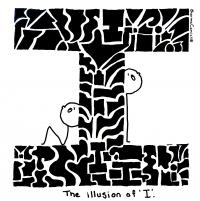
Kazoo Player And The Symphony

Image of the Week
Hand-drawn art by Rupali Bhuva
Image of the Week
Jucătorul Kazoo și simfonia
— de Daniel Ingram

Imaginați-vă că există o mare orchestră simfonică într-o sală de concert mare, iar în fața ei, ca un act de comedie absurdă, stă un cântăreț de kazoo în mod clar nervos, fără partitură de muzică în fața lui. Introducerea orchestrală începe, iar bietul cântăreț de kazoo, care nu are nicio idee despre ce piesă se va juca, încearcă să ofere cea mai bună interpretare a simfoniei alese de orchestră. El este la aproximativ o jumătate de secundă în spatele orchestrei, cântând notele imediat după ce le aude. Deoarece el este un cântăreț de kazoo, el poate juca doar o notă la un moment dat, astfel încât impresia lui despre orchestră este una foarte brută, lovind pe cele mai importante momente ale melodiei, făcând pentru o versiune foarte mică si foarte simplă a amplei si complicatei partituri a simfoniei pe care această orchestră o interpretează minunat în toată gloria ei.

Acum, imaginați-vă că anumiți membri ai audienței au fost blestemați să creadă că ei pot auzi simfonia doar după ce cântărețul de kazoo joacă interpretarea sa. Începând mediatorii, sunt în acest fel blestemați cu toții. Observăm precum și cântărețul de kazoo și, în cele din urmă, ajungem să observăm, să ne ținem de notele cântărețului de kazoo, încântând in performanța sa, pe cât de crudă, liniară și simplă este.

Cu toate acestea, la un moment dat, unii dintre noi realizăm că putem auzi și simfonia, așa cum este ea însăși singură, că țesătura de sunete vine de asemenea din simfonie și acest lucru este cunoscut fără ca cântărețul de kazoo să trebuiască să facă o reproducere limitată, absurdă, în contratimp, întârziată.

În curând, unii dintre noi care suntem melomani vom începe să-l găsim pe cântărețul de kazoo prostesc, precum o glumă care ruinează măreția simfoniei așa cum este.

În cele din urmă, imaginați-vă că cineva pune brusc muzica în fața cântărețului de kazoo, astfel încât el se alătură simfoniei, devine doar o parte din marea învăluire a melodiei, pierdut în mare parte prin grandoarea sutelor de alți muzicieni care contribuiesc cu toții. [Trezirea noastră] este în așa fel, încât în final devenim captați de interpretare, fără a trebui să simțim că avem nevoie de niște cântăreți săraci de kazoo pentru a interpreta și a imita simfonia pentru noi și cu siguranță fără a trebui să simțim că trebuie să fim pe scenă în calitate de cântăreț de kazoo noi înșine.

Semnificația întrebărilor pentru reflecție: Cum te referi la metafora autorului de a te trezi la marea învăluire a melodiei? Poți împărtăși o poveste personală despre un moment în care ai simțit că ai auzit simfonia dincolo de cântărețul tău de kazoo? Ce vă ajută să vă împăcați nevoia unui cântăreț de kazoo cu măreția mai mare care se află în jurul tău?

Daniel Ingram este profesor de meditație, iar fragmentul de mai sus este din cartea sa, "Stăpânirea învățăturii de bază a lui Buddha".
Seed Questions for Reflection

How do you relate to the author's metaphor of awakening to the grand sweep of the melody? Can you share a personal story of a time you felt you could hear the symphony beyond your kazoo player? What helps you reconcile the need of a kazoo player with the bigger majesty that is all around you?


Moved by this reading? Join a live Awakin Circle to discuss in community.
Join this week
More ways to connect

Add Your Reflection

8 Past Reflections
KB
Kurt Becker
Mar 2, 2019
However, at some point, some of us notice that we can also hear the symphony just as it is, just on its own, that the weave of sounds is coming in from the symphony also, and this is known without the kazoo player having to make a limited, absurd, out-of-time, delayed facsimile of it.
BM
Feb 28, 2019
“… without having to feel like we need some poor kazoo player to interpret and imitate the symphony for us,”

Not having read the book, I took the metaphor as a suggestion to not become overly invested in any particular guru or teacher’s philosophy of life and world, but to always measure it against one’s own immediate experience.
AM
Amy Mar 2, 2019
The kazoo player could also be not so poor at all. He could be God. So much of "our personal symphony's are plain and simply off! God, getting our attention to, here and there, affirm our notes/our music ... But challenging us in other areas of a piece. We are not to just "go with the flow" if the flow (of the majority) is contrary to His score.
RS
Feb 26, 2019
In the meditation, in the beginning there is a noise or traffic of one's own thoughts which maybe initially disturbing, but with practice, one learns to observe them without being one with them, eventually as the practice gets deeper, these thoughts becomes few and one is in this ' no thoughts' space even if for a while. To me, this space of no thoughts is the bigger symphony. Pseudo-self with its thoughts is the kazoo player. To go to that 'no thoughts' space, initially one has to observe one's own thoughts without evaluating or judging much like birds coming in and out of a tree or clouds passing past vast sky. Going past the microcosm to be part of macrocosm...
ME
me Mar 2, 2019
I am reading you! I am with you!
SS
Feb 26, 2019
The artist works with a concentration of his whole personality, and the conscious part of it resolves conflicts, organized memories, and prevents him from trying to walk in two directions at the same time.
DD
Feb 24, 2019
My first thought was that I don't relate to the metaphor, and I thought of Nietzsche's saying "And those who were dancing were thought to be insane by those who could not hear the music," which quote I can relate to and even like to relate to. My second thought was that I don't want to be one part of the grand sweep of the melody, largely lost among the grandeur of the hundreds of other players. My third thought is that I want it all, that is, I want to be my own unique individual kazoo player and be part of the grand sweep. Sometimes in a close present encounter with another, I hear the symphony beyond the kazoo player, and while connected to the kazoo player I also feel connected to the symphony with a sense that the symphony is larger than us, it takes priority, and we are part of the bigger majesty of the symphony, and it is very special.
JP
Feb 23, 2019
As a meditator, I have noticed how my mind gets distracted by the external world of sound and sight as well as by my internal world of sound and sight. As I consistently practice Mindfulness Meditation, my mind slowly and gradually gets less distracted. In this quiet and open space I hear the majesty of symphony effortlessly.This is like awakening from my conditionedmind which was bound by my un-awakened or sleepy state of mind. A few years ago, I wentto a weekend Zen retreat. During one our Mindfulness Meditation, I dozed for some time. I was awakened by the hitting by the stick on my back by the Zen master. This awakening experience taught me an importantlesson of awakening myself from my conditioned state of my mind, my un-awakened sleepy sate of mind. It opened up my mind space in which I can hear the grandsweep of the Divine melody, the music of the sphere with no boundary. It creates deep joy, wonderment and harmony. Living everydaymindfully with this awakened state of mind helps... View full comment