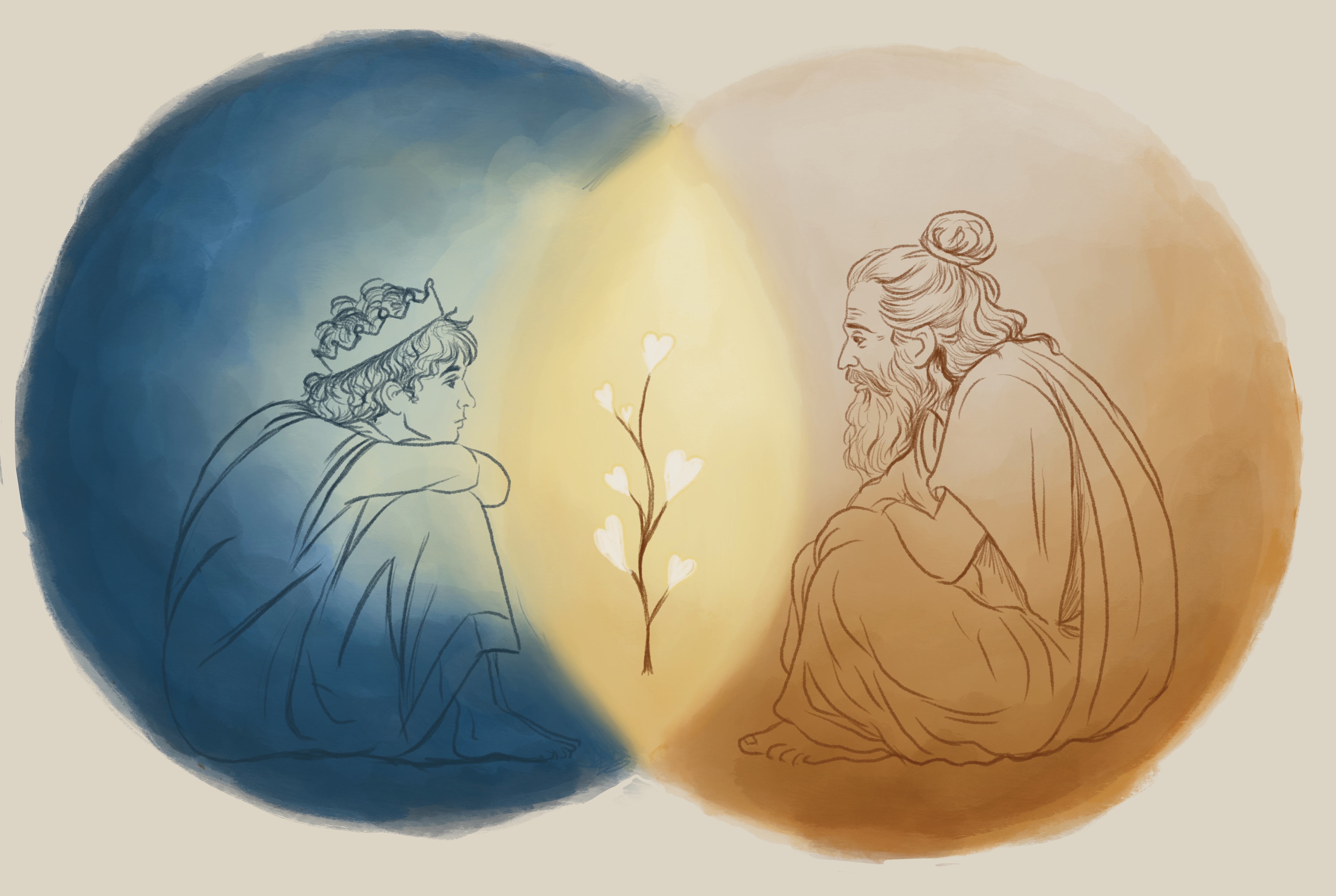
The Turkey Prince

Image of the Week
Hand-drawn art by Rupali Bhuva
Image of the Week

El príncipe pavo

-Por Rebbe Nachman of Breslov

Un joven príncipe sufrió un grave colapso mental y se convenció de que era un pavo. Se quitó la ropa, se sentó debajo de la mesa del comedor real y se negó a comer otra cosa que no fueran huesos y granos que picoteaba del suelo.

El rey y la reina estaban desolados, y ninguno de los médicos de la corte logró curarlo. Finalmente, llegó un sabio que decidió adoptar un enfoque distinto. En lugar de intentar convencer al príncipe de que estaba equivocado, el sabio se quitó su propia ropa, se metió debajo de la mesa y comenzó a picotear el suelo junto al príncipe.

Sorprendido, el príncipe preguntó: «¿Qué haces aquí?».

El sabio respondió: «Soy un pavo. ¿Y tú qué haces?».

Pasaron unos días sentados juntos, relacionándose como «pavos». Una vez que el príncipe confió plenamente en él, el sabio empezó, poco a poco, a ponerse camisas sobre su pecho desnudo.

«¿Estás loco?», preguntó el príncipe. «¡Los pavos no usan camisa!».

«Oh, pero los pavos sí pueden usar camisa», respondió el sabio. «Eso no te hace menos pavo».

El príncipe aceptó ponerse una camisa. Durante las semanas siguientes, el sabio continuó con este proceso: convenció al príncipe de usar pantalones, comer alimentos propios de los humanos en la mesa y, finalmente, sentarse en una silla de verdad. Lento pero seguro, al adentrarse en el delirio del príncipe en lugar de avergonzarlo, el sabio lo condujo de vuelta a la plena cordura y a su vida anterior.

Preguntas semilla para la reflexión

¿Cómo te resuena la idea de que, a veces, la sanación no comienza con una corrección, sino con el acompañamiento? ¿Podrías compartir una experiencia personal en la que alguien te haya encontrado exactamente donde estabas —en medio de tu confusión, tu dolor o tu terquedad— sin intentar sacarte de ahí a la fuerza? ¿Cómo esa presencia inesperada cambió algo en ti? ¿Qué te ayuda a resistir el impulso de querer arreglar o corregir a las personas que amas y, en cambio, a encontrar la paciencia para simplemente sentarte a su lado, en ese lugar —tan extraño a la vez que tierno— en el que se encuentran?

Seed Questions for Reflection

How do you relate to the notion that healing sometimes begins not with correction but with companionship? Can you share a personal story of a time when someone met you exactly where you were, in your confusion or pain or stubbornness, without trying to pull you out of it - and how that unexpected presence changed something in you? What helps you resist the urge to fix or correct the people you love, and instead find the patience to simply sit beside them in whatever strange and tender place they find themselves?
Moved by this reading? Join a live Awakin Circle to discuss in community.
Join this week
More ways to connect

Add Your Reflection

6 Past Reflections
JH
Oct 20, 2026
I am stuck on the why was he believing he was a turkey. I think that entering his world with compassion would be getting to the why of it. Clothes, food etc are simply the visible issues. How does believing he is a turkey serve him? I do this with my clients. If they express that they have a "bad" behavior, I ask them, "How does this behavior benefit you?" Then we find other ways to meet that need. This makes it a shameless process.
AL
Oct 19, 2026
I was taught once to respect the fact that everyone has the inner resources to find what they need. In any case, it seems an imposition to project my own ideas of how someone should be when I’m still discovering who I am. If learning to have the courage to be in “not knowing” applies to me, how much more so to those I encounter?
We learn and grow most by someone simply being with us, not someone trying to correct or change us. That's why many of us grew by having a dog who is faithfully with us, not trying to fix us, usually valuing us more than we value ourselves. I had a friend who would simply be with me, comfortably being himself as we were together, which helped me be myself and grow. What helps me resist the urge to fix someone is my having learned that what helps the most is when I don't try to fix or help, don't correct or give advice, and simply be with the person, not just sitting quietly but being myself and saying what I am experiencing as I am with the person without asking for any response or trying to do anything. I believe that when I am really being present in that way the other has no pressure from me and has the space to be himself or herself.
JP
Oct 15, 2026
Reading this passage evoked my empathy and compssion for the person suffering from identity confusion. "Who am I" is an imporatant question we face in our country and in many parts of the world. People are dicriminated, harrased and some times killed because of racial, religios and cultural diversity.
We need to recognize and deal with this situation with an open and empathetic mind. We all are citizens of the world. Sadly many countries are working against each other and causing suffering and destruction. It is time for all of us to wake up and join our hands to create a compassionate and constructive world. If we coninue liviving in this world with racial, religious, politcal and other biases and divisiveness we all will pay a heavy price.
Namaste,
Jagdish P Dave PhD, PsyD


Namaste.
Jagdish P Dave PhD, PsyD
AM
Oct 15, 2026
What moves me in this story, and in the pairs of yellow flowers, is the profound wisdom of companionship. As a gardener, I know that seeds do not grow alone. We need the encouragement of the living soil, the nourishment of water, the warmth of sunlight, and the unseen relationships beneath the surface. Perhaps healing is much the same. The sage’s willingness to crawl beneath the table reminds me of the deeper, subcortical layers of our being/brain, where experiences not yet integrated may still be waiting for safety, connection, and expression. This is what I love to call Conscious Composting. Not rushing to fix or correct, rather allowing what has been buried, fragmented, or forgotten to become nourishment for something new. And how much easier it is to let go when we are not alone! Companionship invites us to emerge together, to rise from beneath the table, not because someone has pulled us out, but because trust and space to learn safely together has made a new m... View full comment
DD
David Doane, author of A Psychotherapist's View of Reality Oct 16, 2026
I like that -- nonpressuring companionship that doesn't rush to fix but allows and supports growth.