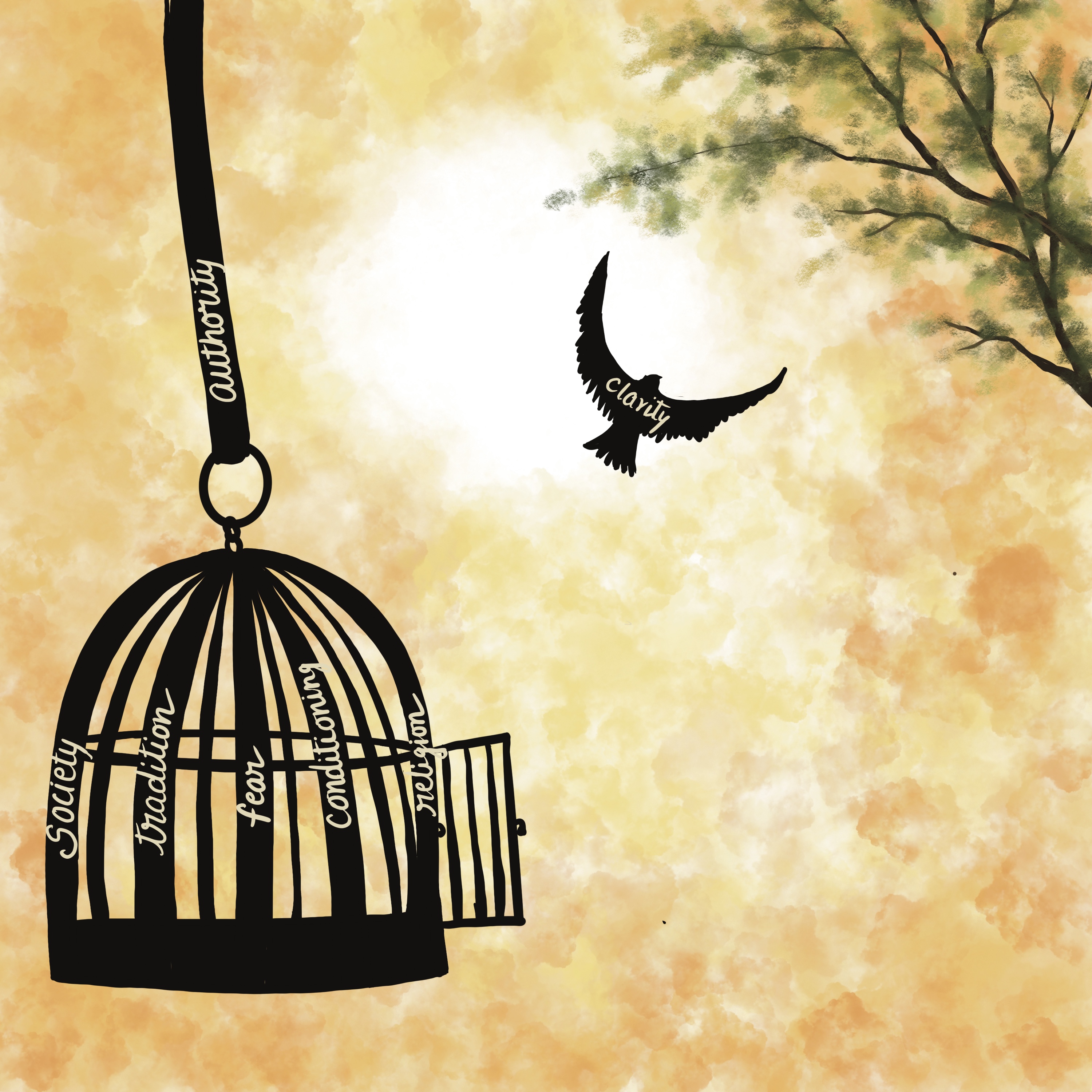
Ask Why Your Mind Is Not Free

Image of the Week
Hand-drawn art by Rupali Bhuva
Image of the Week

The word ‘freedom’ has been greatly abused by tyrannical as well as democratic governments, and religions too, everywhere in the world. Personal freedom and independence do not exist, except perhaps in the scientific world. It does not exist in the business world or in the religious structures which man has organised through fear and belief; it does not exist in governments or in any field of human activity. But man has consistently asserted that he is free and complained that it is environment that enslaves him.
 
Freedom, is independence to think for oneself clearly and not to act according to the dictates of society or one’s own personal inclinations … Freedom is not merely freedom from something, but is freedom in itself. This does not mean freedom to do whatever one likes, so one has to understand not merely verbally but factually what that word implies. We are not trying to define what freedom is; each one would interpret it according to his own inclination or upbringing, and some would even deny that there is such a thing at all.
 
Freedom is to be found not by seeking it, but rather by understanding what it is that imprisons the mind. When these prison walls are broken, then there is freedom naturally, and one does not have to seek it. So what is important is not how to achieve freedom or to ask what freedom is, but rather to ask why the mind, which is the product of time and environment and has had so many experiences of misery and conflict, is not free.
 
Find out why the mind still remains so heavily conditioned after so many millions of years. The mind is conditioned by society with its cultures, laws, religious sanctions, economic pressures and so on. The mind is, after all, the result of the past, and this past is tradition. It lives in this tradition with all its strife, wars and agonies. One must ask if it can be free from its own conditioning. Without freedom from conditioning, humanity will always remain a prisoner and life will remain a battlefield.
 
The first thing to understand in this inquiry is the nature of authority. In any community, law and the policeman are necessary, but we have also introduced a policeman into the inner world of thought and feeling. In this world, obedience has been instilled by tradition, experience and habit – obedience to one’s parents, to society, to the priest. But obedience is born of fear, fear of going wrong, of acting independently, of not being secure, of not being part of the community, of standing alone, of making a mistake.
 
A discipline which comes naturally, without any conformity, is the simple observation of all these fears, anxieties, and envies; to see your own fears, your own ambitions as you see a tree. This very seeing is that discipline. The word discipline means learning, not conformity, suppression or obedience. Learning the nature and the structure of conditioning brings order; not the order of society which is disorder.

Seed Questions for Reflection

How do you relate to the notion that true freedom is to be found not by seeking it but rather through a deeper understanding of what it is that imprisons the mind? Can you share a personal story that has helped you understand the depth of your own conditioning and what it means to break free from it? What helps you observe your fears, anxieties, and envies with the simple clarity of seeing a tree, thereby fostering a discipline that is rooted in learning rather than conformity?

Moved by this reading? Join a live Awakin Circle to discuss in community.
Join this week
More ways to connect

Add Your Reflection

5 Past Reflections
A
Feb 13, 2026
As a kid I remember asking questions in Sunday School. I was not received well. I learned early that adults don't always have the answers', yet they would rather make up an answer. On the flip side a lovely great cousin would ask "A penny for your thoughts". To me this was the beginning of freedom. What are you little one thinking of? How are you enjoying life without someone telling you what, when and how to live? A daydreaming, dressing up, playful, creative, imaginative, relaxed, effortless mind is freedom. An inner Smile exuding equanimity, compassion and connection.
NA
Feb 10, 2026
Krishnamurti’s inquiry into why the mind is not free is deeply resonant. Yet, from the perspective of Babuji Maharaj, there is a further subtlety. Often, the very movement that seeks freedom—however noble—still arises from the mind’s restlessness and sense of incompleteness.

When freedom is no longer sought, defended, or asserted—when even the urge to be free subsides—something deeper opens. This is “freedom from freedom”: a state where observation is no longer an act of will, discipline is no longer effort, and conditioning loosens naturally through inner orientation rather than struggle.
In such a state, the mind does not claim freedom; it simply ceases to bind.

Jiddu-ji emphasizes clarity.
Babuji emphasizes surrender to the subtlest Source.
They are not opposed—Babuji’s view is almost like a postscript written in silence.
DD
Feb 7, 2026
Personal freedom is already ours. Nobody can take that away without my participation. Personal freedom doesn't take seeking it, it takes embracing it, which usually takes courage. We are conditioned to see, think, and do as we should, and it usually takes courage to break out of that and be oneself, which may or may not match one's conditioning. Lack of freedom is imprisonment. We're usually partly imprisoned or free, not a hundred percent either way, and it is up to us how much freedom we take back. My childhood and religious conditioning were well ingrained, and it was due to being open to new ways of looking at life that I began to break free. I began to listen to me and trust me and my truth which fostered my learning and finding my truth and being me more and more rather than living by conformity.
AP
Anil Pandit
Feb 6, 2026
Seeking help from 'Sat-Chit-Anand' to ever reside in "Anand (Happiness)" has helped me to be free from external influences, thereby derive Freedom.
JP
Feb 5, 2026
Freedom, awakening, inquiring , witnessing , fostering self-discipline, nonconformity, courage, forgiving and willingness to candidly inquire the causes of suffering and how to be blissful are the foundations for living wholesome life. J Krishnamurti presents such valuable ideas in his writings and talks. From his talks and dialogues I have learned many valuable lessons of living a wholesome life. A few years ago we- Vanleela, my life partner, I and my friend- Aniruddha went to Ojai, California to listen to J Krishnamurti's talk. I will never forget his presence and his words of wisdom. I have been teaching and counseling for many years. J Krishnamurti has played a very important role in my life as a person, as a parent, as a teacher, as a therapist. Be Yourself, live the Truth, love unconditionally, Listen to your inner voice and follow it. Like many other wise, candid and courageous teachers J Krishnamurti will always live in my heart. I will recommend you to read a short book,... View full comment