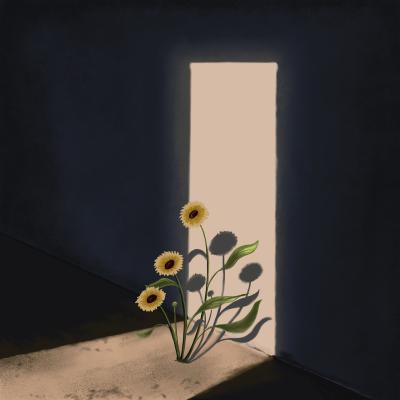
The Dilemma That Faces Us All

Image of the Week
Hand-drawn art by Rupali Bhuva
Image of the Week
El dilema al que nos enfrentamos tod@s
--por Kent Nerburn

Este es el dilema al que nos enfrentamos tod@s cuando decidimos recorrer el difícil camino del perdón. ¿Somos cómplices de malas acciones si no desafiamos a quienes nos hacen daño? ¿O estamos contribuyendo a la oscuridad del mundo si quedamos atrapados en la red de falta de humanidad y crueldad que dio origen a la injusticia?
No sé. Y sin embargo debo saberlo. De alguna manera, yo, tú, cada uno de nosotr@s, debemos encontrar una manera de responder a la crueldad y la injusticia en el mundo de una manera que no empodere a quienes dañan a otr@s. Al mismo tiempo, debemos evitar dejarnos atrapar por su ira y su crueldad.
Una de las grandes apuestas humanas es si lograremos esto mejor haciendo brillar una luz de pura absolución en la oscuridad, confiando en que la luz atraerá a otr@s hacia ella, o enfrentándonos a la oscuridad con la misma fuerza y tratando de inundar el mundo con luz una vez que la oscuridad se mantenga a raya.
En un caso u otro, sin embargo, una cosa es segura: el perdón no puede ser una emoción color pastel desconectada. Se exige en las circunstancias humanas más sangrientas y debe resistir los vientos más fuertes de la ira y el odio humanos. Para ser una virtud real, comprometida con el mundo que nos rodea, debe ser musculosa, viva y capaz de resistir los ultrajes y las desigualdades de actos inhumanos e inhumanos. Debe ser capaz de afrontar el lado oscuro de la condición humana.
Cómo damos forma a ese perdón es una de las cuestiones más cruciales de nuestras vidas. Y no es fácil. A veces nos frustramos tanto que creemos que no podemos soportarlo más.
Pero podemos y debemos; es nuestra responsabilidad humana. Aunque sabemos que el perdón, mal utilizado o incomprendido, puede convertirse en un socio tácito de los males que nos rodean, también sabemos que, aplicado correctamente, es el pegamento que mantiene unida a la familia humana. Es la manera de superar la soledad que muchas veces nos rodea. Debemos encontrar una manera de construir ese puente, incluso si nuestras manos son torpes y los materiales a nuestro alcance son defectuosos.


Preguntas semilla para la reflexión: ¿Cómo te relacionas con la noción de que el perdón debe ser musculoso y vivo para ser una virtud? ¿Puedes compartir una historia personal de una época en la que experimentaste el perdón como el pegamento que mantiene unida a la familia humana? ¿Qué te ayuda a construir puentes de perdón?
Seed Questions for Reflection

How do you relate to the notion that forgiveness must be muscular and alive in order to be a virtue? Can you share a personal story of a time that you experienced forgiveness as the glue that holds the human family together? What helps you build bridges of forgiveness?

Moved by this reading? Join a live Awakin Circle to discuss in community.
Join this week
More ways to connect

Add Your Reflection

9 Past Reflections
EG
Apr 6, 2024
Bridge building...networking....connecting...transforming...metamorphasizing..... forgiveness is an aspect of each of these life components that improve the way something is into something that "Can Be" if we are willing to remove our ego that often limits or inhibits progression from what we think or position we dig our heels ito and hold onto. Inner work of our own forgiveness towards ourselves is the first step into being able to look at the position of others and better understand why they think what they think without compromising our core values of life and love in the purest sense. To thine own shelf be true ......and then it will be automatic and authentic to for give others while maintaining your core virtues. When going through a divorce, forgiveness of behaviors allowed me to remain open hearted to the love of my family and working toward planning a future for their best, loving lives. Dr. Jagdish Dave'helped tremendously with this as did the teachings of Thich Nhat ... View full comment
SW
Apr 2, 2024
This question run deep and is at the core of the anger that had built up inside of me. To turn away from the corruption, cruelty, starvation, vastly growing poverty, the destruction of our mother’s health, poisoning of our world and those creating so much harm to others intentionally has been a dilemma for me. I was brought up with the turn the other cheek perspective and the harm I allowed to myself could fill movies. Not interesting ones as the situation, like most, we are trying to learn from kept repeating in new ways as I had not learned to stand in my center and value myself while valuing others. To ask what is forgiveness? Who am I forgiving? Is forgiving another voice of the ego?... what am learning? Why do I keep bringing this into my life? In essence, what I was doing was empowering the blackness while at the same time enabling light through collaborative systemic process change and empowering project work. There was some good in my work for the other, but what I was doin... View full comment
ST
Apr 2, 2024
We must be able to forgive ourselves before we are capable of foregiving others
BN
Barbie Norby
Apr 2, 2024
Forgiveness seems to be summed up in "forgive them for they know not what they do." Also forgiveness is asking the Divine, "please forgive me for I know not what I do." Having been caught up in a blind, mechanical nature I often do the things I don't want to do. I forget and then allow a lower self within to act through me- criticizing, blaming, judging, hating. Am I really better than the people I condemn as "wrong?" It's all in scale.

When I am able to see this nature (which I've clung to but is not my true self) I can begin to let go of it all. I can see how useless it is. This takes conscious work, but seeing the necessity of letting go of these thoughts from the past which basically resist themselves seems to be what forgiveness and self-freedom truly is. As others responding to this post have said, we are all one consciousness. Every act of forgiveness helps the entire world- now, in the past and in the future.
KJ
Katie johann
Apr 2, 2024
To be honest, I agree that forgiveness is essential. However, I do not agree that it must come from our human-ness.
When we are angry and outraged, the energy that is out there, has personally affected us. And so we have taken some of it on.
Forgiveness is part of our divine nature. It is quite separate from emotion or justice. It is done to purify the self and heal the self. It is a recognition that you have control over Nothing but yourself.

DD
Mar 29, 2024
We are complicit always. I believe forgiveness that is expressed in action, outwardly and explicitly, does more good than forgiveness only in one's head. I believe forgiveness is a glue that brings people closer together. Forgiveness has always been difficult for me. When I have forgiven, and to the degree that I have forgiven, it's a positive experience and I and the other are closer. The more I hold back forgiveness, the more distant I and the other continue to be. What helps me build bridges of forgiveness is knowing through my experience of receiving forgiveness and giving forgiveness, however much forgiveness I've given, is knowing that forgiveness is medicine for me and the other, and knowing through experience that forgiveness brings peace and happiness.
MA
Madhuri
Mar 28, 2024
To err is human and to forgive is divine,; that is what I learnt as a child . Also learnt that to ignore injustice is to support injustice. So Iin my understanding forgiveness has an element of being and lies in the realm of inaction as much as it lies in action. An action not to fix the person but to stop the harm and an action that connects all of us, the victim, the perpetrator and the observers to our individual and collective compassion. An action that restores justice, condemns the act and redeems and restores the person who caused harm. But sometimes forgiveness is much more than action, when I feel deep resentment for the wrongings in history, I see disgust for an act turning into hatred for a set of people and hardening parts of me, freezing my real compassionate self, I need help in unfreezing and flowing. I need spaces and people where I feel held and heard. I have been moved by ' rubaroo roshni ' and other real life stories of forgiveness and restorative justice and I th... View full comment
JP
Mar 28, 2024
Virtues weave the tapestry of our life and make us virtuous, make us human and contrubute to the wellness of life. Virtues connects us and creates harmony in the world. One of the core virtues is forgiveness. I love the famous wise saying: To err is human, to forive is divine. We all have small errors and big errors. I forgive myslfe for making a mistake. Such forgiveness comes from the heart. And such forgiveness elavates my consciousness. Forgiveness has two sides of the coin connected with each other: self-forgiveness and foriveness of others. Both are essential to complete the circle of virtous living. As the author of the article Kent Nerburn writes," It is the glue that holds the human together. It is the way to bridge the loneliness that often surrounds us. Genuine forgiveness is a way to buld that bridge." As a human being I have made many mistakes. That way I have hurt myself and otherse close to me. I cultivate truthfulness courage and boldness to reconize such mistakes ... View full comment
PA
Mar 28, 2024
I am an old (very old) fan of Kent Nerburn going back to Wolf Not Dog, including the film version. I am also of both Irish and Lakota ancestry…much of my own history is wrapped up in Wolf Not Dog. And here too is the essential, life-giving need for both acknowledgment and forgiveness if any reconciliation and reparation is to happen. Lakota people say, “Mitákuye oyàsin,” which translates to “All are my relatives.”