Three Questions For A Better World

Image of the Week
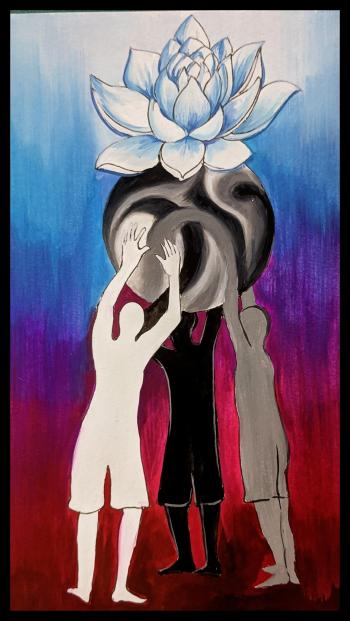
Hand-drawn art by Rupali Bhuva
Image of the Week
Tres preguntas para un mundo mejor
- por Charles Gibbs

Mis amig@s me han ayudado a ver las consecuencias mortales de la creciente brecha entre ricos y pobres. Un sabio líder religioso africano llamado José Chipenda me desafió con una perspectiva cruda sobre esta situación. Cuando lo conocí, el Rev. Chipenda estaba a punto de jubilarse después de dos décadas de servicio como director del Consejo de Iglesias de Toda África. Escuchó mi explicación de la Iniciativa de Religiones Unidas con el escepticismo que sienten muchas personas del sur y del este cuando escuchan a alguien del norte y del oeste promoviendo otra buena idea sobre cómo salvar al mundo.


Cuando terminé de hablar, dijo, antes de apoyar esta Iniciativa de Religiones Unidas, tendría que saber qué haría por tres grupos de personas que he llegado a conocer en mis años en este trabajo. El primer grupo son las personas que nacen para morir. Las condiciones en las que nacen son tan duras y la chispa de vida en ellos tan débil que están en este mundo solo un breve tiempo antes de que esa chispa se extinga y mueran. ¿Qué haría este esfuerzo por un mundo mejor por las personas que nacen para morir? El segundo grupo, y es enorme, son las personas que nacen solo para sobrevivir. Pasarán toda su vida luchando cada día para mantener la chispa física de la vida. ¿Qué haría este trabajo por un mundo mejor por las personas que nacen solo para sobrevivir? El tercer grupo, y este grupo es pequeño, son las personas que nacen verdaderamente para vivir. Son bendecidos con abundancia, aunque a menudo son ciegos y tienen la oportunidad de prosperar en esta vida. ¿Qué pediría y ofrecería este trabajo por un mundo mejor a las personas que nacieron para prosperar?


Llevo esas preguntas conmigo todos los días; y tengo que creer que una parte importante de nuestra educación es inculcar en cada persona el reconocimiento de que los tres grupos identificados por José Chipenda son parte de la familia humana. Todos somos hermanos y hermanas, parte de la misma red de vida; y aquellos de nosotros que tenemos el privilegio de nacer para prosperar no debemos olvidar a nuestros hermanos y hermanas menos afortunados, ya sea que vivan junto a nosotros o al otro lado del mundo.


Preguntas semilla para la reflexión: ¿Cómo te relacionas con las tres preguntas para evaluar nuestras grandes ideas para un mundo mejor? ¿Puedes compartir una historia personal de un momento en que pudiste pensar en los tres grupos al evaluar tu visión de un mundo mejor? ¿Qué te ayuda a invertir en el bienestar de los tres grupos en tu propio trabajo?


Charles Gibbs fue el director ejecutivo fundador de United Religions Initiative (Iniciativa de Religiones Unidas). Ha publicado un libro de poesía y actualmente está trabajando en otro libro.
Seed Questions for Reflection

How do you relate to the three questions to evaluate our grand ideas for a better world? Can you share a personal story of a time you were able to think about all three groups when evaluating your vision for a better world? What helps you be invested in the welfare of all three groups in your own work?

Moved by this reading? Join a live Awakin Circle to discuss in community.
Join this week
More ways to connect

Add Your Reflection

11 Past Reflections
HE
Jan 4, 2022
“The growing gap between rich and poor”
I believe that greed in the most wealthy countries causes need in others.
(Why was my comment flagged as spam earlier?)
KA
Kathryn
Jan 4, 2022
challenging questions. I find as I lean toward remembering my own animal being, my body form as part of this amazing inter-dependent world of life, that I hold more compassion and understanding for humans regardless of their status or life expectancy. I don't hold onto such a strong expectation that we are only here to thrive. Soul Lessons come in so many forms. Might we try to walk simply and to reach out to others with love sharing whatever we have to offer?
D
Jan 4, 2022
Sounds like a pacifier for the evils of capitalism.
Bold, challenging questions that we must all ponder. And then we must act in loving, grace-filled response depending on which group we are in. The wealthy may have the most difficult time, as Jesus of Nazareth noted in his encounter with the rich, young ruler.
KC
Jan 4, 2022
I think there are subgroups of those. For example, those that are born to die but have a strong spark for life. Possibly. Would like to know if that is a thought if mine or a truth. It seems hopeless to categorize them all as weak spark for life. Maybe we need to figure that out.
KL
klm Jan 9, 2022
One can segregate people into groups but when one looks around one will see exceptions in each of the groups. We all are told we're the same ( or are expected to be the same) or equal. We all are similar, but our minds are wired differently our bodies are different. It's what gets labeled as "birth defects" or in some cases as a sin. Tolerance is the answer, but there again some people are incapable of being tolerant. Respect and love goes a long ways as well.
MY
Jan 4, 2022
Everything and everyone come to pass so we are all born to die. Its hard to reach those in the first group, particularly the ones who have given up. For those in the second group, there is hope and I beverage it is hope that keeps them hanging on, surviving, and for some they reach the level of thriving. Among the thrives are a handful of people who wish to make a difference in the lives of those in the first and second groups, the ones who sincerely want to leave the world a better place. I think there is a very small fourth group of insanely greedy people who only think of themselves and their power and will do anything to keep groups one and two in their place. 
LL
loretta land
Jan 4, 2022
A change of heart will change our world and bring harmony here on Earth. Power is emerging from the bottom and is bringing in an honest, sustainable world based on respect and cooperation. It is happening now, and it is arising out of the toxic present paradigm.
DD
Jan 2, 2022
I very much agree with and support what I think Rev Chipenda is saying -- I think his way of saying it is not accurate. Many die hardly having a chance to live and many are struggling to survive -- no one is born to die or born to merely survive. We are each born to live and thrive. It is tragic so many are born into very harsh and sad conditions. I think often about all three groups. I think often about the injustice in the world and have my vision of a better world in which there is justice for all. Problem is I don't do much about it. What helps me be invested is knowing that we are one, care that I have for all people, and belief that a level playing field of fairness, equality, and compassion for all would be best for all.
JP
Dec 31, 2021
I relate to the three groups conceptually - the group of people born in harsh and hard conditions that extingwish the phycal spark of their life that lasts for a brief period of life. The second group is enormous composed of people born to survive. The thid group is tiny composed of people who are born to thrive. I have spent many years of my life in the second group and a few years in the third group. Sadly we have been living in this tripartite world for a very very longtime. Attempts have been made to create a better world by people who belive in communism, socialism, democratic socialism, democracy and spiritualism. We need to go the roots of the system of inequality, apathy, injustice and discrimination. Freedom without responsibilty, equality, humanism and spirutual values is not enough. As mentioned before I have spent a great amount of my life time in the second world. I kow how difficult it is to survive. Thankfully, I had parents who taught me how to live with dignity and... View full comment
NK
Dec 31, 2021
As the saying goes, the process of dying starts the moment your are born. How, when and where are probably the only aspects left for others to discover. That said, it is my hope that the answer to these questions lie in the realms where science and spirituality can collaborate. Science with deep rooted spiritual values can address the first question to a large extent and some to the second one. Spirituality and its understanding through compassion, kindness, sharing, giving and enabling will certainly address a part of the second and make the third group enablers. Just as the spider uses what is within it to weave a web, we humans should go deep within and will find values of sharing, giving, loving and kindness. It is this essence alone that will be possible. United initiatives of any kind should not be mistaken as a way to bring different faiths together, but connecting human hearts under a common canopy or shelter of compassion and sharing so as to bring some aspect of equanimity in... View full comment