Featured Speaker
Veena Howard
When Renunciation Becomes Revolution: The Force Gandhi Called Ahimsa
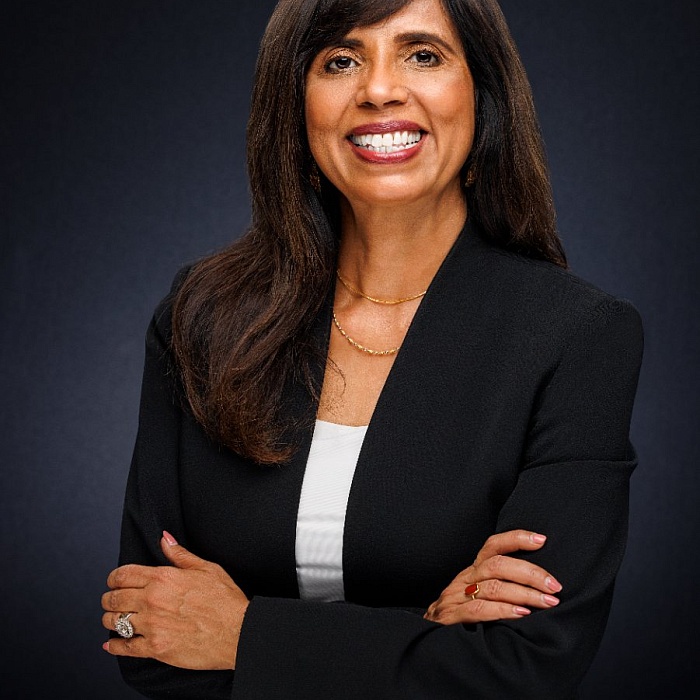
“Gandhi showed that the law of nonviolence was for all times -- truth-force and soul-force are the most potent forces for change ever discovered,” says Dr. Veena Howard, a distinguished scholar, author, and speaker specializing in nonviolence, Gandhian philosophy, and Indian religious traditions. For her, this is no abstraction. Her own family were refugees of the 1947 Partition of India -- they lost nearly everything, and somehow passed on not bitterness, but grace.
Veena’s parents were given three hours’ notice to leave their home. They walked for weeks in the heat -- her mother carrying her eldest brother, six months old, in her lap -- before crossing the border into India. They left behind their house, their business, their entire world. “Not all stories of India’s independence were romantic,” she has said. “There was a great deal of pain and suffering.” Yet what her family passed down was something else: “My grandmother, uncles, dad, and mom used to tell me stories of their exodus, homelessness, and humiliating life in the refugee camps -- but I don’t remember there being any bitterness in their hearts.”
Veena is Professor of Asian Religious Traditions at California State University, Fresno and founding director of the M.K. Gandhi Center: Inner Peace and Sarvodaya. “My healing comes through my studying and teaching,” she has said -- a striking admission that for her, the library and the classroom are also places of repair, where students encounter Gandhi’s principles not as historical artifacts but as living provocations.
Her landmark book, Gandhi’s Ascetic Activism: Renunciation and Social Action (2013), sheds new light on how Gandhi’s fasting, radical simplicity, and voluntary poverty -- long seen as personal piety -- were also a powerful tool for social transformation. He had not retreated from the world through renunciation -- he had found in it his most powerful political weapon. Surrendering things, done publicly and with total conviction, could move millions.
Few scholars of Gandhi’s nonviolence also belong to a living mystical lineage. Veena does. The Sant tradition of northern India -- the path of poet-saints who held that the divine is experienced directly within, as inner light and sound -- is her own. She has spent years translating three books from this tradition into English, sitting with ancient words until something essential crosses over. For her, renunciation and non-possessiveness are not scholarly concepts. They are personal ones.
She is deeply passionate about recovering women’s voices within Dharmic traditions -- who led, who taught nonviolence, and whose contributions the historical record has largely left behind. Her Fulbright-Nehru Academic and Professional Excellence Award recognized this strand of her research: a project titled “Embodying the Jain Ideals of Heroism and Freedom,” examining how figures like Shrimad Rajchandra, Virchand Gandhi, and Mridula Sarabhai wove gender equity and nonviolence together in the late 19th and early 20th centuries -- a dimension of the tradition that scholarship is only beginning to recover. She has served on various boards, including the Board of Trustees of the Parliament of the World’s Religions, and has spoken at numerous national and international conferences.
Join us as Rajni Bakshi -- herself a lifelong chronicler of Gandhi's living legacy -- hosts a conversation with Dr. Veena Howard, a rare scholar for whom renunciation, nonviolence, and inner practice are not subjects of study. They are a way of life.
Related Calls

Jerry White
Oct 23, 2021
Entrepreneurship, Inner-preneurship and Transpreneurship
Lobsang Phuntsok
May 30, 2026
Re-inviting the Uninvited Guests of the Universe

Miki Kashtan
Dec 15, 2018
Vulnerability, Shedding Excess, and Communicating Our Needs