Cortland Dahl
From Himalayan Caves To Brain Labs: Lessons in Human Flourishing
Awakin Call · Editorial Reflection
The Treasure Already in Your Pocket
A conversation with Cortland Dahl, contemplative scientist at the Center for Healthy Minds, UW-Madison, co-founder of Tergar International, and co-author of Born to Flourish
There is a story Cortland Dahl tells about himself as a teenager: wound so tight by social anxiety that he fainted in front of his entire high school during a public speech. His mother had to walk up on stage and collect him. He has since spoken to thousands of people across the world, led meditation retreats on multiple continents, and translated twelve volumes of Tibetan meditation manuals. He calls that mortifying moment a blessing in disguise. He means it with complete sincerity — and, by now, with something approaching scientific precision.
In This Reflection
- The Stories He Carries
- What the Science Is Showing
- What Lies Beyond the Research
I. The Stories He Carries
Cortland Dahl thinks in stories. These are the ones he told in this conversation — each one a small proof of something he couldn't have argued directly.
The Phase Changer — On How Our Wounds Become Our Path
Before he was a neuroscientist or a Tibetan translator or a meditation teacher, Dahl was the kid his friends made fun of -- the one who would discover a new obsession, read everything about it, evangelize loudly, and then, two months later, move on to the next thing. "What phase is Cort in these days?" they'd ask. He was also, simultaneously, wound tight with social anxiety. Introverted, easily overwhelmed by groups, even groups of people he loved. Every person added to a gathering was another increment of stress. He fainted at a school speech. His mother came onto the stage. He describes this now as a "deficit of coolness" from which he never quite recovered -- and without which, he is certain, he would never have stumbled onto the thing that has defined his life.
The Hermit Who Never Said "Mindfulness" — Because The Door Is Not the House

Menka Sanghvi asked Dahl whether the science of meditation had deepened his practice or somehow explained it away -- whether the neuroscience lens had taken anything from the experiential one. His answer began not with data but with a memory. When he first arrived in Nepal and India to live in Tibetan refugee settlements, he had been doing mindfulness practice -- breath, body, awareness -- for years. He assumed that was what meditation was. His first teacher there had spent forty years living in caves in the Himalayas, a renowned hermit yogi, reclusive, wandering. A remarkable human being. And Dahl noticed, over time, that he didn't think this man ever used the word "mindfulness." What he talked about, constantly, was compassion. And wisdom. Those two words. Especially compassion -- not as a mood, but as a motivation, a fundamental aspiration: to help all beings awaken. Dahl came to see that the mindfulness he'd been practicing was a door, not the house. The house was something else entirely.
The Soldier in the Air — Grounding Our Insights
A listener asked whether it was possible to reach gamma oscillation states -- sustained, self-induced insight -- without years of formal training. Could someone simply never have lost it from childhood? Could it arrive by accident? Dahl answered from both science (we genuinely don't know) and from a story. A good friend of his was in the Vietnam War. A mortar shell landed next to him. He flew through the air, shrapnel through his midsection, serious injuries -- and in that moment of flight, he had an experience of pure awareness. Unbounded. The kind the gamma oscillation research would later try to document in advanced meditators. For a decade after returning home, this man tried to understand what had happened to him. It had completely reshaped his life. But he had no framework for it, no one to talk to about it, no way back in. He eventually found his way to Tergar, Dahl's meditation community. That gave him the context -- not to have the experience again, but to understand what it was, to nurture it, to recognize it when it came. The insight had arrived. The container came later.
The Girl in the Remote Village — On Whether Awakening Can Arrive Before Training Does
The same question -- can insight come spontaneously, without formal practice? -- led Dahl to a second story, this one much older. A few weeks before this conversation, he was in Kathmandu with a group of scientists, at the invitation of the Dalai Lama, to spend time with Khandro Kunga Bhuma -- known simply as Kandrola -- one of the great living masters of the Tibetan tradition. Normally, Tibetan lamas do not speak openly about their inner experience. There is a kind of taboo: you discuss it only with your teacher, or perhaps your closest spiritual friends. But Kandrola spoke openly, at the Dalai Lama's invitation. She described being four, five, six years old -- living in an extremely remote, rural area of Tibet, no formal education, no meditation training -- and having experiences of extraordinary insight. Visionary, clear, profound. Years later, she did long retreats and studied personally under the Dalai Lama. Much of that, she said, was simply confirming what had arrived in her as a tiny girl, unbidden, in a village at the edge of the known world.
The Child Who Asked About Buddha Nature — On Reflecting Wholeness Back to Someone Who Doesn't Know They Have It
When his son was born, Dahl was living in Nepal, deep in years of retreat. Suddenly he had a baby. The meditation schedule evaporated. What remained was the dailiness of care. For about three years, he put his son down for almost every nap he ever took -- and he used those moments as a practice, a quiet love-practice, sitting with the child as he fell asleep. At night, after reading a story, he would sit at the end of his son's bed and meditate, breathing audibly. His son would sometimes sync his own breathing with his father's without being told. Dahl would say little prayers out loud, in kid language. One night he said the term "Buddha nature" -- the Buddhist idea that each being has a pure, essential inner nature -- and his son popped his head up. "What is Buddha nature?" Dahl said something like: that means you are already a Buddha. That's who you are. His son rolled and giggled with a kind of unbridled joy. "I'll never forget that," Dahl said. "What a gift it is, to just reflect out to another person: you're good, and I see that in you."
II. What the Science Is Showing
Dahl is a scientist by training and a contemplative by decades of practice. When he speaks about research, he is describing something he has lived from both sides. These are the findings he shared -- striking enough that his own team was, in his word, "shocked."
Teachers Change Students Without Touching Them
In a series of education studies, teachers received simple skill training -- a few minutes a day, for a few weeks, using the Healthy Minds Program app. No intervention was given to students. Not a word about students appeared in the teacher training materials. Six months later, the standardized test scores of students in trained teachers' classrooms were measurably higher than those of students whose teachers had received no training. The ripple required no instruction. The teachers simply carried something differently into the room.
Patients Get Better When Their Doctors Do
In a large-scale randomized controlled trial conducted across hundreds of hospitals in Mexico, healthcare providers received similar training. Patient mortality rates decreased. Discharge rates improved. Under normal circumstances these two metrics move in opposite directions: when hospitals become more efficient, quality of care tends to drop. That both improved simultaneously is, in Dahl's description, "quite rare as a signal." The patients received no intervention at all. The research is currently under review for publication, with Matt Hirschberg as lead author at the Center for Healthy Minds.
Good Intentions Prime the Body to Act
When people practice appreciation or compassion intentionally -- even for a brief moment -- the premotor cortex activates. This is the region of the brain associated with physical action, not just pleasant feeling. What this means, Dahl suggested, is that cultivating the inner space of service is not merely generating warmth. It is priming the nervous system to actually move, to respond, to help -- when and if a moment of need arises. The practice is not decorative. It is preparatory.
Advanced Meditators Can Sustain the Unimaginable
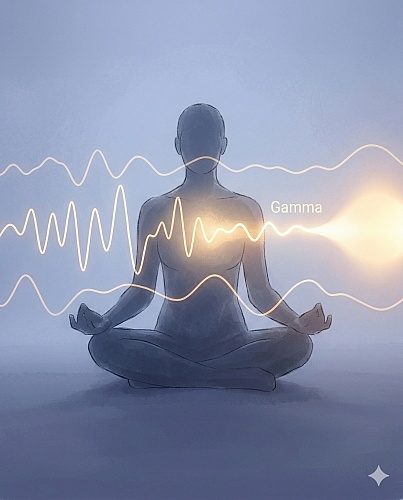 In one of the most seminal studies in contemplative neuroscience, a small group of very advanced meditators -- including Mingyur Rinpoche and Matthieu Ricard, people averaging around 30,000 hours of practice -- were placed in brain scanners and asked to practice non-referential compassion: a state of pure, non-dual consciousness, where self and other dissolve and what remains is boundless care without subject or object. What the researchers found was gamma oscillations -- high-frequency brain activity normally associated with brief flashes of insight -- that these meditators could voluntarily induce and, more remarkably, sustain. This had never been documented. A normal gamma spike lasts a fraction of a second: the neural signature of "aha." These practitioners could rest in it. Dahl was himself a research subject in early versions of this work, before he became a researcher.
"Imagine if you could induce an epiphany like that, and actually sustain it. You could just rest in that epiphany for as long as you wanted. That's basically what they were showing in this study."
— Cortland Dahl
Active Practice Works as Well as Sitting Meditation
One of the more practically useful findings from the Healthy Minds research: at least in the early months of practice, people who do meditation skills as active practices -- woven into commuting, walking, caregiving, any ordinary activity -- show comparable benefits to those who sit formally. The sitting matters. The retreat matters. But the door is wide open for people who can't, won't, or aren't yet ready to sit.
Brain States Become Brain Traits
Every intentional act changes the brain's functional state in the moment -- clench your fist and your neural constellation shifts. The question is how a transient state becomes an enduring trait, a new baseline rather than a passing flicker. The mechanism is neuroplasticity: repeat the induced state often enough, and the brain encodes it. What was effortful becomes default. What required programming eventually just happens. This is, Dahl suggested, how meditation works at its most fundamental level -- and also how belief systems, which feel fixed, are actually far more malleable than we assume.
III. What Lies Beyond the Research
Some of what Dahl said cannot be reduced to a finding. It lives in a different register — in the space where science becomes honest about its own limits, where ancient teaching meets lived understanding, and where the most important things are the ones that open more questions rather than closing them.
The Mystery Is the Motivation
What drives Dahl is not the answers his lab has found. It is the questions the answers keep opening. He describes every research finding as generating a hundred new uncertainties, and speaks about this with something that sounds less like frustration than reverence. He and Davidson had been talking just the day before about dopamine -- a molecule we have collectively reduced to a bumper sticker -- and what the actual science reveals is an almost incomprehensibly complex web of interdependence. We want the simple story. Reality refuses to give it. "It gets more mysterious the further you go," he said. For Dahl, this is the point. The awe is not a by-product of the science. It is the engine.
Nobody Has Solved Consciousness. Not Even Close.
On the question of whether the brain produces consciousness, Dahl was direct in a way that scientists rarely are: there is not a shred of evidence that anyone has ever shown how this happens, nor any theory that is even widely accepted, let alone proven. The best minds on the planet have been working on this for a very long time and have come up empty. He calls this, simply, "scientific dogma" -- a default assumption held in place not by evidence but by convention, which forecloses other hypotheses that deserve serious attention. What if consciousness is fundamental rather than produced? What if brain and awareness are inextricable rather than one generating the other? These are not fringe ideas. They are just not fashionable. They need to be taken seriously, he said, and they are not.
"There is not a shred of evidence that anybody has ever found, nor a theory that anybody widely accepts, that shows how the brain produces consciousness. None. We're not even close."
— Cortland Dahl
Awareness Was Never Absent
 In Tibetan, there is a word: rangrik. Intrinsic awareness. Self-illuminating, like a candle flame that lights everything around it and also lights itself -- you don't need another source of light to see the flame. Dahl uses this as the foundation of everything he teaches. Awareness is not something you cultivate. It is always present. Even in deep dreamless sleep. Even in the most scattered distraction. Even in the middle of a reactive emotional storm. The proof is simple: if someone woke you at any of those moments and asked what was just happening, you could report on your experience. That reporting capacity is awareness. It never left. What meditation does is not create awareness -- it brings an already-present knowing into focus. The treasure was always in your pocket. You just hadn't looked.
You Are Not Broken. This Is Not Self-Improvement.
Perhaps the most quietly radical thing Dahl said, repeated in different forms throughout the conversation, is this: the four qualities his framework identifies -- awareness, connection, insight, purpose -- are not things you need to acquire. They are innate capacities that are already present and simply need to be recognized. The difference between acquisition and recognition is not semantic. It changes everything. If you approach practice as fixing a deficit, you are starting from a false premise. You will exhaust yourself trying to add something to a self that, at its most essential level, was never lacking anything. The practice is discovery. Exploration. Coming into focus. "It's almost like you're bringing things into focus," he said, "not like, I don't have enough of this."
The Voice of Should Is Just Conditioning
Every major decision point in Dahl's life involved a choice between what he felt he should do -- the socially acceptable answer, the sensible path, the thing with a legible justification -- and something quieter that simply felt right without being able to explain itself. He consistently chose the quieter thing. What helped him, over time, was not suppressing the "should" voice but seeing it clearly. Not fighting it, not obeying it -- just watching it. "Oh yeah, there's that voice." And recognizing it for what it is: conditioning. Biological, familial, societal, sometimes all three at once. The voice is not your compass. Seeing it clearly is.
Flourishing Is Not Happiness
With the world as it is, Dahl was asked what it means to have titled a book Born to Flourish. Is it defiance? Is it faith? His answer was precise. Flourishing is not a peak emotional state. It is not a mood to maintain. It does not mean that, coming home to Minneapolis in the middle of ICE raids and community grief, the appropriate response is happiness. The appropriate response is presence. Connection rather than contraction. Insight rather than reactivity. Purpose as a steady thread. Flourishing, in the framework he and Davidson have built, is the question: what does it look like to be at your best -- not in your best moment, but in any moment, including the worst ones? What common qualities show up across people who seem genuinely human, genuinely engaged, genuinely alive to what is happening? Those qualities, it turns out, are trainable. That is either an act of defiance or an act of faith, depending on the day.
Only a Buddha Understands Interdependence. The Rest of Us Just Trust It.
Near the end of the conversation, someone asked what gives Dahl faith when the scale of the world's problems makes individual practice feel inadequate -- too slow, too small, too quiet against what is actually happening. His answer had a Taoist quality. Nature is nature. It will do what it does, and the better move is to align with it rather than fight it. We are biologically wired for interconnectedness. Our brains are social brains. The ripple is not a metaphor -- it is how systems actually function. But we cannot track it. We cannot map it. In Buddhism, he said, they teach that only a Buddha can actually understand the full scope of interdependence, because the web is just that complex. For everyone else, the practice is to anchor in the intention -- the wish to be of service, the motivation of care -- and then let go of the outcome. Not passively. Fully engaged, working hard, showing up, sometimes protesting in the streets. But not controlling. Not knowing in advance what form the good will take. Just trusting that, because we are so deeply interdependent, the effect will happen. We simply cannot predict how.
"We have a total blind spot for what isn't broken. And there is so much that is not broken. At the most essential level of who we are — individually and collectively — it's not broken at all."
— Cortland Dahl
See What Isn't Broken
 Toward the very end of the conversation, in the backstage circle, Dahl said something that seemed to gather everything else together. Those working on the world's hardest problems -- burnout is rampant among them, not because they care too little but because they have trained themselves to see only what is broken. The problems are real. The brokenness is real. But there is a symmetrical blind spot: we almost never practice seeing what is whole. And at the most essential level -- beneath the surface fractures, beneath the cruelty and the failures -- something is not broken, and never has been. In people. In the world. In us. When we practice touching that -- not pretending the brokenness isn't there, but refusing to let it be the only thing we see -- we stop working from empty. We start working from full. And that, Dahl suggested, changes not just how much we can give but what we are actually giving when we do.
The moderator, Menka Sanghvi, ended the formal conversation by saying she just really wanted to go and meditate. It was the most honest conclusion available. Cortland Dahl, for his part, said he was just a conduit -- his job is to be a good translator, to hold open the door between wisdom traditions and the modern world. But the door he's holding open is not to something foreign. It is to something already present in anyone who walks through it. The treasure was always in your pocket. The practice is just learning to look.
Words Worth Sitting With
"It gets more mysterious the further you go. Every time you learn one thing, you open up a hundred new questions. That's somehow how science works — it doesn't lead to certainty."
— On what actually drives contemplative research
"It's almost like you're bringing things into focus — not like, I don't have enough of this, and I need to get better at it. These are innate capacities. The practice is discovery, not improvement."
— On awareness, connection, insight, and purpose as recognition rather than acquisition
"We have a total blind spot for what isn't broken. And at the most essential level of who we are — individually and collectively — it's not broken at all. There's so much beauty, and there's so much richness. When we tune into that, it gives us the energy and the motivation and the clear seeing so that we can engage the problems — but feeling full rather than empty."
— On what sustains those doing the world's hardest work
Cortland Dahl is a contemplative scientist at the Center for Healthy Minds at UW-Madison, co-founder of Tergar International, and co-author (with Richard Davidson) of Born to Flourish. He is co-host of the Dharma Lab podcast and Substack. The Healthy Minds Program app is free and available on all app stores.
This Awakin Call was moderated by Menka Sanghvi and hosted by Mark Foley. Produced for awakin.org by the ServiceSpace editorial team.
Want the full experience?
Listen to the complete conversation with Cortland Dahl.