Call Nuggets
Demetrio J. Aguila, III
A Surgeon's Compassionate Pricing & Rekindling of Volunteerism
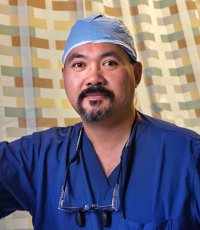 Last Saturday, we had the privilege of hosting Awakin Call with Demetrio J. Aguila, III.
A surgeon in Nebraska, Demetrio Aguila, MD, has drawn patients from 34 states, 6 countries, and 4 continents not only for his innovative, life-changing surgeries for people with chronic pain, but also for the compassionate payment option he offers: in lieu of dollars, patients can donate community service hours. So if a patient needs surgery with an insurance fee of $5,000, a donation of 250 hours of community service can cover the cost -- and the volunteer hours can be crowd-"funded" to boot. “In my heart of hearts,” says Aguila, who served for over 20 years in medical missions for the US Air Force, “I had this hope that we would rekindle in our neighbors, and in ourselves, a sense of volunteerism.” His vision is to offer “world-class health care to all comers in a way that’s compassionate, innovative, forward-thinking, affordable, and fair.” He has been pursuing an MA in Theology for the past 4 years.
Below are some of the nuggets from the call that stood out for me ...
Formative Experiences, Family Culture
“It all started with my parents. I owe them everything.” Aguila is the son of Filipino immigrants to the US, having lived in the midwest and upstate New York. Although there were challenges to navigating two very different cultures, Aguila finds himself “the beneficiary of two cultures.” The Filipino culture influenced his thoughts, prayers, and dreams; there is a hierarchy of need, a hierarchy of authority. This provided Aguila with a sense of order to the world, “providing me with a security and a context by which to understand the love of my parents and the love of God.”
His parents were devout Catholics and the weekly masses they attended were steeped in Scripture. Aguila always felt those words at the forefront of his heart and mind.
On Work Ethic, Inspired by Family and Faith
Aguila’s father was a family practice doctor who worked extremely long hours, often from 5 AM to midnight. But "the one thing that stands out more than anything is that no matter how hard he worked, it was never a burden, never once did he appear to be saddled with distress over what he was doing. It was always a labor of love." “It was always a labor of love.” The concept of “sacrifice out of joy” was a guiding principle that permeated his whole house. His mother had the same sense of joyful giving, as did his extended family, the priests at the church. “Whatever I do [when I grow up],” Aguila remarked, “I want that joy, that mission, that sense of meaning and purpose.”
Aguila recalled that when was in grade school, he presented a report card to his father. His teachers had told him his A’s and B’s were achievements to be proud of. But his father told him this wasn’t good enough, wrapping it in the context of a parable in the Bible about how different people are given different amounts of talents [privilege]; depending on how many talents they were given, they had to make use of them to the best of their abilities. His father emphasized that Aguila had been given many talents, "so you’re supposed to live out and multiply these talents.”
A Moment of Clarity: the M25 Program
M25, the compassionate pricing program Aguila founded, is a reference to Matthew 25, a chapter in the gospel citing Jesus’s words, “These things that you did for the least of my brothers, you did for me. Welcome to the joy of your master’s house.”
The backdrop: for 20 years, Aguila had served as a surgeon in the US military, providing care to military members and their families. During his last deployment in 2007, which was to Afghanistan, 95% of his 300 surgeries was humanitarian work on civilians. While there, he kept thinking, “If I could just take the work that I do here and transplant this practice back in the United States, that would be awesome.” It was a fulfilling mission. And since that time, he has been asking, “How can I do that medical mission work again?” “How do we serve the poor here in the US?”
He thought of these as two separate questions, in the back of his mind "playing one of those little games, like so many other people do well -- which is to ask -- what I will do when I win the lottery? The answer was that I'm going to set up one clinic to take care of people who are underserved. I'm also going to spend some of that money going and traveling to different places to help people like we did in Afghanistan. As I was praying one night in church rather fervently, it was as though God just punched me right between the eyes and he said, 'okay, now is the time; here is the answer.'"
The idea of M25 came to Aguila in an epiphany, as a fully formed concept and in detail, when he was deep in prayer at church one day. “I didn’t hear an audible voice, but I might as well have." The concept of M25 came in its entirety, like a Happy Meal, not a recipe for which he had to gather the ingredients himself. "It wasn't a partial idea or a clue which I needed to tweak or make additions to. ... It was 'here's everything you need to run with it.' In that moment I knew that this is what I have to do. My life changed at that moment. I realized I needed to change my practice structure. I need to figure out how we are going to implement this idea. I knew what the core was, the heart and soul of the practice. And I said -- let's build it, and let's follow the mission."
Compassionate Pricing: Medical Mission Work At Home
Healing Hands of Nebraska, the clinic Aguila founded, has transparent pricing. They don’t contract with insurance, so patients know upfront exactly what the cost of their procedures are. They also are able to keep their overhead and prices down without all the administrative costs of handling insurance claims.
ServiceSpace has long highlighted different forms of capital or wealth, in addition to financial capital — social, intellectual, cultural, and human capital. How or why did Aguila choose volunteerism? "There was always this sense of volunteerism that surrounded me. I also found that it was very fulfilling for me to spend some of my time helping others without expecting anything in particular in return. Just the satisfaction of knowing that I had done it was wonderful. But it wasn't until I was much older that I realized that when you do that you're actually making an investment. In those people that you're helping. While you may not realize it and the people who you are investing in may also not realize that, the fruits of those investments will blossom if given the right circumstances."
Also, Aguila remarked that in America, people don’t often value something that’s offered for free. So the issue, he felt, isn’t just about money. The issue is, “How do we get patients to invest in themselves?” So asking patients to put something in was important. "The patient is on some level thinking to him/herself that they just volunteered 400 hours of my time to get this surgery, and better not to mess this up because I'm going to have to volunteer more time in order to get it fixed. So patients, we've found, are much more likely to follow all their postoperative instructions and do what needs to be done so that they can make sure that their investment is not wasted. Then on top of that, the charity that the patient has volunteered with has benefited from their work. The community, which the charity serves, has benefited from this person's work. And that patient, no matter how poor he or she is, has seen that somebody else out there is worse off and they have helped that person. So what does that do for them? Patient's dignity. What's that do for the patient's self worth? What does that do for their self-esteem? I mean it goes through the roof."
M25 partners with local nonprofit organizations in Nebraska, like The Least of My Brethren in Omaha, that helps get homeless persons back on their feet.
M25 works like this:
- The patient needs surgery or health care.
- They are offered the surgery on a standard fee-for-service basis, and also offered another pricing model. Instead of dollars, they can pay for the surgery with community service hours. This is a proprietary formula that one of Aguila’s gifted staff devised, calculating the monetary cost for various surgeries as well as how many volunteer hours they would translate to (“Think of it like an exchange rate”).
- For example, if a patient needs surgery that costs x dollars, he might need to donate 250 hours of community service to pay for the surgery.
- The patient can invite friends and family to contribute to his / her total volunteer hours, too.
- Aguila sees patients following through with their post-operative care in high percentages because they have already been investing in their own health.
- Patients have also reclaimed their own dignity in serving others who are less fortunate than they, thus beginning the deeper work of healing.
- The surgical team, in turn, sees that they invested in patients because the patients invested in themselves; and that they were able to make good on their core mission without having to travel far away from their families.
Aguila intended initially that roughly 10% of patients might opt for M25, with 90% paying fee-for-service. But he had no idea, and ultimately had to trust. Aguila has approached it like a tithing program (the call in the Bible to give 10% of your possessions). His goal is to be able to flip the ratios around. To that end, he has applied for nonprofit status to be able to accept the many donations people have been wanting to make to M25.
Working outside the insurance model, Aguila has experienced great freedom and flexibility. For example, a small business owner who couldn’t afford the cost or the community service time paid with gift certificates from his business. A rancher paid with a cow.
“The essence of what we do is to restore hope to the hopeless.”
Scaling Up, Lighting a Fire, and a Call to Doctors
Aguila feels the greatest barrier to other doctors doing something similar is fear. Doctors, he said, have forgotten our original calling. “I say this out of love,” he said. Doctors are one of the smartest groups of people, but they’re afraid of trying something different or to think outside the box. The answer to this fear is love.
Aguila is just one person. His hope is to allow this model to replicate well beyond him.
Speaking to those in health care: “If you give yourself the freedom and the opportunity to really spread your wings and use that creative mind of yours that helped you get through medical school and residency and possibly fellowship, then you can do something in your community which is just as revolutionary, if not more so.”
"Because we've grown accustomed to doing things in the way that we've been told, we're no longer accustomed to facing those kinds of odds [of entering and completing medical school] again and just say, 'you know what? Get out of the way. This is where I'm going. You can help me, or you can move, but this is where I'm going.' If we can recapture, rekindle that fire that we had when we were applying to medical school and applying to residency, if we could apply that to the challenges we face today, I am confident that physicians all around the country and all around the world would deliver healthcare in a way that's more affordable, that's more accessible, and that is higher quality than what we do today."
A Divine Mission
"I take comfort in knowing that this isn't my mission. I didn't come up with this on my own. I didn't say, 'ok, look at how brilliant I am. I am going to come up with this idea.' The fact that this is a mission that was given to me by God tells me, 'You know what? Lord, if you want this to happen, then you got to make it happen. I'm here. Just point me in the right direction and squeeze the trigger. I'm going to do what it is ... I'm going to carry out the mission you've given me, but this is your mission. You got to make sure that I have the tools that I need to ensure it, and the opportunities and everything else.'"
"I find myself praying throughout the entire day. I mean, you know, there's probably not more than 10 minutes that goes by without me saying at least a little prayer. There's that ongoing conversation that I have with God that helps me to be open to the promptings of the Holy Spirit and to be open to the mission that God has for me. He has a mission for all of us, but often it's difficult for us to discern what that is because we allow the world around us to distract us."
"You know, the things that I do, I do because I have to, because there's that drive that again, as you mentioned, there's that fire. If I don't do that, then there's a hole. There's an emptiness there that calls for my attention, and it's God that put that hole there. That's the desire He has for us to seek Him out in all of these different avenues. And He says: 'here I am, I'm waiting for you. Here are my love letters. I'm calling to you. I want you to come find me. And if you're not going to find me this way, I'm going to show you another pathway over here. So you can find me that way.' And what we find is that as we start to seek out the mission that He's given us, it's that mission that leads us to Him. And so if we're open to saying, 'okay, that's the mission? Yes, it's scary. But I can tell that's where you're calling me. Let me follow that. Let me go where that's leading me.' And that's where the fire comes over. The fire comes from following that call, listening to it, hearing it and then saying, 'okay, this is scary, but I'm just going to jump in and do it.'”
"There's that old saying, 'a rising tide raises all ships.' So if I do better here, that should help me over here too. If I have the right foundation, if I recognize that I'm not the one that's raising that tide, I just happen to be the beneficiary of that. In my life, I'm not the one doing all these things in a sense. I'm enabling it because there's something greater, which wants those things to happen. More often than not, I'm just standing in the way. And so what do I do? I just say, 'okay, God, you want this to happen? I'm going to open the flood gates. You make it happen.' That's the part that we're often intimidated by. Well, if I opened the floodgates, then there might be a crack in the dam. God is smart enough to fix that crack."
How the M25 Program Changed Dr. Aguila
"It's been inspiring to see that when given the opportunity, that human beings will give their hearts to help their fellow human beings. We just have to give them a mechanism to do it." A spark of hope which he hadn’t expected was witnessing how readily human beings want to serve their fellow human beings if given a framework for it. "Our core, the essence of what we do is to restore hope to the hopeless and the M25 program is a big part of that."
"The M25 Program and all that it involves and everything that's built around it is about fairness at the end of the day. We're acknowledging that the patient's time is worth something. We're acknowledging that my time is worth something. That we find a way where we can all come together and help each other."
How to Support Dr. Aguila and His Work
Dr. Aguila said with clarity, “I would ask you to do three things: number one, first and foremost, is pray. For those of you who do it, pray in whatever form that you do it. If you don’t pray, I would invite you to try it. Second, share this story, tell the world, not because I want them to know what I’m doing, but because it leads to the third thing. It inspires others to throw away fear and to do the hard things. Do something crazy. Do something outside the box. And trust that you were put here for a reason.”
Lots of gratitude to all the behind-the-scenes volunteers that made this call happen!
--Cynthia Li
Want the full experience?
Listen to the complete conversation with Demetrio J. Aguila, III.