Using Attention in a New Way
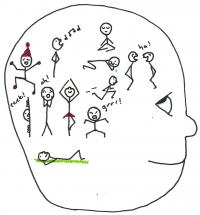
Image of the Week
Image of the Week

One of the things we are trying to do here, is learn to pay attention to seeing what complicates our attention -- where we get caught, what makes it difficult. Because the place we get caught is also the place where we are going to feel stress.  The place we get hung up is often a very important window into understanding how we are most likely to suffer, or how we are more likely to cause problems in our life.

So we start by paying attention, which we all have the capacity to do. Yet when we get interested in this practice, how is it that our ability to stay calmly connected to the present moment gets somehow disrupted?  People who meditate will sometimes think that the disruption is the problem. Disruption sounds like a bad word: "I got disrupted." I got caught. When we do this meditation practice, we try to not judge anything as being bad or inappropriate. Rather we try to fold everything back into the attention. In other words, to notice this. Pay attention. What’s going on. Notice this, notice this. “Ah, I just got caught. I heard someone cough, and it reminded me that my friend was sick, and I wondered if I should visit my friend in the hospital, and I wonder how late Kaiser is open, and then I notice, "I'm teaching a class…oh!" So, it’s an example of getting pulled in. It was an innocent example, but it could also not be so innocent.  Rather than saying that I shouldn’t have had that train of thought, what we try to do is fold everything back into the attention. "Oh, look at that, that’s what a disruption is like. That’s what it’s like for the mind to get hooked, get carried away. That’s what it’s like. That’s what it’s like."

Do you understand that principle? It is a really important one. Sometimes, people who have been meditating for 10 years haven’t learned this one yet. Haven’t learned that there’s nothing that doesn’t need to happen. There’s nothing that you should say "that shouldn’t happen". Rather, it’s one more thing to learn to pay attention to. And if you learn to pay attention well, there is freedom to be found in attention.  In paying attention, there is a way of doing it where you are not caught, trapped, oppressed, influenced, or driven by what’s going on, inside or outside yourself. And that gives you a tremendous power to go about your life. If you have the ability not to be pushed around by your inner compulsions or the pressures from the outside. We learn this by learning how to use the attention in a new way. 

--Gill Fronsdal

Seed Questions for Reflection

What do you understand by "folding everything back into the attention?" How do you develop the ability to not beat yourself up for lapses, and instead constructively move forward? Can you share a personal story where this principle has played an important role in your life?

Moved by this reading? Join a live Awakin Circle to discuss in community.
Join this week
More ways to connect

Add Your Reflection

15 Past Reflections
JO
Jan O'Han
Jul 14, 2015

 Our culture in the US is steeped in "good and bad", black and white - not race but solid opinions with no grey areas, judging everything all the time, so even in meditation the tendency will come up to judge the experience. It's helpful to become un-opinionated I have found, even though I may be judged for that! I love the idea however of folding the thoughts back into attention so that I can learn from them by paying attention rather than supressing or ignoring. With gratitude.


MI
Michael
Feb 1, 2013
 It's kinda funny to think of this as a 'New Way' with something that's been around for thousands of years; and it's still all good. Another interesting 'trick' is to ask your self "Who's having these thoughts?" This can lead us deeper and behind the surface distractions.
A
Jan 19, 2013
 Yesterday, was "whisper, 'I love you' day" (heard it on the radio).  I missed it by 27 minutes, but wish to have you "fold into your attention" that YOU are very much loved!  Distractions are VERY healthy . . . they help us to meditate on people/things/thoughts outside ourselves.  I think God built distractions into our 'lives of meditation' to add interest/ to take us "off our normal" course for a time.  ilu  
LU
Jan 17, 2013
I agree with the point that several people who have meditated for years may not have learned this. This does opens my mind to look at what patterns of behaviour, emotions or situations hook / disrupt my attention. What are those situations / thoughts which make me lose my peace of mind or self control? If I am able to see those and learn to handle them with more insight and observation,that shall resolve several awareness problems and cause permanent, positive change in attitude.
NS
Jan 15, 2013
 Its most simple ,and hardest thing just live in present moment ,and when reacting be vigilant .whatever it is we are facing it will pass.remember we are not  mind or intlect ,we are user of this brain.always love navinchandra
BP
Jan 15, 2013
Building the mental muscle of directing our attention is really strengthening and bringing forth our intention, enabling us to maintain our intentions in the face of whatever occurs, whether external or internal, that would otherwise take us out.  Leading a life with intentions remaining present, thereby generating and realizing possibilities consistent with those intentions is living life powerfully.  What this takes is persistent practice of a life-fitness program, like meditating, with coaching to keep us on the path and get us over the bumps along the way.
JC
James Cowey
Jan 15, 2013
Meditation doesn't help if your land and house are being napalmed by by US B52 bombers from above, as happened in Vietnam. Or could it? when you fight back, staying focussed in the now and not getting hung up on past failures will allow you to win. When you fight back, accepting reality for what it is (i.e. I might very well die) and simply doing what needs to be done in each moment with no expectation of success will allow you to win, at least within your mind if not physically. Once you commit your life to a cause then even death cannot scare you, and thus you are easily able to enter the now without worrying about the future.
NA
Jan 14, 2013
Updated ...  What do you understand by "folding everything back into the attention?"  Folding everything into attention means, a macro view of life that includes all things around us including our own ego (thought-patterns) and emotions. This is ‘Sakshitva’. Sakshitva is a background process or a habit of silently witnessing of our own mind and emotions without analysis.’ It is a  macro perspective on life, as is . This helps us share our joys and sorrows with others, and reduces stress and increases happiness. The other choice would be a micro view of life that is ego-centered, where everything revolves around our likes and dislikes. This makes us more reactive and less sensitive to others. How do you develop the ability to not beat yourself up for lapses, and instead constructively move forward? If we have a macro perspective on life, we will be grateful for our blessings. We will also be less critical of others and ourselves. We notice that... View full comment
GN
G Narayana
Jan 14, 2013
 When we restrict something or restrain somebody, the reaction is aggressive.  Let the natural flow of thoughts be through our conscious mind and slowly the come and drift away and by being conscious of distractions, we drift off into that blissful state where we experience the inner peace.
NA
Jan 13, 2013
 What do you understand by "folding everything back into the attention?"  Folding everything into attention means, a macro view of life that includes all things around us, including our own ego (thought-patterns) and emotions. This is ‘Sakshitva’ or a witnessing, macro perspective on life. This helps us share our joys and sorrows with others, and reduces stress and increases happiness. The other choice would be a micro view of life that is ego-centered, where everything revolves around our likes and dislikes. This makes us more reactive and less sensitive to others. How do you develop the ability to not beat yourself up for lapses, and instead constructively move forward? If we have a macro perspective on life, we will be grateful for our blessings. We will also be less critical of ourselves and others. We notice that perfection is inconsistent with change and evolution. We can only do our best with presence of mind and ‘witness’ the result. ... View full comment
DD
Jan 13, 2013
 "Folding everything back into the attention" means an ongoing process of noticing and allowing, allowing and noticing my consciousness.  It is a process of not trying to make anything happen, not manufacturing, not forcing, not inhibiting, not holding on, and simply noticing and allowing.  Deepak Chopra described this meditative mindful process of paying attention as similar to watching the clouds in the sky pass by without getting attached to any cloud, not trying to make anything out of it, not obsessing over it, and simply allow and notice them.  It does happen that I get invested in some cloud, ie, some thought or awareness, or go off into thinking/confabulating/ruminating triggered by some thought or awareness, and when I become aware of that, I hope to have the same attitude of allowing and noticing it, not beat myself up over it, and allow to pass both what I became attached to and my awareness of becoming attached.  I develop ability to not b... View full comment
RA
Jan 11, 2013
The passage really resonated with me. I like the skillful way in which the author treads into the space of attention and its lapses. After reading the passage, I can see that its the "disruptions" where we "get caught" and lose our attention, bringing much suffering into ones life. While I have approached meditation with a very open mind where all and every thought is allowed to come in and nothing is a distraction, I certainly find it more difficult to approach things that way in daily life. Cultivating attention and awareness is a journey and perhaps being more serious about paying attention will help.
CP
Jan 11, 2013
 What I understand by "folding everything back into the attention,  and  how I sometimes do not beat myself up for lapses, and instead constructively move forward is by practicing what Reuters science editor, Sharon Begley, and psychiatrist Schwartz said in one of their books: "Through mindfulness you can stand outside your own mind as if you are watching what is happening to another person rather than experiencing it herself… Mindfulness requires direct willful effort, and the ability to forge those practicing it to observe their sensations and thoughts with a calm clarity of an external witness… One views his thoughts, feelings, and expectations much as a scientist views experimental data – – that is, as a natural phenomenon to be noted, investigated, reflected on and learned from.  Viewing one's own inner experience as data allows ( one)  to become, in essence, his own experimental subject."   I do not h... View full comment
CH
Jan 11, 2013
 years back i went to a vipassana retreat in sri lanka, nilambe, a beautiful nature setting, very quiet. after 10 days i left the retreat to visit kandy. i walked down the hill 35 minutes in walking meditation to reach a bus to town. when the bus arrived it was crowded. i hardly could get into the bus. it was hot. i managed after hanging for a while outside the bus, getting more inside. i felt irritated about this condition. after sitting 10 days on my own meditation cushion in peace undisturbed. somebody stepped on my toes, anger arising. how could he do this. we were packed like sardines in a tin, sweating, bad smells. why don't they have more busses? then i got pushed over, poked in my ribs, ok this is enough i started loudly complaining and felt so sorry for myself. the 10 days of practise, peace,  happyness had turned sour quickly.                       i got my l... View full comment
LU
luv4all Apr 3, 2013

 Your honest and detailed sharing was quite useful. It just helps to notice changes in attitude in similar situations over a period of time and I am happy about meditation practice too. Acceptance and surrender are difficult but really let go of creating issues which cause unnecessary disturbance within ourselves.