Living Lessons of Biomimicry
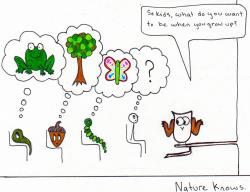
Image of the Week
Image of the Week

Biomimics are men and women who are exploring nature’s masterpieces -- photosynthesis, self-assembly, natural selection, and more–and then copying these designs and manufacturing processes to solve our own problems. I call their quest biomimicry -- the conscious emulation of life’s genius.

In a society accustomed to dominating or “improving” nature, this respectful imitation is a radically new approach, a revolution really. Unlike the Industrial Revolution, the Biomimicry Revolution introduces an era based not on what we can extract from nature, but on what we can learn from her. [...]

When we stare this deeply into nature’s eyes, it takes our breath away, and in a good way, it bursts our bubble. We realize that all our inventions have already appeared in nature in a more elegant form and at a lot less cost to the Planet. Our most clever architectural struts and beams are already featured in lily pads and bamboo stems. Even the wheel, which we always took to be a uniquely human creation, has been found in the tiny rotary motor that propels the flagellum of the world’s most ancient bacteria. [...]

I can’t help but wonder how we will use these new designs and processes. What will make the Biomimicry Revolution any different from the Industrial Revolution? Who’s to say we won’t simply steal nature’s thunder and use it in the ongoing campaign against life?

This is not an idle worry. The last really famous biomimetic invention was the airplane. We flew like a bird for the first time in 1903, and by 1914, we were dropping bombs from the sky.

Perhaps in the end, it will not be a change in technology that will bring us to the biomimetic future, but a change of heart. Our tools are always deployed in the service of some philosophy or ideology. If we are to use our tools in the service of fitting in on Earth, our basic relationship to nature–even the story we tell ourselves about who we are in the universe–has to change. [...]

At the same time that ecological science is showing us the extent of our folly, it is also revealing the pattern of nature’s wisdom reflected in all life. This time we come not to learn about nature so that we might circumvent or control her, but to learn from nature, so that we might fit in, at last and for good, on the Earth from which we sprang.

We have a million questions. How should we grow our food? How should we make our materials? How should we power ourselves, heal ourselves, store what we learn? How should we conduct business in a way that honors the Earth? As we discover what nature already knows, we will remember how it feels be a part of, not apart from, the genius that surrounds us.

Let the living lessons begin.

--Janine Benyus, in Biomimicry: Innovation Inspired by Nature
Moved by this reading? Join a live Awakin Circle to discuss in community.
Join this week
More ways to connect

Add Your Reflection

12 Past Reflections
VA
Mar 23, 2012
Namaste one and all and all in one.  ;)  This passage reminded me of different terms used to describe Nature-- life, love, ecology, interconnection, interdependence, biodiversity/species richness/true wealth (Nature's great university where all unique life forms/species live in harmony and unity).  I think of the word biomimicry as mimicking life (the process, the species, the way life works—ecology).  I have learned so much from Nature (and I feel our true nature mimics that, including how at Wednesday the Mehta/Metta family provides by allowing the abundance to spill forth and share, just how Nature does).  Nature (and children, too!) is the best teacher.  I feel humans as a species (one of the newest on the planet, in terms of the age of our planets and stars) have an ability to get in touch with the rest of life and evolve to a state of interdependence.  We just have been distracted or living life as if we were in a realm separate from t... View full comment
DM
Mar 22, 2012
 "Audio clip from this week's circle of sharing ..."

AU
audrey
Mar 20, 2012
The perfect example of that is Velcro! Those lovely little burrs that get stuck on our socks when we go hiking was the inspiration for a product that not one of us can live without!
KA
Mar 20, 2012
We can learn a lot from the so-called "indigenous people".   We "modern" folks often forget that ;)
KA
Mar 20, 2012
We can learn a lot from the so-called "indigenous people".   We "modern" folks often forget that ;)
KA
Mar 20, 2012
We can learn a lot from the so-called "indigenous people".   We "modern" folks often forget that ;)
EL
Mar 20, 2012
Yes...  Everything starts when the tools of destruction are put down and the seeds of love are sown instead, with that action alone, wisdom is grown..  Wisdom and Food. .. Huh this has blown my mind, since a child I remember that we had a ‘throw your rubbish in the bins campaign’ but we never had a throw your seeds everywhere campaign so it can grow to feed all of us...  That would be great and genius.. However; I almost read this paragraph of Janine Benyus in a laughing ‘paradoxical’ state, as, ecological science is the science we needed to have from the other bio-hazardous, GM sciences we have...  We needed to make a good science – intelligence from the bad we made...  We need to get back to the Earth – Genius – Not at all..   Its almost hilarious though.. We have an amazing universe that saves us from harm, we have a lush earth that can feed, heal and protect us from all the elements, we have no bounda... View full comment
RI
Mar 19, 2012
A main reason we are not a part of the genius that surrounds us is culturally we have been encouraged to have ‘dominion’ over the earth and all its inhabitants, rather than live with the earth and all its inhabitants. We have the power to break away from that view by spending time in nature, appreciating the art and creativity of the universe.  It is in a stillness and an inborn desire to find out how the universe accomplishes all it does with such patience and longsuffering when we begin to discover our place within that setting.  The author refers to the tension between control and learning, which has a lot to do with our confusion as to who we really are-ego and divine.   Frankly this desire for more understanding for me heightened while learning sustainable farming techniques and how interconnected the activities of the soil web were with plant processes (primary decomposers, tertiary decomposers, nitrogen fixers) to nurse plants, plant communi... View full comment
DD
Mar 18, 2012
 An airplane first flew in 1903, and by 1914 we were dropping bombs on people.  That's amazing and sad.  It's exciting that human beings may learn from nature, cooperate with nature, fit into nature, but I'm not optimistic.  Our disrespect for our planet and one another, our greed, our short-sightedness are in high gear.  As the author says, we humans need a change of heart, and we need it now.  It's become crucially important that we see ourselves as of earth, not on earth, as part of earth and not apart from earth.  It's time to work with earth and nature rather than try to fight, control, conquer earth and nature.  It is time to realize that we are Nature, and to work with it and take care of it is to work with and take care of ourselves.   
TH
Mar 18, 2012
 Feeling a part of the genius that surrounds us is really a turning point in a person's evolution. Feeling apart from nature one is bound to mistreat and misuse it, as has been and  is still  generally the case. But the chances for  this  radical shift in consciousness to affect society at large seem low. Unless the passion for technology, which seems to inhabit nearly everyone today, succeeds where reflection and sensitivity have failed to bring the younger generations to want to cooperate rather than subjugate nature.   
CP
Mar 17, 2012
Thanks for the opportunity to respond.  My first impression of the implications of shifting from "apart" to "a part" of the genius that surrounds us, is a reduction or elimination of  conscious desire, and the conscious and unconscious acceptance of what is.   I heard about the value of not desiring when I was in high school but I didn't experience it until about 20 years ago. (Try it for yourself). I still forget it often and I still frequently resist what is by trying to change "it,” but I notice I am most peaceful when I greatly reduce or eliminate desire and accept what is.  Warm and kind regards to everyone. ... View full comment
DE
Mar 17, 2012
Janine I can’t agree with you more that change will have to come from a change in heart, as the heart is the source of all life; the biblical perspective on the same view was modeled by David who prayed in Psalm 51: 10 (as per NIV bible): “: 10) Create in me a pure heart, O God and renew a steadfast spirit within me”. And the Lord answered the Prayer for all people in Ezekiel 11: 19; “I will give them an undivided heart and put a new spirit in them; I will remove from them their hearts of stone and give them a heart of flesh. And the same answer also in Ezekiel 36:25 which was directed to the individual person. 

Thank you Janine Benyus for the lovely peace, I wish everyone could give your views some thought.

Regards,