The Cosmology of Peace
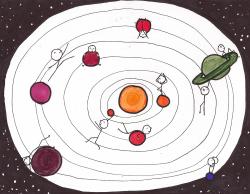
Image of the Week
Image of the Week

 The issue of interhuman tension is secondary to earth-human tensions. If humans will not become functional members of the earth community, how can humans establish functional relationships among themselves? 

It is not exactly the question of whether the nations can survive each other, nor is it even the question of whether intelligent beings can survive the natural forces of the planet; it is whether the planet can survive the intelligence that it has itself brought forth.

My proposal is that the cosmology of peace is presently the basic issue. The human must be seen in its cosmological role just as the cosmos needs to be seen in its human manifestation. This cosmological context has never been more clear than it is now, when everything depends on a creative resolution of our present antagonisms. 

I refer to a creative resolution of antagonisms rather than to peace in deference to the violent aspects of the cosmological process. Phenomenal existence itself seems to be a violent mode of being. Also, there is a general feeling of fullness bordering on decay that is easily associated with peace. Neither violence nor peace in this sense is in accord with the creative transformations through which the more splendid achievements of the universe have taken place. 

As the distinguished anthropologist A.L. Kroeber once indicated: The ideal situation for any individual or any culture is not exactly “bovine placidity.” It is, rather, “the highest state of tension that the organism can bear creatively.” 

-- Thomas Berry in "The Dream of the Earth"

Seed Questions for Reflection

What does "creative resolution of antagonisms" mean to you? How do you relate to the author's use of the terms "peace" and "violence" and what is your definition of these two terms? Can you share a personal story that illustrates a creative resolution of antagonism that goes beyond peace and violence?

Moved by this reading? Join a live Awakin Circle to discuss in community.
Join this week
More ways to connect

Add Your Reflection

9 Past Reflections
NA
Narendra
Aug 1, 2012
  What does "creative resolution of antagonisms" mean to you?  It is a resolution of conflicts without antagonisms and associated violence.   How do you relate to the author's use of the terms "peace" and "violence" and what is your definition of these two terms? Wisdom is peace. Wisdom has no room for violence. Violence is an expression of limited intelligence. There is violence in humans as long as they define themselves as animals.   There is a general feeling of fullness bordering on decay that is easily associated with peace ? ? ? Wisdom is dynamic and creative as expansion of consciousness. It is not dullness (Tamas) that needs violence to be woken-up.   Can you share a personal story that illustrates a creative resolution of antagonism that goes beyond peace and violence?   When I defined myself as a ‘tough cowboy’ (ego) my horse fought me every step. When I defined myself as the self-nature, ... View full comment
GA
Jul 31, 2012
 Violence perpetuated by humans springs from the ego and is based on insecurity. The insecurity in turn is a product of a wrong understanding (Avidya) of our relationship with our environment. We are not two separate entities competing with each other for survival. We are in fact two halves which together constitute the indivisible SELF.
Once we realise this central truth all aspects of existence would become a wonderful spectacle, a glorious dance. Similarities will then attract us to each other and differences will enrich us.
TH
Jul 31, 2012
 The author says the question that has priority ' is whether the planet can survive the intelligence that it has itself brought forth'. This is, at this stage of the evolutionary process, the planet's community is now totally dependent on man's intelligence. Can this realization bring forth an intelligence that will no longer separate man from cosmos and man from man?
Cooperation cannot come about when one either fearfully avoids conflict either mindlessly gives in to it.

To my knowledge, two teachers have most eloquently spoken of this whole issue and both exemplify ' that highest state of tension the organism can bear creatively': J.Krishnamurti and Andrew Cohen.
EL
Jul 31, 2012
 Well, this was truly interesting, truly truly interesting.. If I would have read this two years ago I would have gone ‘wtf’, not knowing what I was really reading, but still reacting to a thought of words: Today however I do know what this means and I do agree, selflessly, unashamedly agree, that; “The highest state of tension that the organism can bear creatively” Peace is nice in the beginning, we are all trying to get that, some places even have it, but what occurs during peace is just another form of complacency that follows man, and a sneakier form of corruption takes its place within humanity, we are blinded by stars if we think that ‘peace’ is all love..  We are human and we need to express and to create, we need to voice and to have a cause and to go to groups and to feel different at times – we are complex as much as we are simple, we are all wanting the same thing in ‘peace’ as much as wanting a smart TV- t... View full comment
BS
Bhaavin Shah
Jul 31, 2012
 Osho defined the ideal man as 'A chaos at ease'. Hinduism often lauds the importance of all Navrasas (nine emotions) vis-a-vis a state of contrived peace. It is harmony that is important and not placidity. Harmony is created through a natural balance of letting oneself live through all types of contradictory emotions. Happiness is one thing, joy is another.

When one lets himself live through happiness as well as unhappiness, anger as well as placidity, in such a way that no trace is left in him after both experiences, then one finds oneself in a state of joy. To me, this harmonizing across opposites is a creative resolution of antagonisms.
CJ
Jul 30, 2012
I'm so excited this passage is up! My conception of "peace" has been fundamentally altered since I first read this: moving from a sort of 'still-waters' image to incorporating the swelling oceans and the rushing rivers, the volcanic eruptions and even the cosmic-time galaxy formations.  "The highest state of tension that the organism can bear creatively" is so evocative for me. I see it happening within our person-systems, constantly processing and integrating our ever-changing being, as well as on the "phenomenal existence" plane.  I'm reminded of Dan Siegel's essential definition of health: integration. The integrating process within me, often feels like a dynamic tension -- and it feels very alive! Even amidst it's challenges and frustrations. I think this can be a tricky passage too. For example, I know that violence is an extremely loaded word, and probably not even worth trying to reclaim at all, though I honor Thom... View full comment
CH
Jul 30, 2012
There is a difference between natures violence and ego's violence.  When we as humans use violence as a solution, rather than appreciating and accepting it as the creators way to allow the evolvement of other animal species and earth's method of regeneration, we hurt ourselves spiritually.  We have an egoic need to control the universe without taking responsibility for our own personal lives.  It is the unhealed healer trying to fix the world.  It comes down to learning to think differently and truly questioning out thoughts.  What are we afraid of?  What is the lesson?

CP
Jul 28, 2012
 Thanks for the opportunity to respond. As I read, I was reminded of Gandhi's idea: There is no way to peace.  Peace is the way." One may also hold productive tension while one is being peaceful.  When one is openly inquiring, there is frequently some wonder which may produce productive tension.  This productive tension can contribute to motivation to continue wondering and/or to find out what one is wondering about.  A finding can often create new questions, and  new wonder which can continue productive tension.  This continuation may be a route to the noticing that the journey and the destination are one.  When that is noticed, one often notices they are one with everyone and everything and that only the present exists. I have not reached that stage.  My wonder and productive tension seem to be leading me in that direction.  I expect one who moves to the level of noticing they are one with everyone and everything has no world... View full comment
DD
Jul 28, 2012
For me, creative resolution of antagonisms means creatively living in harmony with out planet.  It means treating our planet as our mother, which Mother Earth is.  We come from earth.  We are of the earth, not on the earth; we are part of earth, not apart from earth.  It's crucially important for our survival that we treat our planet with respect and take care of it rather than destroy it.  What we do to earth is what we do to ourselves.  Appreciation of our oneness with earth (and all that is)  would foster appreciation of our oneness with one another, and thus foster peace and harmony among all human beings.  In that sense, earth-human harmony precedes interhuman harmony.  The only personal story I think of is that as my awareness of our oneness with one another and earth has grown, I am much more aware of the ecologically horrendous and insane things we do to our earth and am much more supportive of environmentally friendly efforts.&n... View full comment