Looking Through A Window

Image of the Week
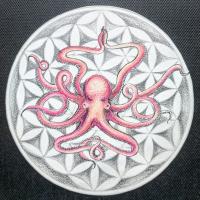
Hand-drawn art by Rupali Bhuva
Image of the Week

Everyone has had the experience of looking through a window and suddenly catching sight of his own reflection staring back at him from the glass. At that point, he can use the glass as a window, to see the world outside, or as a mirror, but he can’t do both at the same time.

Sometimes your reflection in the glass is pretty subtle, and you could easily stand there for ten minutes, looking outside while staring right through the image of your own face without seeing it.

For the purposes of this analogy, imagine that the goal of meditation is to see your own reflection clearly in each moment. Most spiritual traditions don’t realize that this can be done directly, and they articulate their paths of practice in ways that suggest that if you only paid more attention to everything beyond the glass—trees, sky, traffic—eventually your face would come into view. Looking out the window is arguably better than closing your eyes or leaving the room entirely—at least you are facing in the right direction—but the practice is based on a fundamental misunderstanding. You don’t realize that you are looking through the very thing you are trying to find in every moment. Given better information, you could just walk up to the window and see your face in the first instant.

The same is true for the illusoriness of the self. Consciousness is already free of the feeling that we call “I.” However, a person must change his plane of focus to realize this. Some practices can facilitate this shift in awareness, but there is no truly gradual path that leads there. Many longtime meditators seem completely unaware that these two planes of focus exist, and they spend their lives looking out the window, as it were. I used to be one of them. I’d stay on retreat for a few weeks or months at a time, being mindful of the breath and other sense objects, thinking that if I just got closer to the raw data of experience, a breakthrough would occur. Occasionally, a breakthrough did occur: In a moment of seeing, for instance, there would be pure seeing, and consciousness would appear momentarily free of any feeling to which the notion of a “self” could be attached. But then the experience would fade, and I couldn’t get back there at will. There was nothing to do but return to meditating dualistically on contents of consciousness, with self-transcendence as a distant goal.

However, from the non-dual side, ordinary consciousness—the very awareness that you and I are experiencing in this conversation—is already free of self. And this can be pointed out directly, and recognized again and again, as one’s only form of practice. So gradual approaches are, almost by definition, misleading. And yet this is where everyone starts.

Of course, this non-dual teaching, too, can be misleading—because even after one recognizes the intrinsic selflessness of consciousness, one still has to practice that recognition. So there is a point to meditation after all—but it isn’t a goal-oriented one. In each moment of real meditation, the self is already transcended.

Seed Questions for Reflection

How do you relate to the notion that we don't realize we are looking through the very thing that we are trying to find in every moment? Can you share a personal story of a time you became aware that your ordinary consciousness was already free of self? What helps you practice the recognition of intrinsic selfness of consciousness?

Moved by this reading? Join a live Awakin Circle to discuss in community.
Join this week
More ways to connect

Add Your Reflection

6 Past Reflections
AP
Jan 7, 2025
The watcher (me), The Glass window (my tool), The Sighting (my perceived universe) - is all Me !!!
BA
Jan 7, 2025
Thanks for sharing this important teaching! Sam’s own teacher Tulku Urgyen says that once the natural state becomes baseline awakening is assured and meditation is not necessary. Sri Ramana makes a similar observation (and even discourages some forms of meditation).
OK
Omfit Kam
Jan 7, 2025
Yesterday, on a chilly winter morning in Ohio, I walked to work in the biting 20-degree air, but I wasn’t focused on the cold, the walk, or even myself. I was just present. No thoughts, no distractions—just being.

Later, I went to MeAmerica, and halfway through, I felt a similar sense of no-self—a quiet, peaceful state—until I noticed it and returned to awareness.

Moments like these are becoming more frequent, and with practice, my mind feels quieter and more at ease. It’s a beautiful journey.
ST
Jan 7, 2025
Hmmmm- Maybe, "I" am just in a mood, but there is real work to be done and this seems like to put it politely a bunch of mental gymnastics. It is not hard to find a mirror in the physical sense or other humans who are willing to reflect.
"I" am not trying to find any thing. I do desire love and peace and know that it is up to me to choose my experience and " I" am baffled by not only the phrase but the meaning of " intrinsic selfness of consciousness". My personal story is that I find myself reflected by others as acting selflessly. I will continue to look/dive deeper into what part of my shadow may be seeking validation.
DD
Jan 3, 2025
I like Sam Harris' essay and his window analogy. My view is that we are consciousness, so looking for consciousness is silly. Consciousness is free of self. Consciousness in form becomes self and can see self as being separate from consciousness and having consciousness, and can attach all sorts of attributes to itself, but basically self is simply consciousness. I don't know when or how I became aware of that or developed that notion -- I think I heard it and it made sense to me and I nurtured the awareness through reflection. Harris wrote "the intrinsic selflessness of consciousness." It helps me to remind myself that consciousness is constantly taking form, and that form is self. Self is an appearance or illusory and anything more or other than that is what I put onto it.
JP
Jan 3, 2025
Looking Through A Window authored by Sam Harris reminds me of Advaita, NoTwoness. We all are One regardless of apparent differences and divisiveness. It is an illusory, delusion of the Self. The Self is One regardless of apparent differences of me and you, us and them, black and white, rich and poor, me and you, and religious differences. Essentially we are one. In an ancient Indian book of wisdom called Kathopanishad it is described in three Sanskrit words Tat Tvama Asi-Thou art that-the Truth, That Unitive Consciousness. For worldly transactions we relate to each other with such differences. In the spiritual world we all are one. We know how many battles and wars are created by this divisiveness. We tend to forget that in the Divine eyes we all are children of God. An important question arises in me: Who created such divisiveness and dividedness? This inquiry needs to be made with an open and unbound consciousness. We have to keep the window open and the mirror clean to unders... View full comment