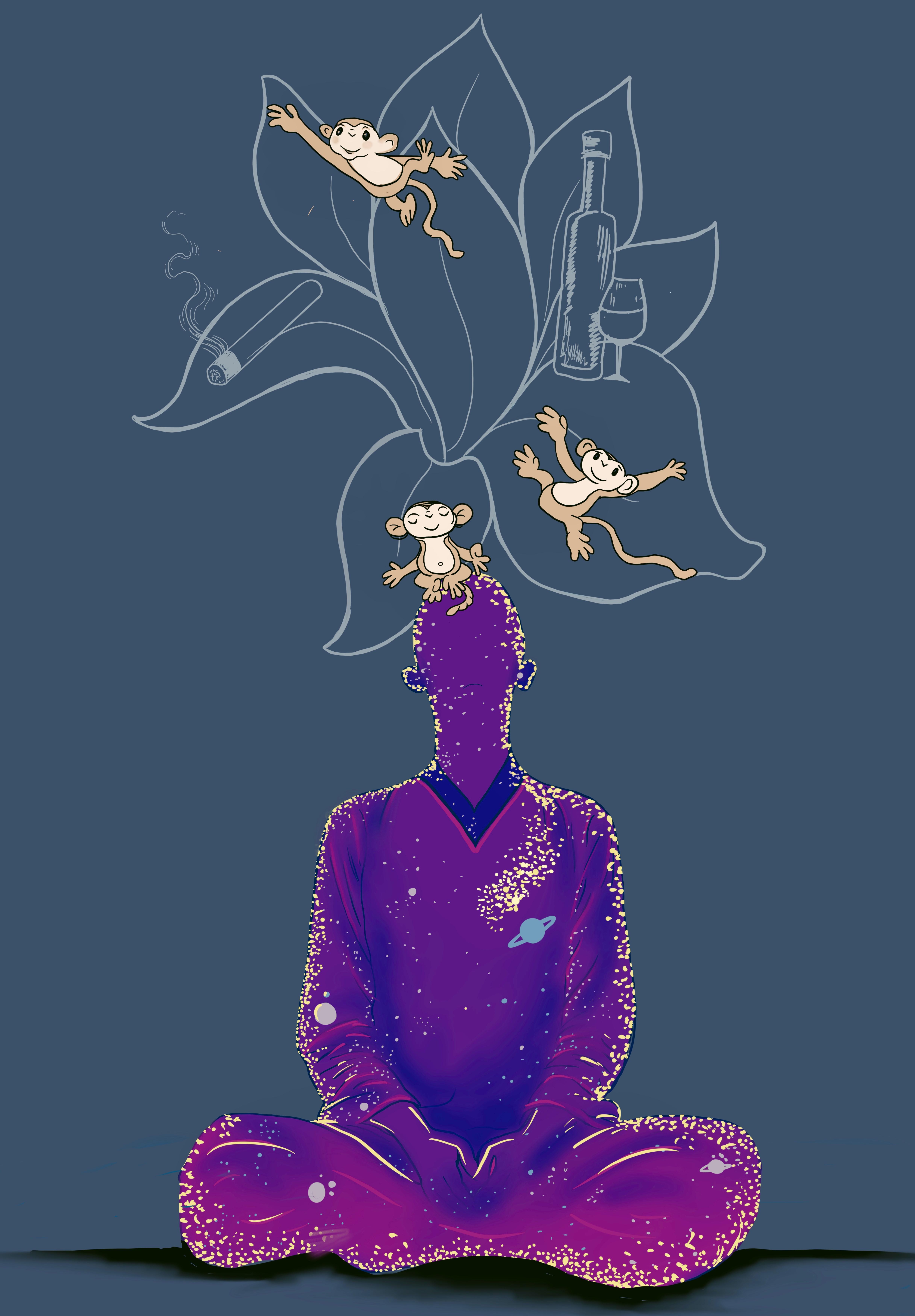
Addiction

Image of the Week
Hand-drawn art by Rupali Bhuva
Image of the Week
Adicción
--por Jac O'Keeffe

Parece que algo que se cree (generalmente de modo inconsciente) que sustenta las adicciones es el siguiente pensamiento: "algo fuera de mí puede hacerme sentir complet@/feliz o entr@".
La experiencia de fenómenos externos continúa mientras intentamos encontrar lo que resolverá este sentimiento de incompletitud. Incluso puede haber una percepción consciente de esa atracción natural hacia el descanso, la paz y la armonía internos. Sin embargo, la mente puede ejecutar simultáneamente la idea de que el mundo exterior es la fuente de "soluciones". Por lo tanto, la búsqueda de la felicidad continúa en el mundo exterior; de ahí que tenga lugar el abuso de sustancias.

Lo mejor que pueden hacer las sustancias es desviar tu atención de los pensamientos persistentes hacia un cierto nivel de olvido por un tiempo, prometiendo unas vacaciones temporales del hábito de creer en los pensamientos. Incluso fumar un cigarrillo puede tener la asociación de cambiar el enfoque mental.
La mente trabaja para buscar su propia resolución; se siente atraída energéticamente hacia la fuente, ya sea que lo desee o no. Así, la mente se ve atraída por esa ruptura en la creencia en los mismos pensamientos una y otra vez, y se crea la capacidad de adicción.

La mente está encontrando una manera de romper el circuito electromagnético creado por el pensamiento repetitivo en el cerebro. El uso de un mantra resulta mucho más eficaz, pero no es tan interesante para el “yo” personal. No es social. No es una “historia” para el pensamiento del “yo”. Gestionar los pensamientos internamente en lugar de hacerlo a través de medios externos (sustancias) puede romper una autoimagen y… bueno, eso no es demasiado atractivo para el “yo” que todavía cree que es en el mundo exterior donde se encuentran las soluciones.

Es raro que una sustancia en sí sea adictiva; generalmente, el cuerpo hace lo que la mente le ordena. La mente imagina que el cuerpo necesita un cigarrillo, pero es la mente quien le ha dicho al cuerpo que ese es el caso. La mente utiliza el cuerpo para sus propios fines. El cuerpo no es más que una bolsa de carne y huesos que funciona exquisitamente. El cuerpo no se vuelve adicto, pero la mente sí. Casi todas las sustancias no son adictivas en sí mismas. La combinación de una sustancia con el dolor de los pensamientos identificados, junto con la promesa de una pequeña distracción para la mente, son los ingredientes de la adicción a las sustancias.

Todas las fuentes de placer tienen la capacidad de convertirse en fuentes de dolor. Tarde o temprano se ve que hay una línea muy delgada entre el placer y el dolor. Ambos no son más que conceptos que se creen verdaderos, que se creen por la experiencia. Hay que tener en cuenta que el esfuerzo de poner en práctica un concepto se revela agotador y algo antinatural. En este punto, la atracción por el placer y la evitación del dolor son dos caras de la misma moneda y el ejercicio de cualquiera de ellas se convierte en un esfuerzo inútil.

Creer que eres un individuo separado dará lugar a la creencia de que eres tus hábitos, tendencias y personalidad. Esto puede causar un gran sufrimiento. Basándose en esta ilusión, la mente puede pasar de una conexión intensa a otra: de los cigarrillos a la comida, del alcohol a las reuniones de AA. Deja que la personalidad sea adictiva: tú no eres tu personalidad. No eres adict@ a nada. No estás involucrad@ en nada de esto. Mientras sigas pensando que eres tu personalidad, el “yo” tendrá algo que arreglar y algo más que hacer. Esto mantendrá viva la historia del “yo”. Se puede explorar el análisis en torno a la adicción… solo para ser rechazado cuando se lo vea como más basura intelectual sobre un “yo” que de todos modos nunca existió fuera de la imaginación. Entonces, ¿qué hacer? Debes saber que, sea cual sea la historia del “yo” que se esté desarrollando, nunca te llevará a ninguna parte. No eres una historia del “yo”. No eres nada a lo que se pueda nombrar. No hay un “yo puedo” o un “yo no puedo”; no hay un “yo”. Bebes alcohol, no bebes alcohol: esto es un estilo de vida y no tiene nada que ver con lo que realmente eres.


No hay nada que arreglar: solo observa y deja de poner tanto esfuerzo en los pensamientos que son “todo sobre mí”. Descansa en el conocimiento de que estás más allá de todo esto. Se necesitan sustancias simplemente para cambiar una idea en la mente, una experiencia que sucede. No te preocupes por nada de esto. Se necesita un “yo” para participar, y tú no eres un “yo”.


Preguntas semilla para reflexionar: ¿Cómo te identificas con la idea de que el cuerpo no se vuelve adicto, pero la mente sí? ¿Puedes compartir una experiencia de una ocasión en la que pudiste sentir que no eras una historia del "yo"? ¿Qué te ayuda a descansar sabiendo que estás más allá de la historia del "yo"?
Seed Questions for Reflection

How do you relate to the notion that the body dos not get addicted, but the mind does? Can you share an experience of a time you were able to feel that you were not an 'I' story? What helps you rest in the knowing that you are beyond the 'I story'?

Moved by this reading? Join a live Awakin Circle to discuss in community.
Join this week
More ways to connect

Add Your Reflection

19 Past Reflections
AN
Dec 19, 2024
Just wondering what is the authority here in proposing that body is not addicted. Parsing out these splits and judging what is real and what is not. I agree with others here who respectfully disagree. Sometimes we need to rest in humility prior to making all encompassing statements. Certainly there is a lot the mind contributes to dealing with addictions.
EL
Sep 21, 2024
Addictions can be relationships, substances, activities … anything that feels like “ I’ve got to have more…

The expression “everything in moderation “seems to fit here.


An addiction or behavior is separate from who I am… understanding the desire to repeat any given thing sheds light on what the underlying cause may be..low self esteem, insecurities, desire to erase life events by numbing the senses, and I think you got the idea.

MO
Sep 13, 2024
Hmmm. I don't think I agree with the premise, "Body does not get addicted, but mind does." Chemical dependency is very real in the body and in the mind. There is no separation of the two. The only Hope is Higher Power.
CA
Sep 11, 2024
My being finds peace in taking care of my family, working, self-care and holistic heath. I read and love to take care of my dogs too. I enjoy music and play guitar. Exercise is important to me at my age. Thank you for sharing . Life is short.
AR
Sep 10, 2024
lost my elder brother to addiction. An intelligent successful person. Even when his body was broken down he would subject hiself to it. 'Cheating' uopn himself. His body was fighting the addictiion and must have been screaming at hi to 'Stop'/ But the mind was gripped, a slave to it. Saw the vacant look in his eyes during the last few breaths. The 'I' was shinning forth in all innocence.
DD
David Doane Sep 13, 2024
I am sorry you lost your brother. I am glad you got to see his I shining forth in all innocence.
EM
emgardner
Sep 10, 2024
tempus gracefully

in a world that rushes
cell phones, emails, busy places
hard to resist
the urge persists

but if we slow
our frantic pace
in a deeper space
contentment grows

hearts and minds
once confined
open wide
peace to find

in slowing down
we come alive
every moment
we can thrive

embrace this way
savoring life, day by day
in this mindful dance
joy, and true expanse

© E Mill Gardner
Milton, 2024
BA
Sep 10, 2024
We are not born addicts. We are born into a pure, spacious, boundlessness of unconditional awareness that has no name. The further we get from this as we learn more and more about the game of living in this world the greater the opportunity for addictive impulses. Fortunately, the spaciousness never leaves us and we can learn to go back to it. This breaks down the addictive impulse.
AW
Sep 9, 2024
I found myself reactive to this passage. Whilst I honour, practice and aspire to mindfulness I know it to be a huge privilege, denied to many, and the many the most vulnerable, so often trapped in the addiction of unhealthy relationships, food abuse, alcohol abuse, substance abuse etc. Obviously there is a spectrum of addiction and the author is talking about fine tuning for those already towards the sunny end of it, but never the less, to not acknowledge the privilege of those who find themselves on the sunny side lacks compassion. The lack of warmth and understanding made me feel uncomfortable, as all elitism does. In addition, I know from personal experience and years of being an holistic therapist that addiction does not all come from the brain. For example an unbalanced microbiome can cause craving which can become addiction.
KE
Kersty Sep 10, 2024
Oh my goodness...you said so very eloquently what I felt most in my heart.
FL
Flower Sep 10, 2024
Still missing the point and need to judge it. It's only elitism because you filter life through that. It's only privilege because you filter life through that. You are still addict yourself needed to insert yourself into this message for it's wrong, when simply accept you gave witness and your words and judgement are an unnecessary addiction
JP
Sep 6, 2024
Our mind gets attached and addicted, not our body. The desire to eat sweet or fried foods arises in the mind, not in the body. We have five senses: smell, taste, touch, hear and see. The mind may make harmful choices and cause problems for the body. Mind is the cause of physical problems. So it is up to Buddhi, the intellect, to discriminate between what is helpful and what is harmful. Discretion is the key that opens or closes our mind's doors. Mind is the cause of freedom or bondage. We need to make wise choices for our physical, mental, emotional, relational and spiritual well-being. It took time for me to go beyond my self-centered ' I story'. I have been practicing the path of going beyond "my my, me me" walls and embracing my "us us, us us" self. Walking on this path creates a deep sense of oneness, a sense of unitive consciousness. Practicing mindfulness in different areas of my everyday life helps me walk on the pilgrimage of my life. It creates and sustains joy, love,... View full comment
GA
Sep 6, 2024
The radical realization that I am not an I or that I am not my body came when I was introduced to A Course in Miracles. It taught that nothing in itself has any meaning. A cup is just a cup. But when I look at that cup memories flow through my mind about when I acquired it. Perhaps it was a gift from a loved one who has passed. Now even though it no longer is function able I can’t let it go. My mind has created an attachment. When I sit silently, following my breath, I realize there is something within me beyond thoughts and even death. It is observing, breathing, moving. Recently the small inner voice said “you are spirit, not a spirit, spirit”. When I asked what that meant the voice explained “that little ‘a’ separates and there is no separation in Spirit, all is One.”


DD
Sep 6, 2024
My view seems to be pretty much the opposite of the view of Jac O'Keeffe. For me, there is no mind-body split. Mind-body is a unity, a continuum. I don't see mind as the boss in charge of body and using body for its own purposes. There was a time that I thought mind and body were real and separate and the two of them together made 'I'. That changed, and I awoke to seeing 'I' as real and as the only real. For me, 'I' is not ego or personality. 'I' is real and is essence, and mind-body is 'I' in form, is an experience of'I'. If anything exists in imagination, it is mind and body, not 'I'. Mind-body is what gets addicted. I agree that nothing outside of 'I' can make 'I' feel happy or whole. I'm not beyond the 'I' story; I am beyond the story of mind and body being two separate entities that comprise 'I', and beyond seeing 'I' as imagination. For me, 'I' is all that really is, and mind-body comes and goes.
SH
Sep 5, 2024
Yes yes yes …. 🌹❤️