Meeting Our Own Mortality

Image of the Week
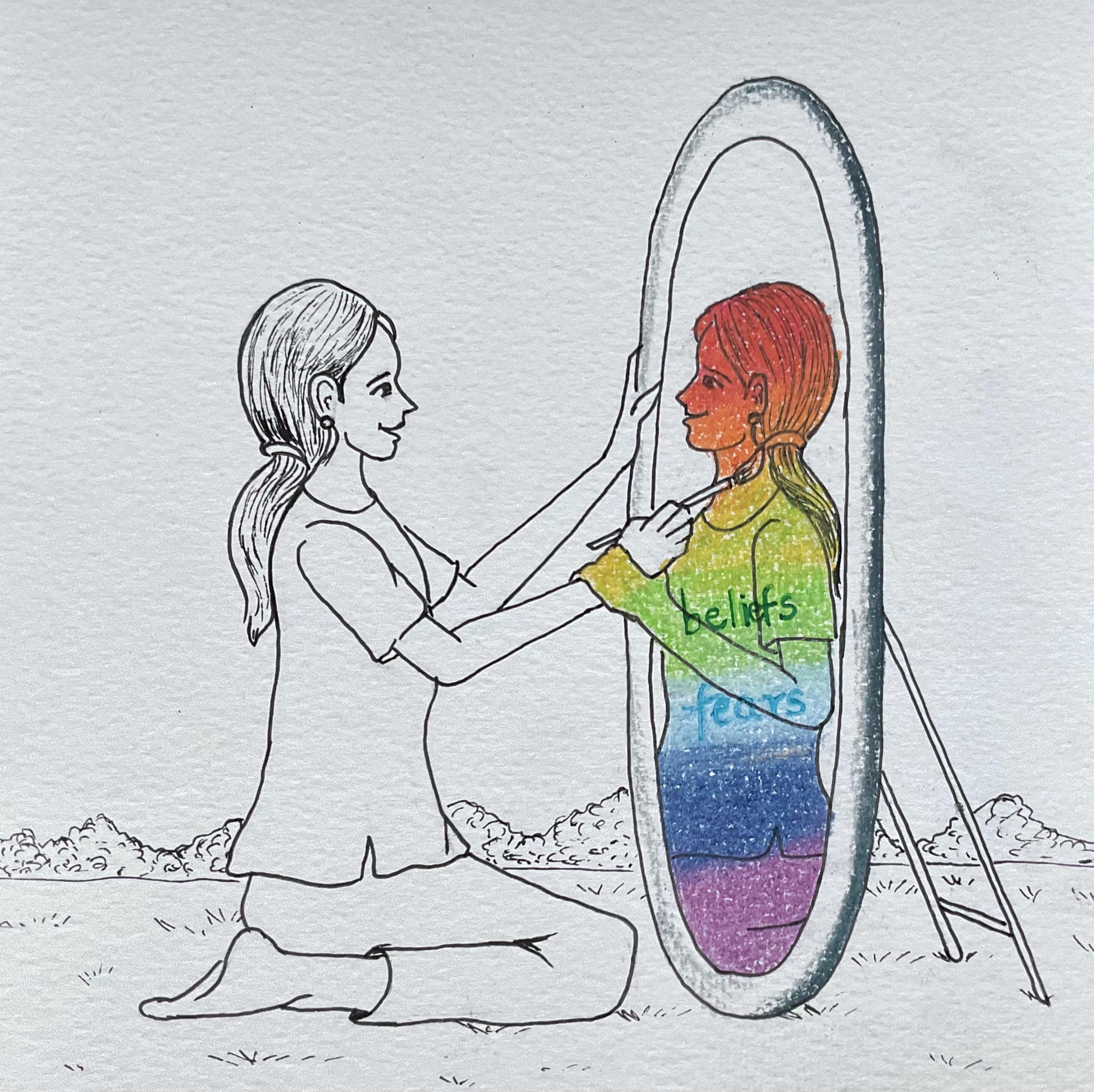
Hand-drawn art by Rupali Bhuva
Image of the Week
Enfrentando nuestra propia mortalidad
--por Navin Amarasury

Las historias nos han ayudado a dar sentido al mundo, desde la antigüedad, cuando nuestros antepasados ​​susurraban alrededor de las fogatas. Los modelos mentales internos que explicaban el mundo exterior dieron forma a nuestras percepciones y formaron la base de la cohesión desde las tribus hasta las civilizaciones más importantes. En estas historias yace una exclusión natural, para nuestras historias de creación o ideologías más amplias, crea sutilmente una forma dualista de ver el mundo y considera como 'otros' a aquellos que viven fuera de nuestra interpretación.

Las historias de la creación y la exploración de nuestra mortalidad son temas fundamental. Como dijo Ernest Becker, "El hombre está literalmente dividido en dos: tiene conciencia de su propia y espléndida singularidad en el sentido de que sobresale de la naturaleza con una majestuosidad imponente y, sin embargo, se hunde unos metros en el suelo para ciega y tontamente pudrirse y desaparecer para siempre. Es un dilema aterrador en el que estar y tener que vivir". Para dar sentido a este temor existencial, la humanidad ha inventado innumerables historias para consolarnos mientras nos asomamos conceptualmente al borde de nuestro precipicio mortal.

Estos cuentos tienen el poder de unir a las personas, pero también de separarlas. Gran parte del conflicto humano ha sido un grupo tratando de convencer al otro de que tiene razón. Desde el punto de vista de Becker, esos conflictos surgen de una inseguridad sobre una cosmovisión singular que se ve amenazada cuando una explicación alternativa erosiona esa base. Las narrativas dominantes tienen una tendencia a ubicar el 'mal' fuera de sí mismas, y la violencia contra otras visiones amenazadoras está justificada. Guerras religiosas sobre qué dios es verdadero, guerras civiles dentro de países con diferentes doctrinas económicas, genocidios que erradican minorías enteras: la mayoría de los conflictos comienzan con encontrar a alguien a quien culpar.
Luego se culpa al chivo expiatorio por todos los problemas, y hay una cooperación colectiva de aquellos en la narrativa dominante para dejar de lado sus antagonismos mutuos y unirse en un odio mutuo. Irónicamente, la muerte o el sacrificio del chivo expiatorio puede fomentar una especie de paz y cohesión temporal entre los que son los 'vencedores', pero la ira subyacente y la ignorancia del ciclo sin fin permanecerán. Cuando señalamos con el dedo culpando a alguien, volvemos a caer en ese ciclo de emociones aflictivas y de falta de empatía. Desde la antigua matanza ritual de animales como sacrificio, hasta los misiles balísticos intercontinentales que causan daños colaterales, incluso si destruimos el objeto al que culpamos, el ciclo permanece.

Como dijo una vez Gandhi: "Solo reflejamos el mundo. Todas las tendencias presentes en el mundo exterior se encuentran en el mundo de nuestro cuerpo. Si pudiéramos cambiarnos a nosotr@s mism@s, las tendencias en el mundo también cambiarían. Así como un hombre cambia su propia naturaleza, también cambia la actitud del mundo hacia él. Este es el misterio divino supremo. Es una cosa maravillosa es y la fuente de nuestra felicidad. No necesitamos esperar a ver qué hacen los demás”. El chivo expiatorio debe convertirse, en lugar de un objeto de culpa, en un espíritu animal que nos ayude a descubrir otras historias y ofrezca la oportunidad de trascender el ciclo a través de una exploración colectiva de posibilidades compasivas.

Explorar nuestros propios modelos mentales y nuestros propios sesgos provoca un cambio en la percepción que nos abre una puerta para cambiar la forma en que nos mostramos en nuestras vidas. Esto, a su vez, crea un ejemplo vivo de lo que es posible, y eso influye en quienes nos rodean. Este cultivo de la empatía a través de la indagación profunda reduce la 'otredad' de aquellos que están fuera de nuestras perspectivas y hace que sea más difícil abstraerlos en el mal que debe ser tratado. Comenzar con nuestros miedos más profundos y creencias más fuertes es un lugar para comenzar. Las semillas de ver el mundo como un espectro de colores complejo pero hermoso pueden cuidarse, lo que permite que el árbol de la sabiduría y la compasión dé frutos.


Preguntas semilla para la reflexión: ¿Qué significa para ti cultivar la empatía a través de la indagación profunda? ¿Puedes compartir una historia personal de una vez que examinaste tu propio modelo mental y viste un cambio en tu percepción, ayudándote a mostrarte diferente en tu vida? ¿Qué te ayuda a cultivar la semilla de ver el mundo como 'un espectro de colores complejo pero hermoso'?


Navin Amarasuriya entregó las riendas de su negocio familiar de 150 años para emprender un camino menos transitado para ayudar a estudiantes, educadores y padres a aprender sobre prácticas de bienestar basadas en la ciencia.
Seed Questions for Reflection

What does cultivation of empathy through deep inquiry mean to you? Can you share a personal story of a time you examined your own mental model and saw a shift in your perception, helping you show up differently in your life? What helps you tend the seed of seeing the world as 'a complex yet beautiful spectrum of colors'?

Moved by this reading? Join a live Awakin Circle to discuss in community.
Join this week
More ways to connect

Add Your Reflection

8 Past Reflections
EN
Nov 5, 2022
It makes for a busy life reflecting and examining mindfully what is going on in my outside world and what is going in on my inside world. Focus on breathing while objectively observing emotions, thoughts, feelings and the weave of each of these in relation to each other is quite a commitment to improving one's relationship with self and others. As we look to improve, deepening our self/other relationships, and not look to blame on any level of this most inner/outer educational process, the scapegoat, our eyes and heart of loving kindness are the reflecting and refracting mirrors of life...quite the kaleidoscope. I'm sure glad I have had Dr. Dave' as my teacher because it is with this knowledge and practice for the past 20 years that I have been even able to write the above paragraph and have some grasp of the beautiful weave in our conversations and my life. Thank you , Dr. Dave', for teaching me weaving at the highest level....weaving hearts of love and loving kindness. Namast... View full comment
CE
Celsa
Oct 31, 2022
Motorimport import voiture dubai
contacter npus pour importer unne voiture de dubai
&anchor_text%
AR
Arlie
Oct 30, 2022
cialis online kaufen wo get cialis prescribed
online is cialis generic cialis generika online kaufen erfahrungen safe buy cialis online
SG
Oct 26, 2022
Cultivation of deep empathy would mean , understanding the point of view of another, his deeper feelings, the reason behind his way of thinking. Sometime s we judge another person based on superficial knowledge and then start casting aspirations, which in turn makes the other person do the same and that results in all round hatred , and very bad relations between people , not only others but our close ones too. Although , it may not be fully related , but I used to run away seeing other's pain and suffering. If I knew someone had passed away in a house I would go there after 2-3 days so that i do not have to witness the deep pain and grief felt by the people at the time of the initial news of a closed one passing away. I would close my eyes if someones wound came in my sight , even in pictures. Through some introspection and inner cultivation I have changed my way of looking at pain. I could see I was fearful the pain would engulf me and make me feel feel miserable. After long ... View full comment
TE
Oct 23, 2022
My egoic mind functions on the basis of separation and differentiation, this is how I (and everyone I know) learns language. Starting with "ME" vs "mom", my hunger vs my comfort, what I like vs what I dislike, red vs blue, hard vs soft, etc. are all separate and distinct concepts and later have words attached to them. This process then continues to MY family, MY community, MY country, MY religion, and so on. These distinct separations along with the principle of "cause" resulting in "effect", allow our "rational" egoic thought to exist. In maturing we can learn that "MY" does not always mean "better", and having compassion, empathy, and love, and expressing kindness, generosity, forgiveness, and patience towards others leads to less isolation, and reduced suffering for ourselves as well as for them, even though it is still based on ME being separate from them (and all else). Finally, realization can dawn of how inherently limited and unsatisfactory the finite egoic perspective is, that... View full comment
JP
Oct 23, 2022
Cultivation of emapthy for me, for others and the world depends on the way I perceive. If the lenses of my perception are narrrow, clouded and selfcentered, my realization of the reality will refect my perception. As I know the Reality is One but it is perceived differently by different people according to their ways of looking at it. About 5000 years ago IndianSages have proclaimed "Ekam sat vipraha bahudha vadanti"-The Reality is One and is seen differently by diiferent seers. It is my realization that there is Oneness in Manyness. I need to go beyond my personal narrowbrand to broadbrand. If I don't expand my vision my empathic realtionship with me, with others and the world will be limited. When I was young my mental model was narrow and rigid brand. Over the time my mental model has become more brand. By pratcing Mindulness Meditation and cultivating and sustaing an attitude of nonjudgemal awareness and loving kindness I have been able to see the word as ' a complex yet bea... View full comment
JO
jo Oct 25, 2022
Wonderful share Jagdish! Enjoyed ! Thank you!
DD
Oct 23, 2022
Cultivation of empathy through deep inquiry means to me to foster a deep understanding and sense of the experience of the other through paying close attention and probably asking questions. Over the years, initially slowly, I have realized that my mental model of most everything is only a narrow sliver of a very wide broadband, my mental model has in regards to some things been rigid, and I've been judgmental. I have seen a shift in my perception including more broadness and openness of perception which helps me to see more and be more accepting and compassionate. What helps me see the world as a complex and beautiful spectrum of colors is being open to the possibility that all is one, all comes from one source, all is made of the same stuff, and all is innumerable different expressions that appear to be separate. Openness to that possibility along with study and reflection became realization for me that that possibility is true.