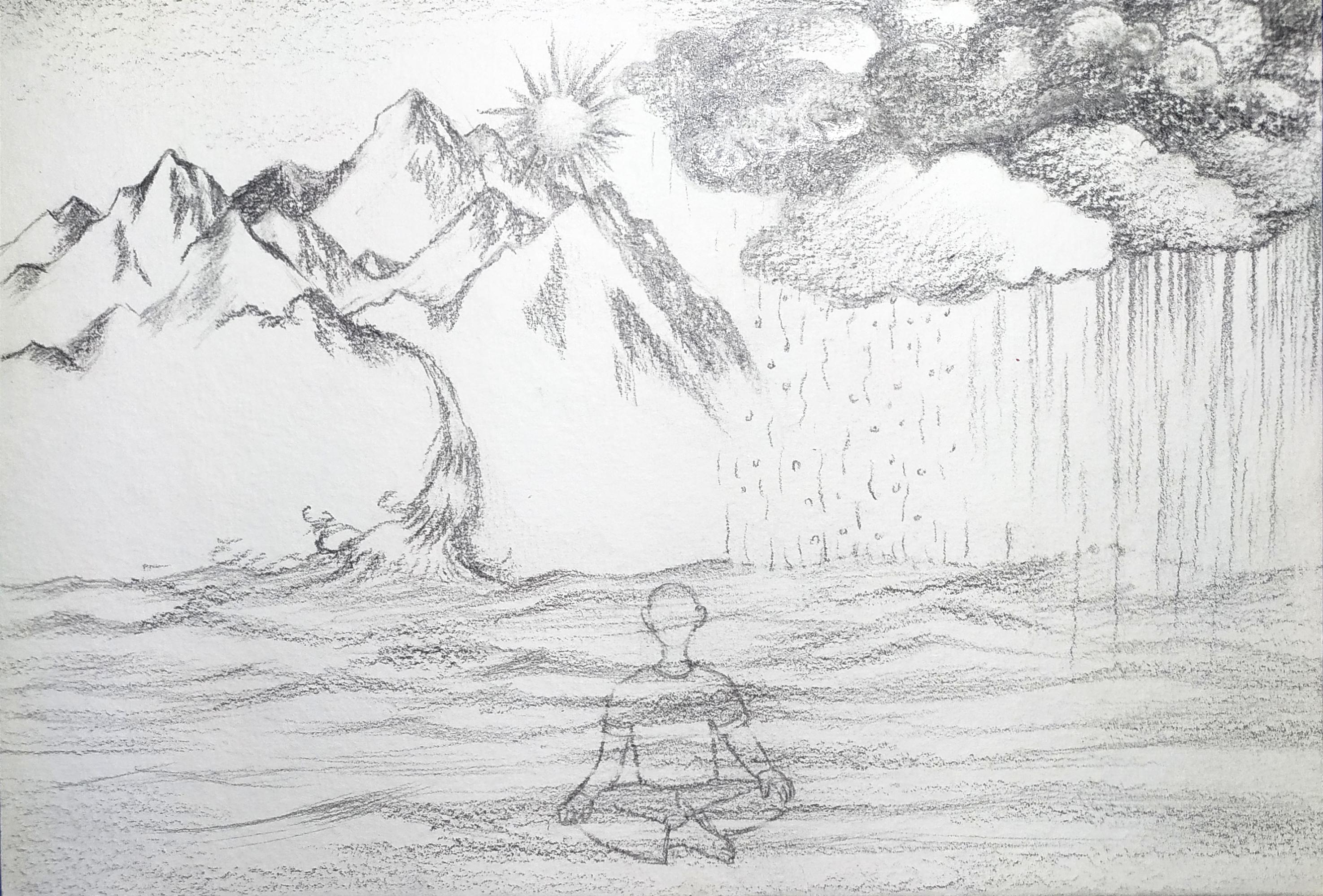
Three States Of Water

Image of the Week
Hand-drawn art by Rupali Bhuva
Image of the Week
Tres estados del agua
--por Natureza Gabriel Kram

Imagina que nunca has estado en la Tierra. La visitas primero en invierno, donde alguien te presenta el agua. De un vaso, lo vierten sobre tu mano. Bebes. Notable.

Imagina que sales hacia un lago congelado. Nunca has visto esta sustancia antes. Lo pateas con la punta de tu bota: sólido. Caes sobre tus manos y rodillas, te agarra la palma cuando presionas tu mano contra él: escalofriantemente frío. ¿Qué es esto? Preguntas. Tu guía responde, agua.

Imagina que entras en una sala de vapor. El vapor caliente se arremolina en una niebla que oscurece. ¿Qué es esta nube? preguntas. De nuevo, agua, viene la respuesta.

Si te encontraras con el agua por primera vez, vistiendo sus tres caras, no creerías que fuera un solo elemento. Sin embargo, por supuesto, cada uno de estas: agua líquida, hielo y vapor es, de hecho, agua en diferentes estados. Un líquido, un sólido, un gas: sus propiedades físicas completamente diferentes; contradictorias, de hecho.

Acabo de explicaros la Teoría Polivagal, a través de la lente del agua. Explica la relación entre el sistema nervioso autónomo y el comportamiento social, y cómo, dependiendo de si nos sentimos segur@s o en peligro, emergen diversas plataformas neuronales que dan forma a nuestra experiencia corporal, emociones y pensamientos, percepciones y comportamientos.

El agua, en su estado líquido, puede estar quieta o fluir rápidamente pero se comporta líquidamente. En nuestra analogía, el agua líquida representa nuestro sistema de conexión. Esta es la plataforma neuronal activa cuando nos sentimos lo suficientemente seguros en nuestros cuerpos para abrirnos a la conexión; une el corazón y la respiración con el rostro y la voz. Hay un viejo adagio que dice que algunas personas llevan el corazón en la manga, pero eso no es del todo cierto; en realidad llevamos nuestro corazón en la cara y en la voz. La capacidad del nervio vago se refleja en la variabilidad de nuestro ritmo cardíaco ya través de la expresión de nuestro rostro y la prosodia de nuestra voz. [...]

Tú, como el agua líquida que se convierte en vapor, eres diferente cuando la seguridad está ausente. El vapor representa el sistema de lucha o huida: respuesta defensiva de alta energía evocada para responder a la amenaza. El vapor aparece como energía de lucha o como energía de vuelo. El correlato emocional de la lucha es el continuo de la ira, desde la irritación leve hasta la ira homicida. El correlato emocional de la huida es el continuo del miedo, desde la preocupación leve hasta el terror. [...]

Nuestros cuerpos suelen responder a la sensación de inseguridad pasando del agua líquida al vapor y al hielo. Si el vapor no nos pone a salvo, si no podemos luchar o escapar de la amenaza, el hielo nos inmoviliza. Su acción fisiológica es de caída y bloqueo metabólico, y si se presenta con fuerza evoca la liberación de opiáceos endógenos (analgésicos) para adormecernos ante la muerte inminente. El hielo es la respuesta de último recurso a la amenaza. Mientras que el continuo emocional del vapor es la ira y el miedo, el del hielo es similar a la depresión. Es una retirada, un colapso, una muerte social. Se correlaciona con la disociación.

Saber dónde estamos polivagalmente (vapor, hielo o agua) nos indica lo que necesitamos para volver a casa. El vapor debe enfriarse y condensarse para volver al agua líquida, pero el hielo puede enfriarse indefinidamente y no se derretirá. Apoyar el bienestar requiere satisfacer las necesidades del estado del sistema nervioso del momento presente. Cuando eres vapor, ves como ve el vapor. Y tú, y el mundo, lucís de cierta manera. Cambia el estado y la historia sigue. Condensa el vapor nuevamente en agua líquida y la forma en que la persona percibe cambia por sí sola.

Preguntas semilla para la reflexión: ¿Cómo te relacionas con la metáfora de los tres estados del agua y cómo nuestra percepción está moldeada por el estado en el que nos encontramos? ¿Puedes compartir una historia personal de un momento en el que te diste cuenta de dónde estabas y de lo que tenías que hacer para volver a casa? ¿Qué te ayuda a darte cuenta de en qué estado te encuentras?


Natureza Gabriel Kram es un fenomenólogo de conexiones, autor de Prácticas Restaurativas de Bienestar y convocante de la Alianza de Prácticas Restaurativas
Seed Questions for Reflection

How do you relate to the metaphor of the three states of water and how our perception is shaped by the state we are in? Can you share a personal story of a time you became aware of where you were, and what you needed to do to come home? What helps you become aware of which state you are in?

Moved by this reading? Join a live Awakin Circle to discuss in community.
Join this week
More ways to connect

Add Your Reflection

17 Past Reflections
PS
Paula Scatoloni
Oct 19, 2025
I have been listening to Veda Austin’s research on water. A tangible way to consider the human body and its response to trauma and relational ruptures. The biggest one being the relationship to water itself as a sentient force.
NG
Nov 30, 2022
While it is nice to see this hear, it would have been lovely if you had asked permission to re-publish my article.
PD
Patty de Llosa Feb 26, 2023
Deep apologies. I often take messages from awaken to Facebook. I was one of the editors of the daily good and karma tube for a while and feel this is a service to humanity, as is your work.
CA
Catherine
Jul 30, 2022
Thank you. I am giving a concert in an hour after a singing workshop. I will try to stay in a liquid state
KO
Korey
Jul 29, 2022
Just want to ssay your article is as astounding. The clarity in your post
is just excellent and i can assume you're an expert on this subject.
Well withh your permission let me to grab our RSS feed to keep uup to date with
forthcoming post. Thanks a million and please keep up the gratifyinhg work.
ST
Jul 27, 2022
We can be the observer of ourselves in these emotional States as the theater of the ego and therefore choose our naturally loving state.
ML
Jul 27, 2022
This is a very helpful article/metaphor. I am one who needs to keep unfreezing. So I am attracted to people and try to have people in my life with whom I feel safe and who are also positive, joyful, friendly.
RP
Roshan Pattnaik
Jul 27, 2022
Nice
CW
Cynthia Winton-Henry
Jul 26, 2022
So appreciate this. I've needed specific help to unfreeze the ice zone. Laughter, dancing for short bits, chants, and being willing to include what I most fear.
NG
Natureza Gabriel Kram Nov 30, 2022
This is the subject of our work at the Restorative Practices Alliance, and what I've spent the past 25 years studying.
MP
Jul 26, 2022
We do well in seeking to emulate water. Water is a great teacher and holds great wisdom. One such is the action of no action, of action without ego. By simple obedience to temperature and gravity, water spreads its blessing throughout the world, it helps shape the world, it beautifies the world. This obedience is surrender.
As for the seed question, it is the idea that we are not home that keeps us from realising that we are already home.

Inhale, Exhale, Inhale

Arising from the universal ocean
We are snowflakes,
Each unique,
Each perfect,
Each falling
Back to the ocean
To rise again,
Unique, perfect.
AN
Jul 26, 2022
Being a source of energy, we have the capacity to transform phases knowing very well how to do it as situation warrants.
JA
Jul 26, 2022
The author did not discuss So, one can changing ice to water part. By getting love and caring (sympathy), ice does change to water with time. So, most of the time, the ice stage is not the end; the transition through all three states is ongoing.
DF
Jul 26, 2022
What a wonderful presentation. I have been been working on breathing through my nose. How simple yet I often forget. It makes life very liquid
DD
Jul 22, 2022
We wear our hearts not only on our sleeves, face, or voice, but throughout our bodies. Author Kram seems to see us more as machines determined by conditions than as persons with at least limited freedom and control. As I see life, our response and our internal state are shaped by our perception. Our perception is not determined by external circumstances but is from inside us. I became aware of that at some time years ago. In that sense I came home. What I needed to do to come home was to trust me and be me. l'm not a powerless victim being triggered by external circumstances. I, including my perception and response and internal state, are influenced by conditioning and by external circumstances, such as by steam, ice, and liquid, but are not determined by them. My perception, response and internal state can be my own and independent of external circumstances. Paying attention internally helps me become aware of what state I am in.
NG
Natureza Gabriel Kram Nov 30, 2022
Good sir- physiologically, with regard to the Autonomic Nervous system, which is what I am writing about in this post, we wear our hearts on our faces and in our voices. The literal signal of our heart-rate variability is expressed through these circuits. That is what I'm saying. I do not see people as machines. The nervous system is, one might say, the altar of the spirit. Our work comes exploring the ways that our autonomic nervous systems, which are the neural architecture of the mind-body connection, shape our visceral state, sense of identity, our emotions, cognitions, how we interpret what is happening around us, and how we behave. This is not machine-like, but it is determined by our felt sense of safety versus threat. Understanding the way that the autonomic system, which is beneath cognition, shapes these facets of our experience opens the opportunity for transforming them. If we don't understand the nature of ice, it is more difficult to melt. Our work unites neurophysiology and mindfulness. If these fields are not brought together, many modern people practicing mindfulness are in fact practicing dissociation.
JP
Jul 22, 2022
Reading this passage authored by Natureza Gabriel Kram reminds me of Adi Sankarachrya the enlightened Vedantic teacherborn 1500 hundred years ago. He describes four states of consciosness: normal state of wakefulness-Jagrati, dream state of consciousness-Swapna, Sushupti -sound sleep state of consciousness, and Turiya-Transcendental or Unitive state of consciousness. The first three states of consciousness are like liquid, solid, and steamy states of consciousness and water going through the first three states of consiosness without being bound by liquid, solid, and steamy states of consciousness. When our contemplative practices go deeper we realize the Trancedental or Unitive Conscousness. And that is Self, our True Nature. This is the defining charecteristic of a Self-realzed being with no divisive boundaries and barriers, beyond time and space. When my meditative state goes deeper I experience Turiya, the Trancendental Consciousness. In that state the egoic mind, the little self... View full comment