Meeting Our Own Mortality
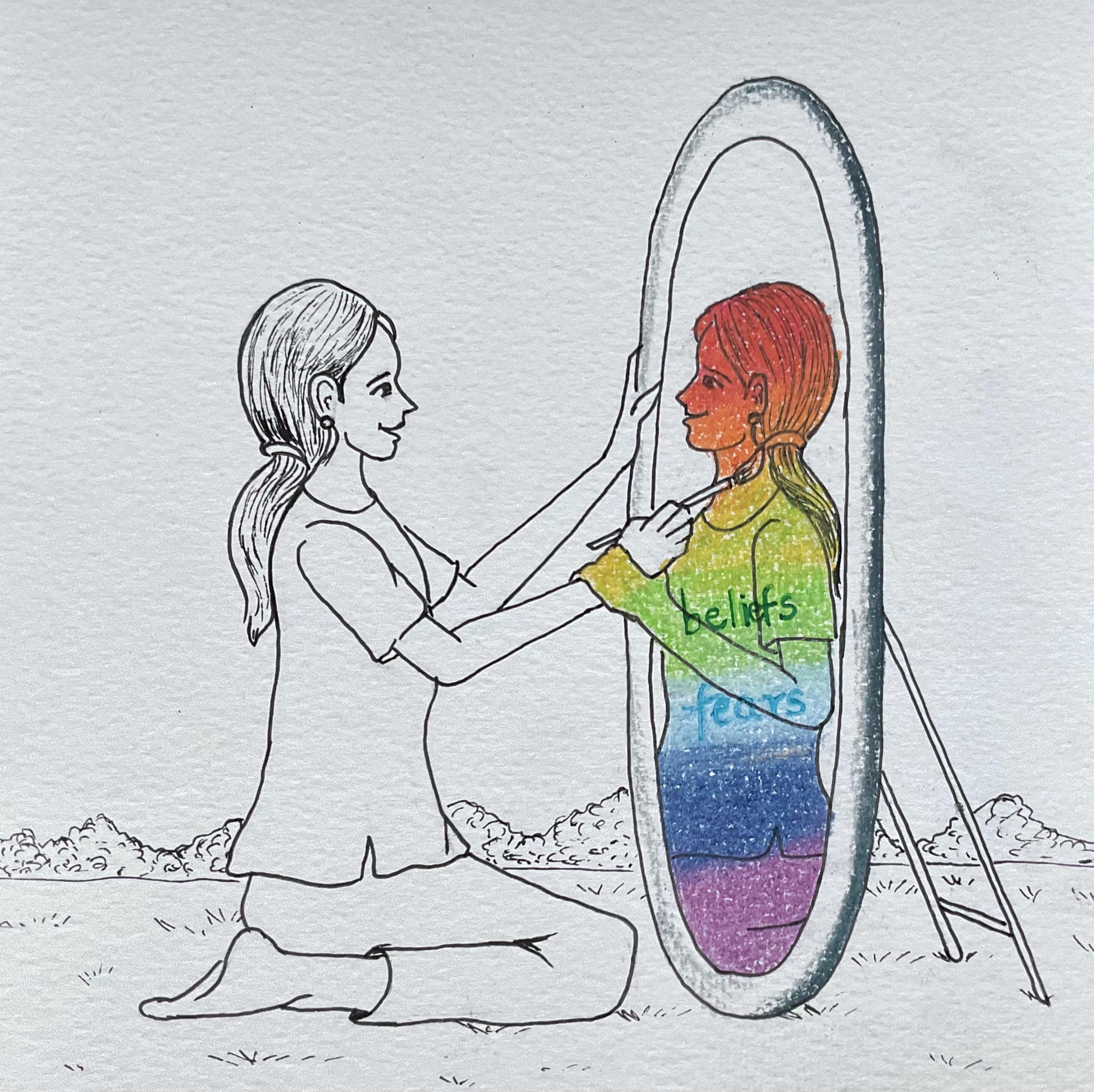
Image of the Week
Hand-drawn art by Rupali Bhuva
Image of the Week

Stories have helped us make meaning of the world, from ancient times when our ancestors whispered around campfires. Inner mental models that explained the outside world shaped our perceptions, and formed the basis of cohesion from tribes to the greatest civilizations. In these stories lay a natural exclusion, for our stories of creation or broader ideologies, subtly creates a dualistic way of seeing the world, and 'othering' those who live outside of our interpretation. 

Creation stories, and the exploration of our mortality is a foundational theme. As Ernest Becker put it, "Man is literally split in two: he has an awareness of his own splendid uniqueness in that he sticks out of nature with a towering majesty, and yet he goes back into the ground a few feet in order to blindly and dumbly rot and disappear forever. It is a terrifying dilemma to be in and to have to live with." In order to make sense of this existential dread, humanity has invented countless stories to comfort us as we conceptually peer over the edge of our mortal precipice. 

These tales have the power to bind people together, but equally, to tear them apart. Much of human conflict has been one group trying to convince the other that it is right. From Becker's point of view, those conflicts stem from an insecurity about a singular worldview that comes under threat when an alternate explanation erodes that foundation. The dominant narratives have a tendency of locating 'evil' outside of themselves, and that violence against these threatening other views is justified. Religious wars about which god is true, civil wars within countries with differing economic doctrines, genocides that eradicate entire minorities - most conflicts start with finding someone to blame. 

The scapegoat is then blamed for all the problems, and there is a collective cooperation of those in the dominant narrative to put aside their mutual antagonisms and bond in a mutual hatred. Ironically, the killing or sacrifice of the scapegoat can foster a kind of temporary peace and cohesion among those who are the 'victors', but the underlying anger, and the ignorance of the endless cycle will remain. When we point our finger in blame at someone, we fall back into that cycle of afflictive emotions and lack of empathy. From ancient ritual killing of animals as sacrifice, to intercontinental ballistic missiles that cause collateral damage, even if we destroy the object we blame, the cycle remains. 

As Gandhi once said,  "We but mirror the world. All the tendencies present in the outer world are to be found in the world of our body. If we could change ourselves, the tendencies in the world would also change. As a man changes his own nature, so does the attitude of the world change towards him. This is the divine mystery supreme. A wonderful thing it is and the source of our happiness. We need not wait to see what others do.” The scapegoat should become, instead of an object of blame, a spirit animal to help us discover other stories and offer a chance at transcending the cycle through a collective exploration of compassionate possibility.  

Exploring our own mental models and our own biases cause a shift in perception that opens a door for us to change the way we show up in our lives. This in turn creates a lived example of what is possible, and that influences those around us. This cultivation of empathy through deep inquiry reduces the  'otherness' of those outside of our perspectives and makes it harder to abstract them into evil that must be dealt with. Starting with our deepest fears and strongest beliefs is a place to begin. The seeds of seeing the world as a complex yet beautiful spectrum of colors can be tended to, which allows the tree of wisdom and compassion to bear fruit. 

Seed Questions for Reflection

What does cultivation of empathy through deep inquiry mean to you? Can you share a personal story of a time you examined your own mental model and saw a shift in your perception, helping you show up differently in your life? What helps you tend the seed of seeing the world as 'a complex yet beautiful spectrum of colors'?

Moved by this reading? Join a live Awakin Circle to discuss in community.
Join this week
More ways to connect

Add Your Reflection

8 Past Reflections
EN
Nov 5, 2022
It makes for a busy life reflecting and examining mindfully what is going on in my outside world and what is going in on my inside world. Focus on breathing while objectively observing emotions, thoughts, feelings and the weave of each of these in relation to each other is quite a commitment to improving one's relationship with self and others. As we look to improve, deepening our self/other relationships, and not look to blame on any level of this most inner/outer educational process, the scapegoat, our eyes and heart of loving kindness are the reflecting and refracting mirrors of life...quite the kaleidoscope. I'm sure glad I have had Dr. Dave' as my teacher because it is with this knowledge and practice for the past 20 years that I have been even able to write the above paragraph and have some grasp of the beautiful weave in our conversations and my life. Thank you , Dr. Dave', for teaching me weaving at the highest level....weaving hearts of love and loving kindness. Namast... View full comment
CE
Celsa
Oct 31, 2022
Motorimport import voiture dubai
contacter npus pour importer unne voiture de dubai
&anchor_text%
AR
Arlie
Oct 30, 2022
cialis online kaufen wo get cialis prescribed
online is cialis generic cialis generika online kaufen erfahrungen safe buy cialis online
SG
Oct 26, 2022
Cultivation of deep empathy would mean , understanding the point of view of another, his deeper feelings, the reason behind his way of thinking. Sometime s we judge another person based on superficial knowledge and then start casting aspirations, which in turn makes the other person do the same and that results in all round hatred , and very bad relations between people , not only others but our close ones too. Although , it may not be fully related , but I used to run away seeing other's pain and suffering. If I knew someone had passed away in a house I would go there after 2-3 days so that i do not have to witness the deep pain and grief felt by the people at the time of the initial news of a closed one passing away. I would close my eyes if someones wound came in my sight , even in pictures. Through some introspection and inner cultivation I have changed my way of looking at pain. I could see I was fearful the pain would engulf me and make me feel feel miserable. After long ... View full comment
TE
Oct 23, 2022
My egoic mind functions on the basis of separation and differentiation, this is how I (and everyone I know) learns language. Starting with "ME" vs "mom", my hunger vs my comfort, what I like vs what I dislike, red vs blue, hard vs soft, etc. are all separate and distinct concepts and later have words attached to them. This process then continues to MY family, MY community, MY country, MY religion, and so on. These distinct separations along with the principle of "cause" resulting in "effect", allow our "rational" egoic thought to exist. In maturing we can learn that "MY" does not always mean "better", and having compassion, empathy, and love, and expressing kindness, generosity, forgiveness, and patience towards others leads to less isolation, and reduced suffering for ourselves as well as for them, even though it is still based on ME being separate from them (and all else). Finally, realization can dawn of how inherently limited and unsatisfactory the finite egoic perspective is, that... View full comment
JP
Oct 23, 2022
Cultivation of emapthy for me, for others and the world depends on the way I perceive. If the lenses of my perception are narrrow, clouded and selfcentered, my realization of the reality will refect my perception. As I know the Reality is One but it is perceived differently by different people according to their ways of looking at it. About 5000 years ago IndianSages have proclaimed "Ekam sat vipraha bahudha vadanti"-The Reality is One and is seen differently by diiferent seers. It is my realization that there is Oneness in Manyness. I need to go beyond my personal narrowbrand to broadbrand. If I don't expand my vision my empathic realtionship with me, with others and the world will be limited. When I was young my mental model was narrow and rigid brand. Over the time my mental model has become more brand. By pratcing Mindulness Meditation and cultivating and sustaing an attitude of nonjudgemal awareness and loving kindness I have been able to see the word as ' a complex yet bea... View full comment
JO
jo Oct 25, 2022
Wonderful share Jagdish! Enjoyed ! Thank you!
DD
Oct 23, 2022
Cultivation of empathy through deep inquiry means to me to foster a deep understanding and sense of the experience of the other through paying close attention and probably asking questions. Over the years, initially slowly, I have realized that my mental model of most everything is only a narrow sliver of a very wide broadband, my mental model has in regards to some things been rigid, and I've been judgmental. I have seen a shift in my perception including more broadness and openness of perception which helps me to see more and be more accepting and compassionate. What helps me see the world as a complex and beautiful spectrum of colors is being open to the possibility that all is one, all comes from one source, all is made of the same stuff, and all is innumerable different expressions that appear to be separate. Openness to that possibility along with study and reflection became realization for me that that possibility is true.