Call Nuggets
Patty de Llosa
Practice of Presence
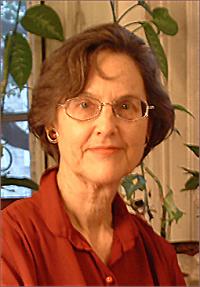 We’ve had so many guests on Forest Calls who were inspiring, engaging, and wise. But it is rare to have a guest quite as generous a Patty de Llosa. Throughout our call she was clearly being mindful of who said what during our sharing. She took the time during the interview to remember them by name as she recalled their comments.
Perhaps, though, it is not so surprising given her life. She studied many different spiritual philosophies and practices, worked as a reporter and senior editor for top magazines, lived in Peru as the wife of the Governor of Loreto Province where she also headed their Green Cross and worked with the Peace Corp. On top of that she raised three children. Perhaps one would naturally develop phenomenal people skills and an appreciation for details with a life trajectory as varied and demanding as that!
.jpg) But what set her on the path where we find her today? Her parents were students of Gurdjieff, an Armenian spiritual teacher in the early 20th century. He believed we could awaken to greater consciousness, “remember ourselves,” through the study of ancient practices and writing, music, and movement. She also studied his works and lived by his philosophy to question everything. He explained that we lose our way in daily confusion. “But call upon something in yourself that can focus on the essential.” That is what began her practice of mindfulness.
But what set her on the path where we find her today? Her parents were students of Gurdjieff, an Armenian spiritual teacher in the early 20th century. He believed we could awaken to greater consciousness, “remember ourselves,” through the study of ancient practices and writing, music, and movement. She also studied his works and lived by his philosophy to question everything. He explained that we lose our way in daily confusion. “But call upon something in yourself that can focus on the essential.” That is what began her practice of mindfulness.While visiting her mother many decades ago, she discovered she
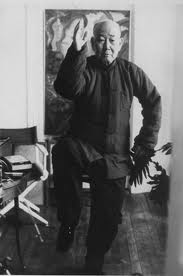 had taken up T’ai Chi, a practice almost unheard of back then. Curious, she went to learn it herself from the renowned master TT Liang. “For years I was working hard to acquire consciousness; that was the Gurdjieffian mode—to develop our body in a conscious way. When I came to T’ai Chi I discovered grounding, which was for me a new dimension of presence. T’ai chi mysteriously worked on me below my mind.”
She was very focused on service for the 18 years she lived in Peru. Among other roles she served as president of the Green Cross. They gave out medicine to people who lived on the rivers of the Amazon jungle. She also worked closely with the Peace Corps. But her marriage ended and she returned with two of her children to the US, feeling depressed and that everything that went wrong was her fault. Her mother introduced her to the works of Jung, but she didn’t like him at all. “Beneath our world of reason another lies buried,” he said. That was scary for her. In her search for consciousness, she had turned her back on what was unconscious. She realized it was time to pursue that work. As she said, “I always wanted to know the true truth, and I wish to be who I am.”
Was she conscious of trying to pull together the threads of her outer service with her inner work? “We all play many parts, some we are unaware of. And while I was good at doing many things I was also pretty down on myself. So I started to write a conversation that began with the question, ‘Who are you and why are you down on me?’ Out of
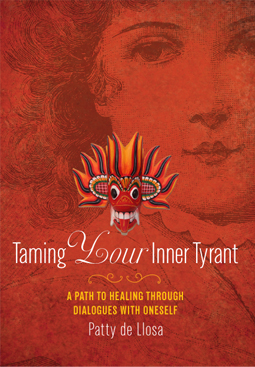 it came my book, Taming Your Inner Tyrant. So in the pursuit of mindfulness I have become more free to be who I am. This is called presence. When I’m caught in an emotional reaction it is sucking my juices. But when I bring my attention to what is being sucked in my body, that is how the energy changes.” In an article for Parabola she writes about body consciousness. "My mind can be in China, and my emotions can be reacting to anything. But my body can only do one thing at a time, so body consciousness keeps me in the moment."
"Breathing," she reminds us, “happens in the diaphragm, the muscle of emotion and the biggest muscle in the body. And when we can’t breathe, it’s because we can’t bear what’s going on.” This conflict she believes can be attributed to our being called in two directions at the same time: to be in the world and to be of service to the extraordinary energy that calls to us all the time. 'Because we have bodies our work on Earth is to create a place where something of a higher quality wants to come in. It demands our presence.'"
Stressful work at Fortune magazine caused a lot of pain in her body.
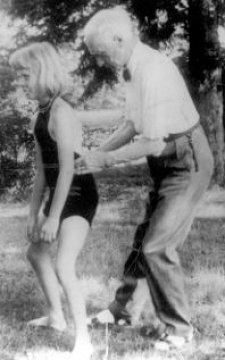 Mentioning this to a friend and practitioner of Alexander Technique (AT), she received her first treatment. “The call of Alexander Technique is to return to yourself, to notice how you are. The relationship of the head to the neck is crucial. The technique is there so we can teach people how to meet every challenge in life through expansion rather than contraction. It is neuro-muscular release.” It also has the capacity to lead one into deeper spirituality. This led her to be trained as a teacher in AT. Many callers expressed their interest in this therapy, and Patty both empathically and generously offered to meet or talk with them personally to help them use these techniques for their own benefit.
No longer working at Time or Fortune, Patty now turns her attention to her AT practice, yoga, writing for Parabola and for herself. Another powerful book is The Practice of Presence, in which she explores all of the things we spoke of in the call. It is a wonder to all of us that Patty could have done—and continues to do—so much in one lifetime! But her gentle wisdom and generosity are the fruits of all her labors. And we are so deeply grateful to her for sharing them with us.
Want the full experience?
Listen to the complete conversation with Patty de Llosa.