Featured Speaker
Mehdi Aminian
Listen to the Reed: on Separation, Silence and Finding the Center
Reflection Question
When has a separation, from a place, a person or a part of yourself, taught you to listen more closely?
Share Your Reflection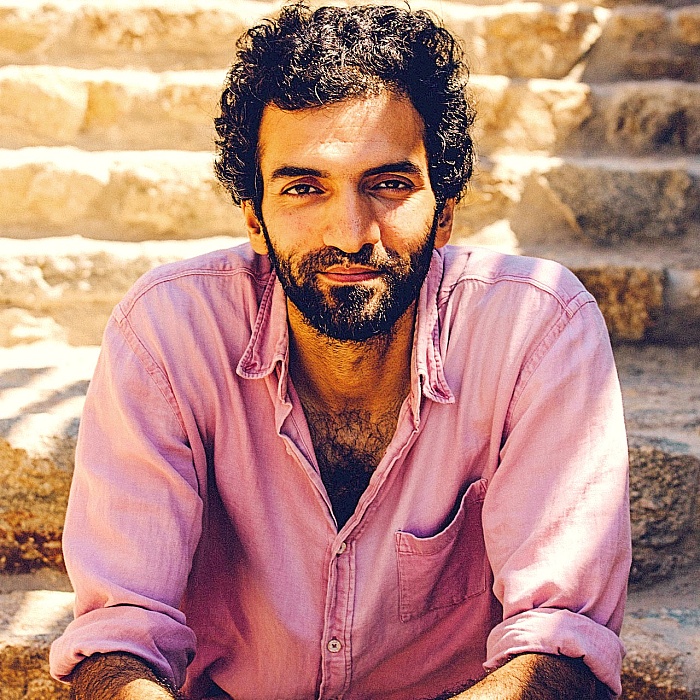
"My love, remain a child,
The world will force you to grow.
My love remain a child,
you will be sick and tired of the world if you grow up.
It is so cruel that the moment you forget your childhood it turns you into a stone!"
-- Ahmad Shamloo
When Mehdi Aminian finished playing his ney, an end-blown bamboo flute that originated in the Middle East, for an online circle this September, he wondered aloud: when did music actually begin? "Was it when the silence started? Was it when I started breathing?"
The question is characteristic of a musician who begins with not knowing. Aminian is a Vienna-based composer and ethnomusicologist who, in 2013 after a chance conversation during a train ride, founded Roots Revival to bring musicians from different cultures together around sonic traditions that sit between underrepresentation and extinction.
For Mehdi, each project starts with a desire to understand. As he remarked in a recent interview, he listens deeply and lets the composition reveal itself. He spends months listening and researching, then invites musicians rooted in varied traditions to teach his ensemble from the inside. Music, in his practice, emerges from friendship and camaraderie across generations and geographies.
His own separation came early. He was born in Isfahan, a desert city in Iran where people gather under the old bridges at night to play music. At six he heard a cousin play the ney and still remembers the goosebumps. At nine he poked holes in a plastic pipe, hoping to make an instrument of his own, and played it for friends with no intention of ever going on stage.
Born just six years after the Iranian Revolution of 1979, and drawn to an open exploration of music, he left the country alone at 16 and moved to Bosnia. This was his first turning point. Curiosity then carried him to Herzegovina, Malaysia and the Netherlands.
Playing the ney itself holds an active lesson in patience. Ney is essentially a length of reed cut from the reed bed, and while rooted in the ground, the reed has its balance and its center. "Once it's been cut from its home, it always has to find its center," he explained. Working with the ney teaches, as Mehdi has learned, a consistent form of enthusiasm as the instrument takes a few years to mature into a tune and sound.
Much in the same way, exploring folk songs, beginning with those from Romania, brought him closer to his own heritage, even though he was far from home. "I believe that all roots are connected," he says. That conviction shaped a later project, Quieter than Silence. It grew from his friendship with a Syrian oud player and was dedicated to displaced Syrians. Watch "Lullaby for a Travelling Child" here as Mehdi sings to stones in a quarry, as an ode to softening them through lullaby.
At its core, his music is about being present, in both a spiritual and a social sense. The spiritual side takes him to the origins of sound and silence; the social keeps him rooted tenderly in the context around him.
Rather than returning to tradition unchanged, he favors improvisation and transformation grounded in deep understanding and works closely with artists who keep age-old musical practices alive. As he reminds those who would preserve old music as it is: "what we call 'tradition' was itself once an innovation."
In Vienna, his research foregrounds the idea of "home." As a doctoral researcher at the University of Vienna and the Austrian Academy of Sciences, he has documented Naqshe Khani, or "pattern singing." A lead carpet weaver sings the carpet's pattern aloud to the others at the loom. The practice is fading with the craft: Iran's weavers, largely women, have fallen from about 2.2 million to an estimated 750,000.
The research became a documentary, Woven Sounds, and a concert thereafter where a weaver sang on a stage for the first time in her life. "The creation process felt like returning home," Mehdi wrote.
His path has been as varied as his music. He holds degrees in computer engineering, animation and information sciences, followed, unusually, by a master's in jazz composition from Bucharest, and he was a 2017 Young Leaders Fellow of the Aspen Institute Romania.
Join us in conversation with this ney player and patient listener, who makes room for deep music the world might otherwise stop hearing.
Listen to Mehdi
Lullaby for the Travelling Child
Ney Solo, Woven Sounds in Hong Kong
The Space Between
And a short ney offering with reflections on silence and Rumi's reed, from the ServiceSpace Medicine of Flow pod: watch the clip.
Five Questions with Mehdi Aminian
What Makes You Come Alive?
At this moment: Muisc, poetry, reading, spending time with my daughters, meditating, cooking, learning, teaching, creating spaces where people can meet, listen, make something together and I really feel alive when I feel being a medium for creation.
Pivotal Turning Point in Your Life?
Leaving Iran at the age of 16.But in a wider sense, as Rumi suggests, with every breath we are irrevocably transformed, if love is present.
An Act of Kindness You'll Never Forget?
There are so many instances that it is hard to highlight just one, and they never seem to end. The world runs on kindness. I have been especially humbled by the generosity and kindness of people in Iran, Austria, Germany, Spain, and Romania, the places where I spend most of my time.
One Thing On Your Bucket List?
I don't really keep a bucket list. Usually pick from the suggestions life offers, or renegotiate the offerings when possible.
One-Line Message for the World?
Many one-line messages throughout history have led to catastrophes, so I'd rather be cautious about adding another one, just to avoid a potential catastrophe :)
Related Calls

Bindhumalini Narayanswamy
Aug 21, 2021
Music as soul-food: playing at the edges

Molly Jane Sturges
May 1, 2022
How I Learned Love From Serving The Dying

Luc Reynaud
Apr 1, 2017
Music as a Force of Love