Featured Speaker
Bhante Buddharakkhita
Dhamma Seeds In Unlikely Soil: The First Ugandan Buddhist Monk
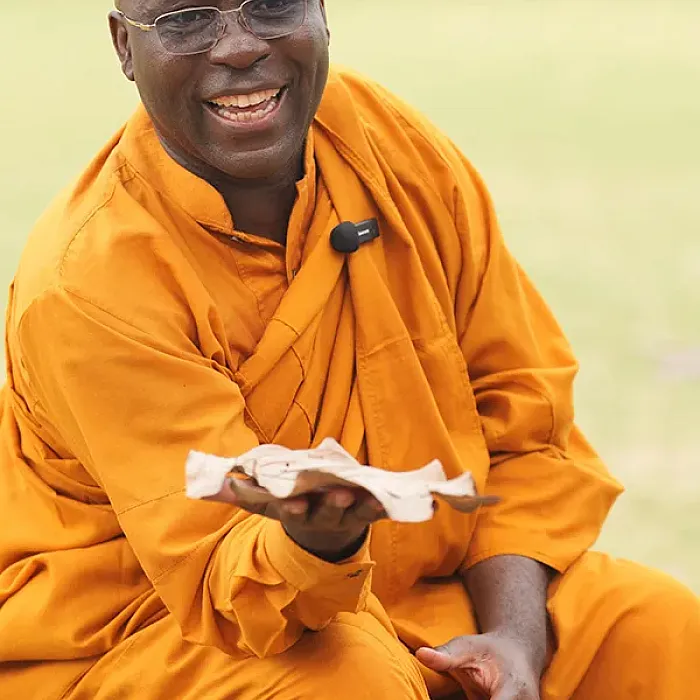
When he was a boy in Kampala, his mother had a saying: "If you have nothing to say, keep quiet. If you have nothing to do, go to sleep." On the long, hot afternoons when she sent him to nap, the restless child could not sleep — so he lay awake instead, watching her breathe, listening to the silence settle over the room. Years later he would call those quiet afternoons his first lessons in stillness.
That boy, Steven Kaboggoza, born into a Catholic family in Kampala in 1966, grew up to become Bhante Buddharakkhita — the first Ugandan-born Buddhist monk, founder and abbot of the Uganda Buddhist Centre at Garuga, overlooking Lake Victoria. He teaches Theravada Buddhism with an "African flavour" — so people don't dismiss it as "weird, foreign and Asian" — and offers mindfulness to heal deep wounds, including what he calls Africa's "colonial hangovers."
He never set out to be a monk. In 1990 he left for India to earn an MBA — but found the Buddha instead. There followed years of seeking, a young man wandering a candy store of faiths: Baha'i, Sufism, Hinduism, each tried and left still hungry. He won an audience with the Dalai Lama and asked how to carry this wisdom home to Africa; the answer was simple: "Find spiritual friends."
After a detour that even included teaching scuba diving in Thailand, he came to the United States for eight years of patient apprenticeship under the renowned Bhante Henepola Gunaratana at the Bhavana Society, in the forests of West Virginia. In 2002 he was ordained a Theravada monk by the late Sayadaw U Silananda in San Jose, California — given the name Buddharakkhita, "protected by the Buddha."
Then came the hardest journey: home. In a country that had never seen a Buddhist monk, he was taken for a madman, a witch doctor, a wizard. Children fled; taxis sped past; neighbours refused to sell him land. When he founded the Uganda Buddhist Centre in 2005, his Buddha statue was once mistaken for a kidnapped baby — soldiers broke down his temple door to "rescue" the child inside.
He met it with patience. When a neighbour spread a rumour that the centre sold children's heads, Bhante did not defend himself — he opened a school and gave a scholarship to that neighbour's own child. "It is always good," he reflects, "to return good for evil."
His first converts came from within his own family. Within a month of his return, his mother, his sister and her husband, and several nieces and a nephew had all taken refuge — an echo, he notes, of the Buddha's first five disciples. But his mother went furthest of all. The woman who had first taught him silence took refuge, then asked to ordain; when he warned her it would be hard at her age, she replied, "If you can do it, I can do it." In 2008 she became the first Ugandan Buddhist nun, Dhammakami — "one who loves the Dhamma."
It remains patient work — just two monks for a nation of forty million. Beyond the centre, Bhante is a visiting professor of Theravada Buddhism at Union Theological Seminary in New York and holds an honorary doctorate from Thailand's Mahachulalongkornrajavidyalaya University. He has taught meditation on six continents, sits on the advisory council of Buddhist Global Relief, and is the author of Planting Dhamma Seeds: The Emergence of Buddhism in Africa and Sowing Seeds of Peace. His centre runs a Buddhist Peace School, an African Buddhist High School, and clean-water and medical projects serving some 1,500 neighbours. His quiet calling: to train 54 novices — one for every nation in Africa.
Even surviving a shooting at close range did not turn him bitter. He speaks instead of transforming trauma into dhamma, in his own four-word motto: more dharma, less drama.
Join Mark Foley and Zoe Weil in conversation with this gentle pioneer, who turned a lifetime of being misunderstood into a homecoming for the heart.
Related Calls
Tracy Cochran
Jul 6, 2024
Presence: Coming Home To Yourself and Opening to Life

Awakin Retreat: Community Evening
Sep 6, 2025
Live from Redwood Vihara Monastery

Shantum Seth
Aug 17, 2024
Inner Journey in Outer Spaces: In the footsteps of Buddha