Featured Speaker
Lata Mani
When the Brain Unplugs: Catastrophe as Doorway
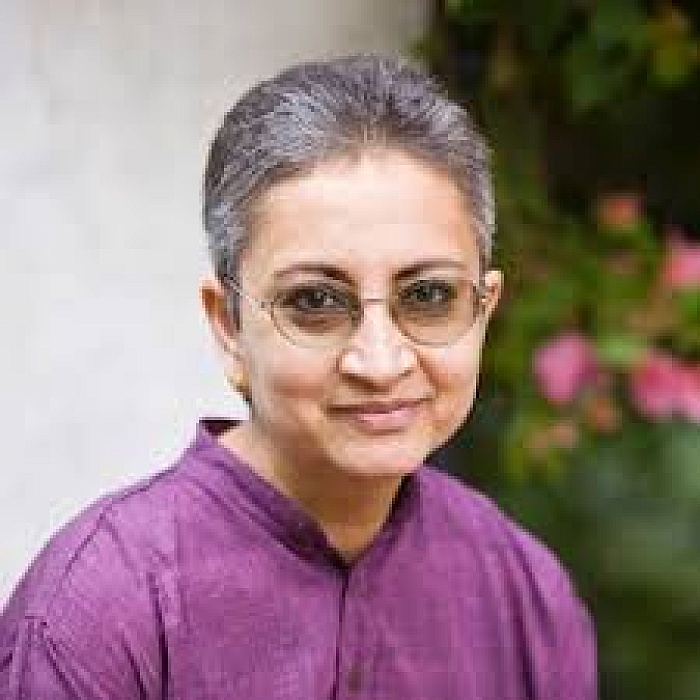
For three years, Lata Mani could not read. The feminist scholar who had made her name examining how colonial power speaks through the bodies of women—whose work on sati became foundational in postcolonial studies—found herself, after a catastrophic head injury, thrust into a different kind of knowing. “I had lived in my head until then. With the brain unplugged, my body and heart became my primary teachers.I began to experience expanded states of consciousness—things I didn’t have the language for.”
In the early 1980’s the women’s movement in India shaped Lata’s entry into UC Santa Cruz’s legendary History of Consciousness program. There she studied alongside Ruth Frankenberg, Lisa Lowe, and bell hooks—scholars who would become leading figures in postcolonial and women of color feminism. Lata’s landmark work on colonial debates over sati revealed how arguments framed as “saving women” systematically erased women’s voices. At the core of this work was an inquiry into who speaks, who is heard, and how knowledge is organized by power.
Then came the accident. What emerged was not retreat but reorientation: a spontaneous awakening to Devi, the Feminine Divine. A philosophy rooted in tantra—not the Western caricature, but its deeper vision: the universe as living consciousness, embodiment as sacred, relationality as the fabric of existence.
Her book Interleaves records this passage. The Tantra Chronicles, compiled with her late partner Ruth Frankenberg, braids mystical teaching with ethical inquiry. SacredSecular and The Integral Nature of Things dissolve the modern divide between reverence and critique. Her 2022 Myriad Intimacies—winner of the Nautilus Book Award—weaves essay, poem, and video into a meditation on intimacy and interconnection.
With Argentine filmmaker Nicolás Grandi, she has pioneered “videocontemplation”—films that slow perception beneath habit. The Poetics of Fragility features Angela Davis, Cherríe Moraga, and Nora Cortiñas. Her latest, Longing Suite (2025), traces a heart–mind–body awakening to the Divine, built on poems from the early years following her accident. Poet Arundhathi Subramaniam calls it “both sacred arc and sensorium; pilgrimage and homecoming.”
She has also written four children’s books, translated into nine Indian languages—finding contemplation in spider webs and tamarind trees.
Join Pavi Mehta and Cynthia Li in conversation with a thinker who discovered that catastrophe can be a teacher, that fragility can be strength, and that attention itself—slow, reverent, embodied—can be a form of healing.
Five Questions with Lata Mani
What Makes You Come Alive?
The world is teeming with possibilities if only we learn to notice them. This inspires me to keep breathing, walking, trusting.
Pivotal Turning Point in Your Life?
A head injury in 1993 which turned out to be Divine Mother's calling card.
An Act of Kindness You'll Never Forget?
Too many to name. The seemingly modest yet radical act of learning to notice makes it so.
One Thing On Your Bucket List?
I don't have a bucket list!
One-Line Message for the World?
I would not dream of offering a "message" for the world though I can say that we have infinite reasons to trust and in these intense times this can bring comfort.
Related Calls
Gary Zukav
Oct 30, 2021
Universal Human
Americ Azevedo
Feb 2, 2013
Truth Demands to be Lived..
Doug Powers
Apr 15, 2017
Cultivating and Teaching Freedom