Featured Speaker
Danusha Lameris
Where Grief and Joy Become Poetry and Presence
This call explores poetry not as performance or consolation, but as a lived practice of presence — a way of staying with what is tender, unfinished, and real. Together, we’ll listen for how language arises from the body, how loss and love coexist without canceling each other out, and how art becomes a form of ethical attention. Through grief, devotion, illness, music, and memory, our guests -- Danusha, Haleh and Pavi invite us into a terrain where poetry is less about saying something beautiful, and more about learning how to be here.
 Danusha Laméris: Danusha began writing poems because she didn’t know what else to do with heartbreak. In her early thirties, she experienced a succession of profound losses — the death of a lover, a brother, and a child — and poetry became a way to stay present in the body when words themselves felt fragile. Her work returns to a central question: how do we begin again, not in theory, but in lived, daily life?
“What’s gone is not quite gone… not the language, but the bones of the language,” she writes, naming the way grief lodges itself beneath speech. Danusha’s poems dwell where sorrow and pleasure coexist — where beauty does not erase loss, but learns to breathe beside it. She believes a poem isn’t finished until it changes her, and will revise a single piece for years, following where it leads.
Former Poet Laureate of Santa Cruz County and author of The Moons of August and Bonfire Opera and Blade by Blade (upcoming), her work invites intimacy with what is unfinished, imperfect, and deeply alive. Read Full Bio.
 Haleh Liza Gafori: Haleh Liza Gafori first encountered Rumi as sound. Growing up in a Persian household in New York, she listened to her parents recite verses she couldn’t yet understand, sensing their power in the way they softened rooms and opened hearts. That early imprint eventually led her into the delicate work of translating Rumi — standing between Persian and English, devotion and discernment.
“I saw myself sharp as a thorn. / I fled to the softness of petals,” Rumi writes in her translation, capturing the alchemy that draws Haleh to this work. For her, translation is not reproduction but relationship — a way of allowing ancient poems to speak freshly into questions of ego, love, death, and generosity. Her acclaimed book Gold presents Rumi as a living voice rather than a distant mystic.
A poet, educator, and vocalist, Haleh often sings in Persian alongside her readings, dissolving boundaries between poetry and music. Her work invites listening with the whole body — where language still knows how to transform. Read Full Bio.
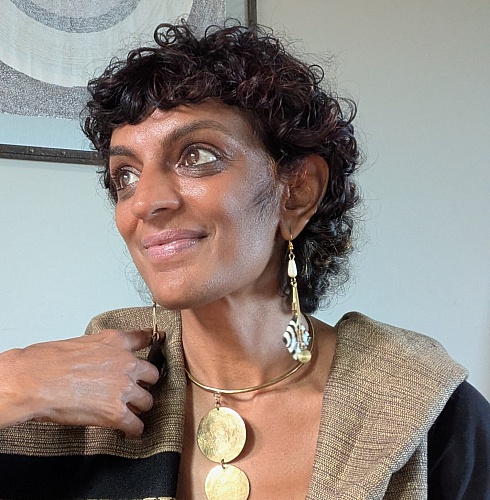 Pavithra Mehta - Pavi grew up in a family of twenty-one eye surgeons, surrounded by people restoring physical sight. But she was drawn to a different kind of vision — the stories that help us see. Her granduncle Dr. V once handed her a nine-item to-do list; item #4 simply read: "Quality Care For All." That inheritance shaped everything that followed.
She documented Dr. V's revolutionary work in the award-winning book and film Infinite Vision, revealing how Aravind Eye Care became the world's largest provider of sight-restoring surgery by treating millions for free. The deeper question continued to guide her: what systems might we design if we trusted people's innate generosity? She co-founded Karma Kitchen, a pay-it-forward pop-up restaurant, and has been long-time anchored several other Servicespace projects including Dailygood and Awakin Calls.
In recent years, parallel medical journeys — her husband's bone marrow transplant, her own cancer treatment — became another terrain for practice. On her blog The Poetry Of, she writes with startling beauty about skeleton flowers and wild swings, choosing presence even when the body is failing. Poet, writer, dancer, Pavi lives where heartbreak becomes generosity, and generosity becomes sight. Read More.
Join us in a shared field of listening, where grief and joy are welcomed as teachers, and poetry becomes a way of being together.
Related Calls
Aurelio C Hammer
Dec 26, 2020
Listening to our Inner Music
Bindhumalini Narayanswamy
Aug 21, 2021
Music as soul-food: playing at the edges

Lucy Grace
Apr 27, 2024
The Pulse of Nature: Opening to the Unplanned Path