Call Nuggets
Claudia Bernardi
Art for Political Change

How does an individual and a community process and heal from violence? Is it possible to regain hope in humanity after witnessing the killing of loved ones? Claudia Bernardi is an artist that immerses herself in communities broken by war and violence, facilitating individuals through the creation of murals that help them to express what words cannot.
“When people from outside ask us what happened to us, and they write in their notebooks what we tell them, we have to believe that what we tell them is what they write. In reality we don't know that, because we're illiterate. We don't know how to read and write. But when we paint this mural we know what story we are telling.” (Guatemalan indigenous woman)
In this Global Awakin Call, Claudia described incredible moments of transformation, where stories of victimization changed into stories of individual and collective empowerment. Each mural serves as a breath taking illustration of our shared humanity and of the power of community.
Realizing the Obscene
Between 1980 and 1992, a civil war in El Salvador killed more than 75,000 people, many of who were children. At the end of the war, a UN Truth Commission was formed in order to carry out exhumations and unearth missing information about the history of the war.
With the Argentine Forensic Anthropology team the commission began exhumations outside of a church in the town of El Mozote. Claudia participated through the creation of archeological maps, which visually rendered the location of the human remains. Expecting to unearth the remains of adult men and teenage boys, the team was shocked to instead discover the remains of children under the age of 12.
“After exhuming children for more than two months and finding human remains that were so little, the question that kept coming back more and more frequently to me as the exhumation went on was, "What would it be like to come back to this place and create art with children of the same age we are exhuming today?"
At the time, the thought seemed impossible, almost obscene --- "obscene" is the Greek way of seeing outside the scene, not see-able, not possible. But the concept stayed with Claudia.
Fourteen years later, she returned to El Mozote during the rainy season to facilitate the creation of a mural that spans seventeen meters wide and six meters high. It honors the community’s past through images of planting, harvesting, and hammock making, and it depicts a collective vision for the community’s future through illustrated ideas of what El Mozote can become. It is almost impossible to imagine that this mural exists on the walls of the same church where so many were killed.

“The whole community participated -- men, children, youth, adults, elderly --- it was a remarkable experience, one of those moments where we think, “What art conquers, politics can never conquer. There was an incredible humbleness in the power of people coming together to tell the story, and in this case the story of their community.”
As the facilitator, Claudia does not paint, she does not suggest, and she does not lead the project. Her only role is to ask, "What do you want? What do you want to say in this mural? What story do you want to tell?" Then she works with communities by building consensus, which Claudia explains is very different than working towards democracy.
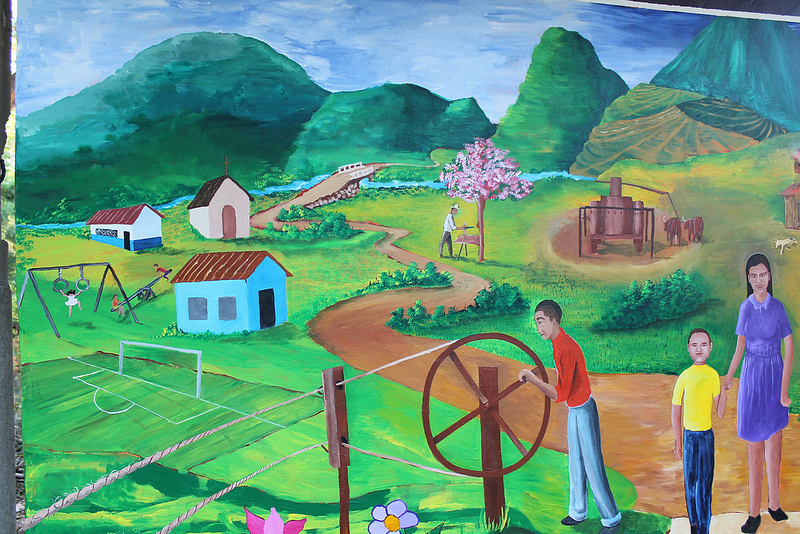
“In democracy you go for the majority. In the work we create, everything we agree upon has to be accepted by everyone. There is a great moment of arrival to trust, to say "We are all in this together, and this is how we will cement this huge new edifice of the mural."
Transformative Moments: “We grew up believing we were victims. Now we believe we are muralists.”
Another mural project that Claudia facilitated was painted in the largest ex-clandestine center of detention and extermination in Argentina, which is known as ESMA (the ESMA Navy Mechanical School). Thousands of people passed through ESMA, very few of which emerged alive.
Claudia had three days to build consensus amongst 53 to 60 Argentines, people that are known to be very opinionated. The challenge was to try to see at all times where they were in accord. Claudia’s role was to highlight that which they all agreed upon, to say, "Let's not focus on what you disagree about, but on what you do agree on."
Another kind of challenge: these were people that would be creating a mural in the same place where their family members had been detained and exterminated.
With all these challenges, Claudia’s gift as a facilitator and artist helped the mural to emerge into its own identity.
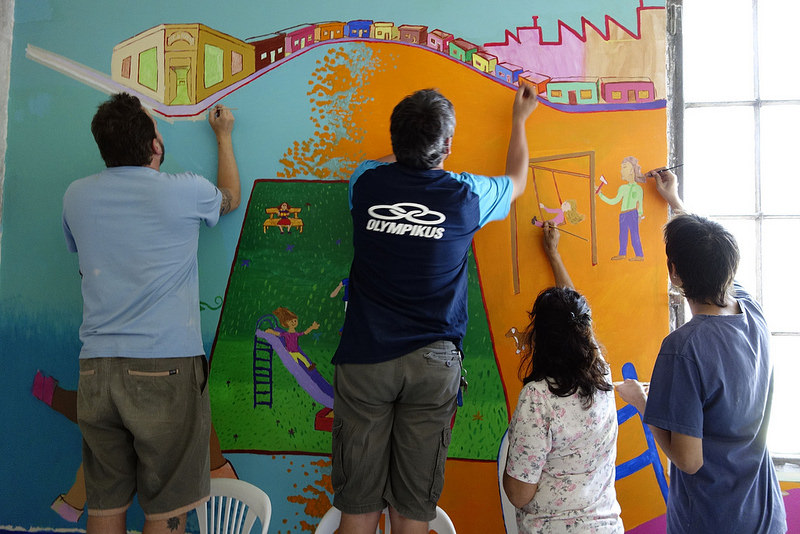
“There's a moment in which the mural talks. My role at that moment is to say, "Take a step back," which is hard because they're all painting 20 centimeters away from the wall. I'd say, "Take a step back. Look at what you're doing.” That moment is magical.”
Claudia describes how each mural has its own identity, and the people that are working on it realize this not through reasoning but through emotion.
“The people that are painting the mural cannot believe that it's so beautiful. How it happens, I have no idea. But it always happens that there's a moment in which the art work has its own identity.”
During the facilitation of this mural, Claudia passed by a participant who was a son of two disappeared parents. He said to Claudia, "You know what's the best thing about this mural?" sort of nonchalantly. Claudia responded "No, what is the best thing about this mural?" Without looking away from the painting, he said,
"Well, the best part of this mural is that, for people like us, who grew up thinking of ourselves as victims (in a way, we are), here you come and tell us that we are muralists and we believe you."
.jpg)
I think that is also part of the transformation. Many times people that I have worked with want to replicate this experience of transformation. This is the second part of the evolution. Some of the participants will re-initiate and re-implant the same kind of experience in other parts of their communities.
“The project never stops. It has involved many different lives, but it is always the case that the project itself doesn't end. It becomes something else that I totally trust will happen.”
Can Art Mitigate Extrinsic Violence and Help Us to Heal Internally?
“I remember that Stravinsky said, "Art that makes us feel makes us hurt." I love that. Maybe part of the paradox is that art is a very gentle, almost surgical tool that, through its beauty, cuts sharp in a place that hurt. But because it is also beautiful, it allows us to see beyond the hurt. I think this is what I see happening all the time in the collaborative mural projects.”
Claudia explained that a big component that helps the pain to be possible to witness and to transform in images is exactly because people are doing it together. In the case of the mural in Argentina, more than 50 Argentine people came to agree that a moment of change was when the Argentine Forensic Team would call them to say that the human remains had been found. They recognized that that moment was a thunderbolt to their head. That's when they painted what they called "the big thunderbolt." Part of the possibility to experience deeply the pain and at the same time transform that, is the fact that everyone recognizes that what they feel is what everyone feels.

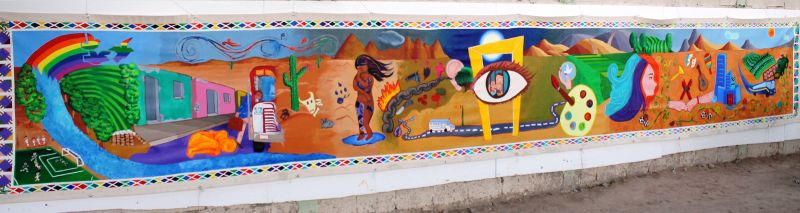
Another example is when Claudia was working in Guatemala with a group of about 35 indigenous women who were survivors of sexual violence during the armed conflict. These women came from different regions of Huehuetenango and therefore spoke different languages. Claudia explained that with the help of interpreters, they all seemed to be simultaneously surprised to recognize that what happened to them had happened to other women. They didn't know that, and didn't know that it had happened in a similar way, because the methodology of the army was quite systematic.
Towards the end of the mural project, one of the women said, "When people from outside ask us what happened to us, and they write in their notebooks what we tell them, we have to believe that what we tell them is what they write. In reality we don't know that, because we're illiterate. We don't know how to read and write. But when we paint this mural we know what story we are telling.”
Claudia proudly shared that this mural went from Huehuetenango to be exhibited at the University of San Carlos in Guatemala. The women traveled with the mural and they went from feeling shame for being illiterate to becoming the central piece of the exhibit. The mural also made it into the President's House, when Alvaro Colom was President. That was the journey the mural took, because it tells the story in a remarkably vivid way. For Claudia that's a moment of transformation; the women realized what the mural was for them, a book of history without words.
For Claudia, going from Guatemala to El Salvador to Northern Ireland to Serbia to Ciudad Juarez Mexico --- all the places that have in common the presence of a violent history --- what she sees is that art will not mitigate the violence and art will not necessarily change the history of the country.
“Art will probably change, even if in a slight way, the reason for which one chooses to be in association with others. That is the beginning of a community change. In this way, art is a huge, very potent tool for reorganizing communities. If there is a process of healing, it is the process of healing the way we see the possibility of the future, with less tragedy than we have been seeing in our recent past. That in itself is a transformative process.”
Walls of Hope
The School of Art in Perquin, Mexico is what brings Claudia the largest amount of hope and pride altogether. From the beginning this school has always been a community-based project and the most successful part of the school is that it's a locally-run school by four artist-teachers from the area of Morazan, Mexico.
The Perquin school has become a model, called now "the Perquin model," studied in universities in the U.S., in Switzerland, Argentina, etc.
“What is different about this art school is that it's open to all members of the community - children, youth, adults - in a country and a community that is hugely polarized by local politics and the tragic legacy of the war.”

The four teachers, America Argentina Vaquerano, Claudia Verenice Flores Escolero, Rosa del Carmen Argueta, and Samuel Amilcar Varela, started by being students of the school, then apprentices of the school, and finally teachers of the school. They entered knowing nothing, but then out of practice they became art practitioners and also community organizers.
The school functions by organizing town meetings with the community and asking, "What is it that you want?" The school’s major concern is to train young boys and girls to become independently able to sustain themselves through artistic activities instead of migrating to the United States for economic opportunities, which appears the only way they can see their future.
“Although it's a tiny "amendment," what we can say is that by learning how to work with wood, by creating furniture, boys and girls have created an independent economic life. We are proud of that. “
Claudia would love for everyone to visit the art school’s webpage, www.wallsofhope.org.
“Learn about what we do. Tell us about your part of the world. Maybe there is a project that can occur out of this conversation. Maybe there's a project in your community that you identify as something that can be done. Maybe we can work that together. Maybe we can have a conversation about how to do it. Every opportunity is a good one to start connecting other links in this big chain. Maybe this is the next step.”
Want the full experience?
Listen to the complete conversation with Claudia Bernardi.