Emotions for Liberation
Many years ago, I walked into the kitchen of my guru’s ashram, and found him shouting at the cooks. Force- waves of anger were bouncing around the room, almost visible to the naked eye. Then, in mid sentence, he turned, saw us standing there, and smiled. The energy in his eyes went soft. ‘How did you like the show?” he asked. Then, chuckling, he slapped the head cook playfully on the back, and walked away. The cooks giggled, and went back to work, galvanized by the energy he had injected into the afternoon.
That moment changed my understanding about emotions. The clarity and fluidity with which he had shifted from intense anger to good humor was only part of it. More interesting, I felt, was the fact that he had been using anger as a teaching tool. Was he really angry? I don’t know. All I know is that he seemed able to ride the wave of his anger with perfect easiness, and let it pass without a trace.
One of the ideals of yogic freedom is detachment from emotions. It’s a basic axiom, in fact, that an advanced practitioner has perfected the ability to control, transcend, or at least be a disengaged witness of his emotions. Yet because we have so few models of what genuine detachment looks like, we tend to confuse yogic detachment with being buttoned up, or unemotional, or indifferent.
My teacher was modeling something quite different. As I saw it at the time, he was demonstrating a kind of freedom in emotions. This allowed him to work with emotional expression as an artist or an actor might work with a palette of feelings in order to inspire others, or induce a shift in the situation around him. The secret was that he was able to be conscious within the emotion.
Most people assume that a good spiritual practitioner never gets carried away by emotion -- at least not by negative emotion.
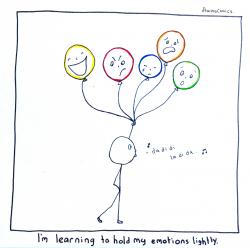
Yet the deeper truth is that spiritual practice will not eliminate negative emotions. Emotions are part of the palette of life, part of the way consciousness moves. Not only can’t you get rid of them, but you’d feel empty and impoverished if you did. Practice can change your relationship to emotions, so that instead of being swamped by certain feeling states, you can hold them, contain them, see into their essence, and ultimately, use emotions in the service of your liberation.
--Sally Kempton, in Using Emotions for Liberation
What does using emotions in the service of your liberation mean to you? Can you share a personal experience that illustrates conscious emotion? How can we develop ourselves to find freedom in emotions?
I agree with both John and jon that there is no other exit to such dramatic crises than getting over those feelings of hatred and revenge which might seem at first sight justified. And that, in such a situation, one is ultimately responsible for one's action. A very difficult thing to keep in mind in the midst of such a powerful mimetic process as unchained collective violence. Nevertheless, as John says, some people are wise enough not not give in to such a frantic and absurd emotional climate.
yes, beautifully put, the question is 'how we get there' (to an attitude that can support reconciliation).
The other point is accepting the other emotions we must deal with on our path to getting there, or accepting where we may fall short....
The ideas that our suffering is always our own fault seems like a half-truth, like all truths. Many innocent people are caught up in genocide, friendly fire, and a million other circumstances outside of their making or control. What could be sadder than a starving mother who cannot feed her crying, dying child! Actually many things are just as sad and happening every moment of every day. We need to avoid overly simplistic, transcendent ideas that often don't apply. Yes, a great deal of our suffering is self-inflicted and a great deal of it is not.
In my teens I had an intoxicating romantic interlude on a mountain top visible on my ride to school every day. The relationship failed to flower as I wished and every time i glimpsed the spot it triggered a deep melancholy, an ache for the kind of love/connection that seemed beyond my reach. After months of self-pity, I realized I was sick and tired of the emotion and that I was in fact inflicting it upon myself by replaying the scenario of desire and disappointment. With that epiphany I consciously chose to break the habit of lifting my eyes longingly to the spot when I passed it and soon was free of the daily downer.
Rightly said that we need to avoid getting stuck in our feelings or blaming others for causing our feeling. Holistic Scientist has said that "Suffer is at fault". Recognize without any doubts that the nature is very balanced and just in its dealings with all, in every aspect of life. So, you will not be punished if it is not your fault. Conversely, if you are suffering, then it must be your fault despite the circumstantial evidences that suggest otherwise. Accept your own fault, ask for forgiveness and do not crane revenge. With this realization one will be able to reconcile an interaction and not get emotional.
I don't consider feelings to be positive or negative, good or bad. We may find some unpleasant and some pleasant, but all of our feelings are of value. They tell us how we are doing in this moment. Through deep understanding of our feelings we can gain claity about how to best respond in order to maintain or create harmony, balance and a sense of well-being for ourselves and for others. We need to avoid getting stuck in our feelings or blaming others for causing our feelings. Our feelings belong to us and we need to take responsibility for them. Honest, authentic expression of our feelings is best paired with respect for the other person and trheir needs and the avoidance of the use of guilt, shame and other manipulative behaviors in an attempt to control others. Even in major conflicts when we create a respectful connection with others miracles can happen.
I totally agree with CheriD. A Guru is one who can only give you what he has. A Guru will not let anyone his limitations where as the true Guru will tell you what he has accomplished in spirituality and what still needs to be done. If there is business in religion then what is the disciples going to get out of it? It is said by a true Gyani Purush that there should be no commerce in religion where as there should be religion in commerce. Commerce here means any dealing one does throughout the day.
I think the problem of gurus , and this word, 'guru', I think, should be used very carefully, is also that they have to deal with the image the followers tend to build around their personality. This image distorts their relationship with the student and gets in the way of actual understanding. More often than not one has to understand in spite of the guru's personality.
Understanding of emotions is very important. Once the root cause of emotions are understood, then emotions will subside and then the tone will make a great impact on the other person. It is very important that emotions do not hurt the ego of other person. That can only happen if you deal with the other person without your ego on the high string. A person who knows 'who am I ' can detach away from emotion since he can see who the doer is. Good spiritual practice is to discover the world within.
I had a teacher tell me that I didn't need to speak, my emotion was written all over my face. That was a long time ago, but I don't think I've come very far in being conscious in the "emotion". That part of the story is the perfect lesson for me, right now.
"How did you like the show?"
Great show! Great show! Pat him on the back - and walk away......
It reminds me of my school days. The most sadistic teacher in the school was the French teacher -followed on by the Scripture teacher. Lord help us kids on the days when they needed to vent their accumulated venom - somewhere. Where? Us kids!
We left school hating Miss Prosser and nursing the emotional wounds inflicted on us - and of course we hated French.
"Great show.! Great show!.........
yes, absolutely the master chef of ours is ours, so the first enemy to ours also is ours,and if we asked our selves what is the only way to expresses all this?? the answer will be (EMOTIONS),although your example is very simple, and we do not care about this situations which may be happen thousands time per day in our Arab nation ,but it is a real complete reading our emotions and I add that is the instinctive emotions we have from our GOD,so we have to use it as should to be thankful to our ALLAH cause these good optimistic emotions can change our life and make it better , i hope so:) :)
The point of any spiritual practice is to not to teach you to suppress your emotions. That kind of practice would be tedious and temporary. A true practice is one which teaches you the true reality of this material world and which thus helps you let go of attachments. At that point, you are able to express any emotion outwardly but don't get attached to them, so you can move away from them easily. It gives you a capability to witness your emotions objectively and not get carried away by them. This kind of discernment in turn will help your practice get stronger.
One can find freedom in emotions when one minimizes or able to get rid of the bondage from desires and ambitions.That means when your mind becomes PURE.
First let us not put emotions, thoughts and behaviour in separate compartments. They are closely related to each other.
Second control means steering our life towards its assigned goal. For example if a person has chosen to be a teacher he/she would have to use all known methods to achieve the goal of teaching. Role play is part of the basket of teaching tools.
I have used role play often to get an idea to sink in or a new perspective to dawn. In this role play all participants are invited to participate. I alone don't do the role play. This ensures that all of us learn to get in and out of roles with ease. This needs considerable practice. The danger is that we tend to get stuck to a few roles that we like; noble or villainous.
I wonder how else the guru might have chosen to communicate? While the ability to easily express all emotions, including anger, is a positive, isn't the ability to chose what a person wants to express and to model just as important. Will the cook go home and feel righteous in expressing his anger at his wife or child? Yes, to the freedom to feel and express emotions, but ? ? ?