Virtues Are Like Vitamins
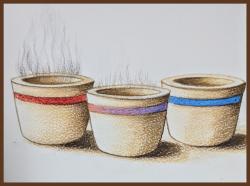
Image of the Week
Hand-drawn art by Rupali Bhuva
Image of the Week

Virtues can be a little bit like vitamins. Vitamins are essential for health. But what if you get more than your body needs? If you take too much Vitamin C, it won’t hurt you. If you overdose on Vitamin D, though, it can do serious harm: you could wind up with kidney problems.

A great philosopher named Aristotle thought virtues were like Vitamin D. Too little of a virtue is bad, but so is too much. He believed that every virtue lies between vices of deficiency and excess. Too little humor is dry; too much is silly. Too little pride makes us meek; too much breeds narcissism. Too much self-restraint leaves you doing homework while your friends are tailgating. Too little self-restraint means you’ll really regret eating that fourth [ice-cream].

Consider generosity. I’m a huge fan of generosity. I’ve spent my whole career studying it and I wrote an entire book about how it can drive not only our happiness but also our success. I found that in the long run, givers tend to outperform takers. But there’s such a thing as being too generous. It’s a recipe for burnout. Take teachers. Education is about helping students, so we love teachers who are selfless. But in our research Reb Rebele and I found that the most selfless teachers ended up being the least engaged in the classroom—and their students did the worst on standardized achievement tests.

A second beloved virtue is authenticity. “Be true to yourself” is a core theme in more than half of commencement speeches. I wouldn’t encourage you to be false to yourself. Of course you should be genuine. But if authenticity is the value you prize most in life, there’s a danger that you’ll stunt your own development. To be authentic, you need to be crystal clear about your identity and values. You need to know exactly who you are. And that can tether you to a fixed anchor, closing the door to growth.

A third popular virtue is grit. “Never give up” appears in more than four of every ten graduation speeches. Persistence is one of the most important forces in success and happiness. But that’s only half the story. For every J.K. Rowling and Walt Disney and Lennon and McCartney, there are thousands of writers and entrepreneurs and musicians who fail not for lack of grit, but because of how narrowly they apply grit. Never give up is bad advice. Sometimes quitting is a virtue. Grit doesn’t mean “keep doing the thing that’s failing.” It means “define your dreams broadly enough that you can find new ways to pursue them when your first and second plans fail.” 

Today, my advice for you is to take a page out of the Goldilocks story. Like porridge, virtues can be too hot or too cold. More isn’t always better. Watch out for virtues that burn too hot, not just too cold. If you want to be resilient, find the right amount of generosity and authenticity and grit.

Seed Questions for Reflection

How do you relate to the notion that virtue lies between the vices of deficiency and excess? Can you share an experience of a time you found virtue in balance? What helps you know the right amount of virtue?


Moved by this reading? Join a live Awakin Circle to discuss in community.
Join this week
More ways to connect

Add Your Reflection

11 Past Reflections
AP
Jun 29, 2021
The ultimate virtue is to adopt personal 'Golden-mean'.
AJ
aj Jun 29, 2021
Amen! I like the word "personal" with regard to a 'Golden-mean". Seems what might be 'golden' for one, is but 'rust' for the next. Again, amen Anilkumar!
RA
Rachel
Jun 29, 2021
I am of the opinion that finding balance is merely a way of wading in the waters that are bound to surround and drown you if you are not careful in your pursuit. There are times when being crystal clear about your identity and what you value can lead to self-destruction, distractingyou from purpose. While finding that balance that connects your past to your future may be a daunting task, it is necessary in order to find what drives your passion. Understanding what and why you are the way you are is a virtue within itself. For me, it was realizing that the balance of my life did not equal the sum. I carried the sum in excess and the balance as a deficiency. It mattered not how I was going to get to the sum; the sum was what I needed. I just read one of the comments below from Shane K. Floyd, PhD. which states that, "The uniqueness of trying to find balance can involve one's ability to express the meaningfulness of the journey itself." Wow! This was powerful in its message ... View full comment
AM
Amy Jul 1, 2021
I hear you! Amen
SK
Jun 29, 2021
Finding balance in the purest sense of form revolves around what one understands to be his/her own moral compass. The uniqueness of trying to find balance can involve one's ability to express the meaningfulness of the journey itself. It is through this experience we discover what works in life for us and does not work, yet holding steadfast to what we believe to be true untilanswering our own call for change.
AJ
aj Jul 1, 2021
❤️
AS
Jun 29, 2021
The "Right Amount" of Virtues.
so well put and explained...Nice... feels great to understand...
DD
Jun 26, 2021
The right amount lies between deficiency and excess, between too little and too much. Virtue is behavior of high moral standard that is done to benefit well being, that is, is done for growth. For me, if a behavior is not intended to further growth, it's not virtue. If the action is too much or too little it can still be virtue if the action was done with the intention of facilitating growth (even if it doesn't). I find virtue in balance when the action intended to foster growth is just the right amount. For example, giving exactly the right amount reempowers and facilitates growth, giving too little doesn't help or helps little, and giving too much is likely disempowering or disrespectful which also doesn't help. What helps you know the right amount is paying attention to the other, respect where he or she is at and what he or she is saying, and pay attention to your own experience and judgment.
NS
Jun 25, 2021
SAMATVAM YOG UCHYTE. SHRIKRISHNAS MESSAGE IN GEETA..ALSO YUKT A AAHAR VIHAR=SELF REALIZATION =ETERNAL LOVE=DARSHAN.
À¤
ललित Jun 29, 2021
गीता उपदेश"समत्व योग उच्छ्ते' से एक ध्वनि निकलती प्रतीत होती है कि " परस्पर सम्भाव ही यथार्थ है."
JP
Jun 25, 2021
Finding a balance between two extremes is a virtueby itself. In Buddhism it is called the middle path. In Yoga it is called equanimity-Yogahasmattvam uchyate. I use these words of wisdom in almost all walks of life such as eating, working, sleeping, talking and resting and thinking. Following the middle path helps me avoid the vices of deficiency and access. As Adam Grant says," If you want to be resilient, find the right amount of generosity and authenticityand grit." Or to put it differently to find "virtue in balance." Once one of our friends invited us to celebrate his birthday. It was a wonderful gathering with lots of delicious vegetarianfood items and different kinds of fruit juices. Normally I am careful about what and how much I put into my belly. That day I forgot to eat in moderation. And I paid a heavy price for my indulgence. That was a good lesson for mefor walking and staying on the middle path. I apply mindfulness in all walks of life. Awareness an... View full comment