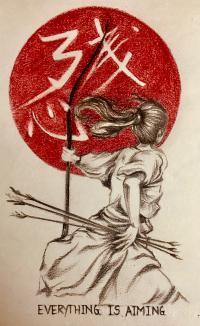
Zen Of Archery

Image of the Week
Hand-drawn art by Rupali Bhuva
Image of the Week

In the 1920s, a German professor named Eugen Herrigel moved to Japan and began training in the martial art of archery, with a legendary archer named Awa Kenzo. Kenzo was convinced that beginners should master the fundamentals of archery before attempting to shoot at a real target, and he took this method to the extreme. For the first four years of his training, Herrigel was only allowed to shoot at a roll of straw just seven feet away.

When Herrigel complained of the incredibly slow pace, his teacher replied “The way to the goal is not to be measured! Of what importance are weeks, months, years?”

When he was finally permitted to shoot at more distant targets, Herrigel’s performance was dismal. The arrows flew off course and he became more discouraged with each wayward shot. During a particularly humbling session, Herrigel stated that his problem must be poor aim.

Kenzo, however, looked at his student and replied that it was not whether one aimed, but how one approached the task that determined the outcome. Frustrated with this reply, Herrigel blurted out, “Then you ought to be able to hit it blindfolded.”

That night, Kenzo took Herrigel to the practice hall, with the target hidden in the dark. Settling into his firing stance, Kenzo drew the bow string tight, and released the first arrow into the darkness. Bullseye. He drew another one. Bullseye again. 

Complete awareness of body and mind in relation to the goal is known as 'zanshin'. Literally translated, zanshin means “the mind with no remainder.” In other words, the mind completely focused on action.

We live in a world obsessed with results. Like Herrigel, we have a tendency to put so much emphasis on whether or not the arrow hits the target. If, however, we put that intensity and focus and sincerity into the process -- where we place our feet, how we hold the bow, how we breathe during the release of the arrow -- then hitting the bullseye is simply a side effect.

Seed Questions for Reflection

How do you relate to the notion of committing to the process instead of obsessing about the outcome? Can you share a personal experience of a time when you opened up to the process instead of measuring the way to the goal? What helps you not get distracted by results and instead stay committed to the process?

Moved by this reading? Join a live Awakin Circle to discuss in community.
Join this week
More ways to connect

Add Your Reflection

10 Past Reflections
TI
Till
Dec 26, 2023
The brilliant teacher and virtuoso jazz pianist Kenny Werner mentioned ZITAOA in his creative composition class at the New School way back when. He has written a book on effortless practice as well and I can personally attest that acquiring any musical skill demands the ability to figuratively shoot throw-away arrows at bales of hay. All day, err'' day. Results are secondary. Micro-Improvements are the starting bonus.
AM
Aug 23, 2021
I tend to be in process, perhaps getting a little lost in it and miss "the goal "
RA
Oct 9, 2019
Yes, we are always obsessed about the outcome instead of the process. I feel when sometimes, outcome is no longer our choice or what we believe to be ourchoice and there is ' do or die' situation, when process is the only the choice we have, much like Pi in story 'Life of Pi' , when faced with such situations in life, we focus with full awareness on the process and we are surprised the outcome turns out much better than what we had anticipated because full awareness without worrying about the outcome brings better results. I experience this sometimes when faced with difficult weather situation- in middle of snowstorm, when faced with situation that seems impossible - driving through rough snowstorm telling myself , just do the best you can .. that onepointedness perhaps makes the task possible. In what seems to be impossible situation, such baby steps with fulll awareness without mind being clouded with results makes it possible and acually much better outcome than expe... View full comment
AP
Oct 9, 2019
I was reminded of the story when Dronacharya was testing his students in archary. Having perched a small bird on a tree, the task was to hit it from some distance away. Before allowing the student to shoot he would ask "What do you see?". The replies varied from seeing multiple things like the bird, the branch, the tree, the sky etc.. Arjun's reply was "I see only the bird" Only he was permitted to shoot and he did pass the test. There was a rejoinder to the same story, whence Karna (another notable archer) was asked: "What do you see when you try to shoot a target?" His reply was: "I do not see anything. I feel that I am the arrow and moving towards the target !"
DL
Oct 8, 2019
I was a competitive triathlete for many years and enjoyed the training as well as the races. Over time though the races and my results became less important and fulfilling to me but I never lost the desire and enjoyment of just running, biking and swimming. I have not competed in a triathlon in many years but I still love going on a nice long run in the mountains, jumping into a cold pool and feeling the wind on my face during a long ride. I've learned to love the actions of these activities more and more over the years and am not really interested in how fast or far I can go anymore. The process and enjoyment of it is what interests me most. Once I detached myself from the outcomes everything became more enjoyable and meaningful.
AJ
aj Oct 10, 2019
Amen Danny!
JS
Jigisha Shastri
Oct 7, 2019
This is what early childhood education all about. Duringthe early years of 3-6 age, education is all about the process and not about reaching targets/milestones/goals. What is very interesting is that programs for young children, which emphasize processes of development, reach these 'targets' and beyond. This needs to be ingrained in individuals and in education programs as childrengrow older. When one is involved in the process there is no outside pressure to perform. We do what we want and involvement in the task, in here and now is much more. Learningand interactions that occur during the 'process' are of higher order and lead to immense satisfaction
DD
Oct 5, 2019
My mantra for a long time has been 'process, not outcome.' Focus on right action, as Buddhism advises, and leave outcome to forces outside your control. In interpersonal interactions, I revel in times I trust the process, that is, times that I stay present, go with what I am experiencing, and let outcome happen. What helps me trust and stay committed to process and not try to control outcome is the positive outcomes that occur when I do that. Also, I know that going with present process is within my power (I'm human) and outcome is outside my power (I'm not God). Also, I love the excitement and aliveness of commitment to the process, and don't like the dullness and deadness I feel in outcome focus. Also, I like the openness and freedom I feel in process focus and don't like being controlling and manipulative as I am when trying to control outcome.
JP
Oct 4, 2019
Reading this passage reminds me of the advice my father used to give me when as a student I was working on my assignments. His advice was: "Focus on your work with sincerity, intensity and one-mindedness. Remain focused on the process. And the right result will come." I have followed his advice in many walks of my life as a student, as a teacher, as a counselor, and also in taking care of my health and the health of others in my family. As the Zen saying goes," The path is the goal." I will never forget the time when I waited patiently for four long years for marrying my beloved lady Vanleela. Her father did not want her to marry me because I came from a poor family. Vanleela was raised in a very affluent family. Her father thought and felt that his daughter will be miserable going to a poor family. Vanleela out of affection, regard and concern for her father accepted to wait for four years. Both of us felt the loving presence of each other in our hearts. Both of u... View full comment
RA
Oct 3, 2019
Very humbling passage. Bows to all the beings who cultivate with such dedication.