Featured Speaker
Randima Fernando
Designing Humane Technology: Between Godlike Tools, Paleolithic Minds, and Misaligned Systems
The real problem of humanity is the following: we have paleolithic emotions; medieval institutions; and god-like technology. -- E.O. Wilson
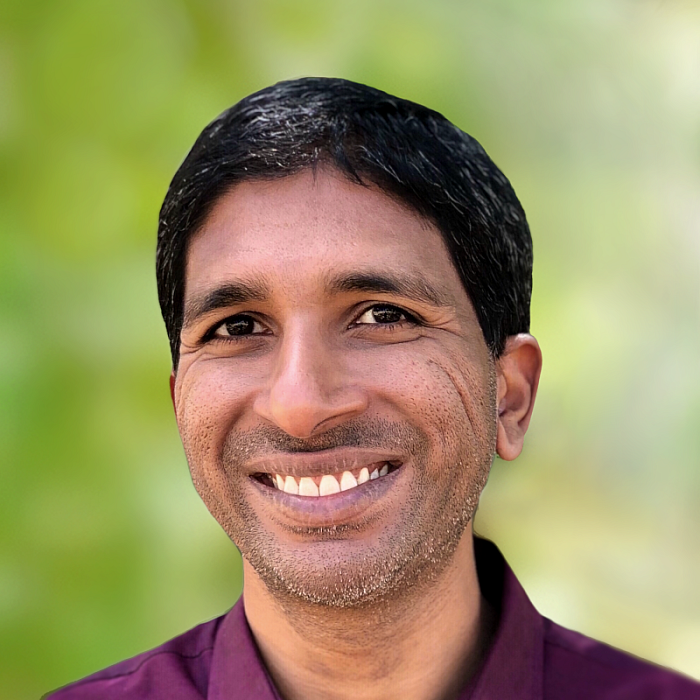 Born in Sri Lanka to a father who taught him to program and a mother who taught him Buddhism, Randima Fernando spent seven years helping developers get the most out of GPUs at NVIDIA, seven more bringing mindfulness to nearly a million students. Then, in 2018, he co-founded the Center for Humane Technology with Tristan Harris and Aza Raskin, to help re-align "god-like technologies" of our age with humanity's best interests.
CHT's pioneering work clarifying the unintended consequences of social media platforms was featured in the 2020 Emmy-winning Netflix documentary The Social Dilemma. The film reached 100 million people in 190 countries -- carrying a debate that had largely stayed among engineers and ethicists out into everyday households. More recently, as AI threatens to concentrate power in a handful of hands, hollow out the meaning people find in work, erode human relationships, and fracture society's shared grip on what's real, they've turned their focus to AI Dilemma -- reaching policymakers, technologists, and millions of people worldwide to help forge a "narrow path" of responsible AI, deployed with wisdom, foresight, and discernment. CHT's AI work is featured in the film The AI Doc.
Randy was born into a family where inner practice and outer craft mattered equally. His mother taught him and his sister the foundations of Buddhism and meditation; his father taught him how to program a computer at age eight. His love for that craft, especially "lighting up pixels on the screen," brought him to Cornell University to study computer science and graphics. The threads of technology and dharma would continue to weave together in his life, in unexpected ways.
At NVIDIA, he led several award-winning software projects and authored three top-ranked books helping developers harness the power of the company’s newest graphics chips (GPUs). His first book explored the hardware shading language that enabled the world’s first truly programmable GPU. Decades later, GPUs would become the foundational engine of the artificial intelligence revolution now underway.
Eager to find ways to serve the nonprofit space, Randy walked away from NVIDIA in 2009. (NVIDIA would later become the world's largest for-profit company.) Randy had been volunteering for an organization called Mindful Schools, a not-for-profit that became a pioneer in providing high-quality online secular mindfulness training for schools. As its Executive Director, he helped to vastly scale their impact while keeping a close eye on quality. During his tenure, Mindful Schools trained nearly a million students and over 20,000 teachers in mindfulness across 50 U.S. states and 100 countries. Their work was featured in TIME magazine's 2014 cover story, "The Mindful Revolution."
A meeting with Tristan Harris in 2015 paved the way for his journey of co-founding the Center for Humane Technology in 2018. Connecting the dots across technology, psychology, culture, and systemic incentives, he named the toll directly: "In the end, when you add it all up, you end up in a society that is more divided, more distracted, less able to make sense of the world, less able to see each other and have meaningful conversations, and less able to coordinate on important problems."
But he urges us to resist simply blaming individuals: "The conversation is much more about misaligned systems and incentives than bad people." He points to a core Buddhist principle of dependent co-arising -- that everything is inextricably shaped by conditions around it, and similarly technology, also is never "neutral," but decidedly shaped by the incentives that built it. "I think the best thing to hold in mind is technology has always been a great accelerator -- humanity's greatest accelerator. And AI is the pinnacle of that acceleration... If we already have a predominantly extractive system, AI is turning that extraction on overdrive."
In his spare time, Randy enjoys playing tennis and table tennis, painting, playing the piano and guitar, and keeping up with the meditation practice that his mother taught. He also served as a board member of Spirit Rock Meditation Center from 2019 to 2025.
Join us in conversation with this keen student of both dharma and technology.
In Conversation With
|
Investment strategist working at the intersection of finance, systems change, and inner transformation |

Yahoo 5th employee and Editor-in-Chief for 15 years, jazz fiend and former vice chair of Stanford's Board of Trustees |
Five Questions with Randima Fernando
What Makes You Come Alive?
I'm strongly driven by helping to make the world a little more fair in the ways that I can. Both personally and professionally I like to see how I can apply my time, energy, and relevant expertise to be of service.
Pivotal Turning Point in Your Life?
I'll answer with less of a turning point and more of a trajectory-setting point, which is being born to my awesome parents. They taught me two pivotal things: First, the Buddhist way of viewing and operating in the world, which I think has saved me a lot of suffering. My mother was primary on that one. And second, giving me interest and skills in the realm of computer programming, which turned out to be really useful. That one was mainly from my father.
An Act of Kindness You'll Never Forget?
When I was living at an apartment complex in Santa Clara, I was tired and doing laundry on Sunday morning... and for the first time, I locked myself out! But since it was Sunday the office wasn't open for several hours, and my kind neighbors took me in and fed me breakfast. I played with their kids, and just had a wonderful time getting to know them all.
One Thing On Your Bucket List?
It's pretty much empty. Some things I'd like to do, but nothing critical. But if I had to name something, it's take my wife to Switzerland.
One-Line Message for the World?
The mantra of "intention and effort" often helps me... maybe it will help you too!
Related Calls

Bart Weetjens
Aug 30, 2025
Inner Well-Being as the Catalyst for Social Well-Doing
Nipun Mehta
Mar 8, 2014
Where Do We Find Gandhi Today?
Jay Chodagam
Nov 23, 2013
Fulfillment over Achievement