Featured Speaker
Amardeep Singh
Rediscovering Lost Sikh Heritage: Building Bridges Beyond Borders Through Stories & Songs
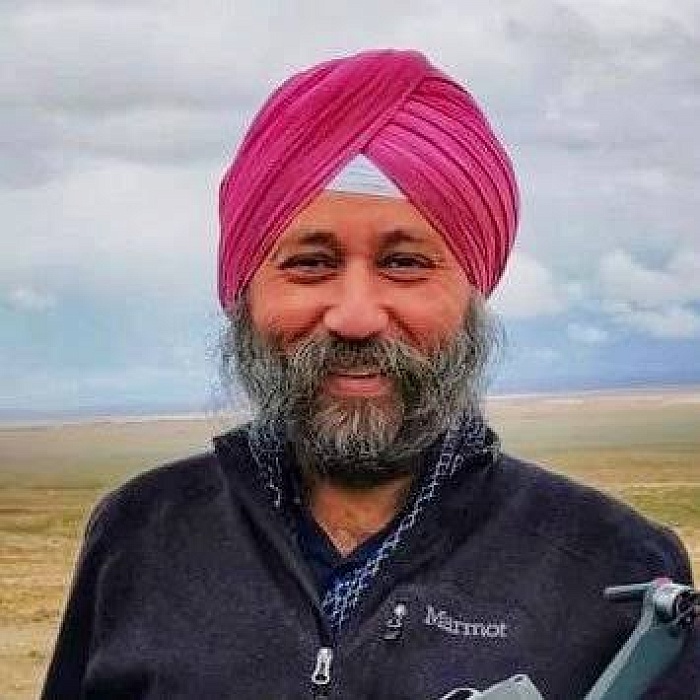
In 2014, Amardeep Singh, a Singapore-based financial executive, stood underneath a bridge in Muzaffarabad, a city cradled by the lower Himalayas in the disputed region of Kashmir, in the Indian subcontinent. His forefathers had lived there until a tribal invasion, following the India-Pakistan partition of August 1947, forced them to flee. They eventually migrated to and settled in Gorakhpur, North India where Amardeep was born. These painful earlier losses, which lived silently in his family’s home, kept tearing through his imagination through adult years. Brewing alongside that ancestral grief was a more personal dissatisfaction — one that had quietly grown through 25 years at American Express reaching its helms in Asia, until he finally stepped away.
Now at the bridge, Amardeep stood in introspection. He’d originally planned to bring back some soil for his two daughters – a tangible token of their lost roots. But he chose differently, walking off from that place in paltry thirty minutes, ditching the easy route of relaying reminders of communal divisiveness to the next generation. What started shows how to fully embrace our discontent – as medicine. He quotes from Guru Granth Sahib, the sacred Sikh scripture, "Dukh Daru, Sukh Rog Bhayaa". Our medicine lies in the very discomfort we spend our lives trying to avoid.
Amardeep travelled deeper into Pakistan instead, using his long-growing gift of photography, to document Sikh heritage: the remnants of murals, frescoes, temples, and forts, featured into the everyday stories of Hindus, Sikhs and Muslims alike, before partition separated them. At these sites, he stood in the gaze of questions. Without much preplanning, the result was a portfolio of over 5,000 images from 36 cities. A self-described "accidental author," he saw new spiritual narratives in these images, creating two books, Lost Heritage and The Quest Continues, for an expanded understanding and intergenerational awareness on the forgotten nuances of the Sikh heritage.
Each project laid the foundation for the next, leading to a nonprofit venture called Lost Heritage Productions. In 2019, Amardeep and his wife, Vininder Kaur, travelled to over 150 villages and cities from Afghanistan to India to Bangladesh, developing the 24-part Allegory docu-series. He and his team didn’t shy from intractable geographies, where they found many friendships. The series retraced the footsteps and vision of Guru Nanak – the founder of Sikhism – and his revolutionary dialogues with Bhakti movement spiritual-mentors such as Kabir and Naamdev, along with Sufi figures like Sheikh Farid, whose words found their way into the Guru Granth Sahib.
Inspired by mystic-poet Kabir's playful, convention-baffling couplets whose final resting place in Maghar in India was bare 18 miles from Amardeep’s home in Gorakhpur, he is now at work on Oneness in Diversity (completing by 2027). This work revives the writings of 15 spiritual mentors from the 13th to 17th centuries who raised their voice against hatred and separateness by pointing humanity to one-ness. This is being delivered through musical renditions and multilingual interpretations. Amardeep has generously shared his learnings and methodology for present day application, as an independent visual ethnographer, producer, director and author, at cultural and academic forums. Including the Harvard India Conference in Boston and the Library of Congress in Washington DC, to name a few.
Extending this learning, by 2032, he is developing a search-engine with meaningful translations of 4300+ Gurbani verses. In this massive effort, Sikh musicology is core to the experiential delivery of wisdom where each verse is ideally sung only in a particular Raga (melody) for its full impact. But the subtleties of this music and sound-based spiritual tradition have been on a decline, which Amardeep’s audio-visual works are concertedly restoring with musicians and instrumentalists across borders and faiths, with visual artists and textual scholars.
Intrinsic to his projects and travels, Amardeep has ventured beyond the standard external markers of Sikh identity (clothing, geography, language) into discovering its philosophical, form-free core – one he believes could shape public life across faiths, within and beyond the Sikh community. Along his journey, he let his own identity take a hit, a process both agential and borne of cosmic-intervention. His projects observe the evolution of a faith by accepting its invitation of self-reflection and contemplation, which is also Amardeep's personal understanding of Bhakti, or devotion. (Bonus: watch this short episode, Unfurling the Self.)
Amardeep attended the Doon School in India and later earned an MBA at the University of Chicago Booth School. Since the early 2000s, he has been based in Singapore.
Join our moderators Manu Singh and Sufi-vocalist Radhika Sood Nayak for a call with this non-conformist explorer and custodian of true wisdom and non-duality.
Five Questions with Amardeep Singh
What Makes You Come Alive?
Creating bridges where humanity has built walls; through stories, music, journeys, and contemplative interpretation that remind people that beneath language, religion, geography, and identity, there is one shared pulse of awareness. The work of uncovering forgotten voices, restoring fractured memory, and transforming wisdom into living experience is what gives meaning to my existence.
Pivotal Turning Point in Your Life?
The realization that spirituality is not about inherited labels, ritual identity, or borrowed belief but about inner awakening through direct reflection and lived experience. Travelling across lands, listening to silenced histories, and witnessing how deeply humanity longs for connection transformed my path from personal pursuit into a lifelong responsibility toward collective remembrance.
An Act of Kindness You'll Never Forget?
The quiet moments when people placed trust in a vision long before there was proof it would succeed; offering support, encouragement, shelter, collaboration, or simply faith during uncertain phases. Those unseen acts of human generosity revealed that compassion often arrives not through grand gestures, but through people becoming temporary guardians of another person's purpose.
One Thing On Your Bucket List?
To leave behind a timeless reservoir of wisdom, music, stories, and contemplative understanding that future generations can turn to; not as doctrine, but as a mirror helping humanity rediscover inner coherence, dignity, and oneness amidst division.
One-Line Message for the World?
When the noise of identity settles, humanity discovers it was never separate.
Related Calls

Ariel Burger & Cleary Vaughan-Lee
Jun 10, 2020
Becoming and Witnessing in These Tumultuous Times

Veena Howard
May 9, 2026
When Renunciation Becomes Revolution: The Force Gandhi Called Ahimsa

Stories of Soul Force (Jan 18)
Jan 18, 2025
Live From Gandhi Ashram