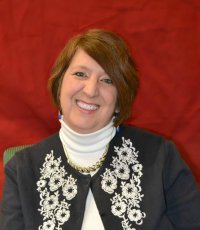
Speaker: Marjorie Maddox
Engaging With the World Through Poem & Story
 "As one re-reads Marjorie's poems, which have airy beginnings usually in breath, voice, intimation, they grow increasingly concrete until situations, relationships, and feelings are palpable and deeply moving."
-A.R. Ammons on Maddox's poetry collection As Perpendicular as I.
Marjorie Maddox has a dedication to exploring the world through the written word that is hard to miss. And it started young. This poet, professor, fiction writer, editor and self-described bookworm grew up reading in the branches of trees, suspended upside down on the couch, and by flashlight under bedtime blankets. Named after an artist aunt and born into a family that encouraged her writing, Maddox began composing and giving away her poems in childhood. Her early captivation with the alchemy of words led to a lifetime calling. Her gifts were honed at a series of institutions; a BA from Wheaton College, an MA from the University of Louisville and an MFA from Cornell, where she studied under the tutelage of the celebrated poet AR Ammons.
Maddox's poetry collection "Local News from Someplace Else" weaves together an exploration of the horrors and threats of the modern world with the universal hopes and joys that exist in the midst of it. Many of the collection's poems take their subject matter from newsletter clippings. 9/11, school shootings, Hurricanes Sandy, Katrina, and more. "I was really fascinated by this idea of what do we call safe anymore. How do we raise a family in a world where we see these tragedies happening every day how do we struggle with, and balance what we see in our lives?" Her poems peer into the darkness with unflinching, empathic eyes. They seek for and reveal the transcendental qualities of the human spirit that have seen us through the millennia. [Example, her moving poem "Seven-year-old Girl Escapes from Kidnappers"].
Today Maddox is the author of eleven collections of poetry. She has in addition published several children's books, and over 500 stories, essays, and poems in journals and anthologies. A slew of awards have found her over the years, including Cornell's Casen Award, the 2000 Paumanok Poetry Award, an Academy of American Poets Prize, a Breadloaf Scholarship and four Pushcart prize nominations. Currently Maddox is the director of the creative writing program at Lock Haven University.
As a creative writing professor she is passionate about the work of facilitating students' introduction to the world of ideas and to places and points of view that are different yet related to their own. "I love to get them to think about what literature has to do with everything you go through day-to-day," she says. And it is all a mutual process, in her eyes: "Writing and teaching are both a process of discovery."
Empathy is writ large between the lines of her work. As one of her interviewers put it, Maddox has a gift for "getting into other people's skins." She employs particular stories about specific events, places and times in her poems and through them opens a door into the universal. Of her book "What She was Saying" author Robert Morgan says, "Maddox's stories open up unexpected, little noticed corners of our world. . . . Some read like fables; some surprise with bold humor. All celebrate the mystery of the familiar, the strangeness of the ordinary, and the humanity of marginal lives."
Maddox lives with her husband and two children in Williamsport, Pennsylvania, home of the Little League World Series. Her array of poetry books include three on baseball — a subject that is part of a rich family legacy. Her great granduncle was Branch Rickey, the former Brooklyn Dodgers general manager and team president who changed history by signing on the Major League's first black player: Jackie Robinson.
Maddox's relationship to poetry brims with metaphor. And her process takes different forms. As she likes to tell her students, "Sometimes poems come in through the front door." You begin already knowing exactly what you want to write about and how. But sometimes poems arrive, "through the backdoor and...I will discover what I want to write about after I follow an image or an idea." In her experience the writing is often a doorway, an entry point and means by which to meditate upon a certain thought, visual, or even landscape.
Tucked into the rigors and the discipline of the practice are also its priceless rewards. Through it Maddox is reminded to slow down and cherish the times of joy and community and "all the good things that we give each other."
What part of the writing life does she cherish the most? "That 'ah' moment when things finally start to click into place and you see all those connections."
Join us in conversation with this gifted poet and teacher!
Five Questions with Marjorie Maddox
What Makes You Come Alive?
I am most alive when I am connected to words through writing, reading, and teaching. Writing allows us not only to confront this sometimes hopeful/sometimes frightening world but also to transcend it, not only to see ourselves more clearly, but to look beyond ourselves to others. As Flannery O'Connor said, "I write to discover what I know." Joan Didion echoed, "I write entirely to find out what I'm thinking, what I'm looking at, what I see, and what it means. What I want and what I fear." And so we have the crafted words intersecting with our discoveries, our meditations, our yearnings. Because writing is by nature such a solitary act, it also can be invigorating to meet face-to-face with readers, continuing a conversation started with the words on the pagea rapport very similar to teaching. Channels open up. Listeners respond with their lives. Similarly, I've witnessed many student epiphanies where brain, heart, and spirit click into action. Yes, this also makes me come alive!
Pivotal turning point in your life?
In 1997 as part of the 50th anniversary celebration of Jackie Robinson's breaking the major league color barrier, I was privileged to read poetry at the National Baseball Hall of Fame. As the great grandniece of Branch Rickey -- the general manager of the Brooklyn Dodgers who worked with Robinson -- I was thrilled to meet the courageous Rachel Robinson. Although she and Jackie were the real heros, I will never forget when she turned to me and said, "Oh, Mr. Rickey, that wonderful man!" I also am thinking of an excerpt from Donne's "Satire III": "doubt wisely; in strange way/To stand inquiring right is not to stray;/To sleep or run wrong is. On a huge hill/Cragged and steep, Truth stands, and he that will/Reach her, about must, and about must go."/ I was dutifully reading undergraduate homework when I ran smack into epiphany. It is OK to question; what is important is to keep moving forward. Life is a process of growth, discovery, faith. To my teenage self, this was a huge revelation.
An Act of Kindness You'll Never Forget?
Here is an act of kindness that also shaped who I am today. Most children, I believe, grow up loving words -- the rhythm of a story, the music in the nursery rhyme. That love and passion can be encouraged (and I was fortunate in this aspect) or, unfortunately, sometimes squashed. Too many times, I've heard even teens describe the arts as impractical. But the opposite is true, isn't it? Literature has very much to do with our everyday lives. In my house, writing was a valued skill, worthy of being nurtured. My mother, in particular, encouraged me, typing up my early attempts in "books." My aunt took me with her on trips in her Volkswagon camper. She'd find a particularly captivating landscape and set up her easel. I'd take out my pencil and journal. Together, we'd create. What gifts these acts of kindness were to a young child!
One Thing On Your Bucket List?
Recently, I've had a desire to reconnect with my former teachers and professors. I imagine this yearning comes, in part, from publishing my newest book of poems True, False, None of the Above (Poiema Poetry Series), which explores what it means to write, read, and teach literature in a world thatat turns, rejects, embraces, or shrugs indifferently at the spiritual. The poems look closely at how books mark and mirror our lives, which, of course, I learned from some amazing teachers. My bucket list: to return as author to my high school, to Wheaton College, to the University of Louisville, and to Cornellinstitutions that gave so much to me. I'd love to give back, through meeting with young stu
One-line Message for the World?
Literature can lead us to discovery by bringing us face-to-face with ourselves, with others, with the world around us, and with the world to come.Make your passion your life's work.
RELATED CALLS
Mandy Catron
Jun 2, 2018
A Better Way To Talk About Love

Parker Palmer
Feb 23, 2019
An Elder's Look Back at Healing Our Divided Selves and Worlds
David George Haskell
Jan 6, 2018
Songs of Trees: Interconnections Between People and Trees